

August 24, 2026 – The first block-time reduction since launch went live at epoch 1020. Three more feature gates stand between the network and its 200ms goal.
In Summary
Solana mainnet cut its target slot time from 400ms to 350ms at epoch 1020.
The change went live on 21 August 2026, the first such reduction since launch.
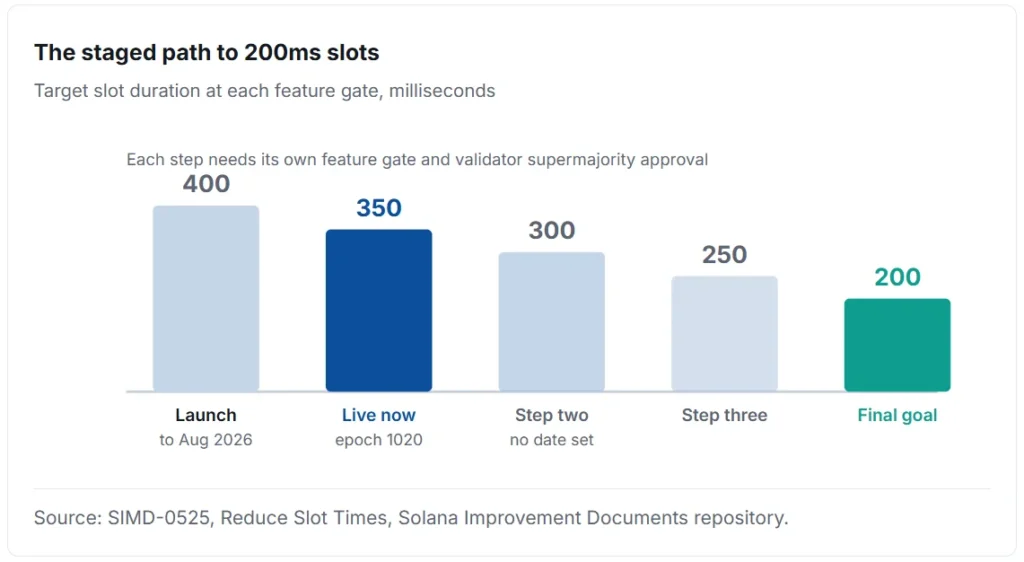
SIMD-0525 sets out four feature-gated steps, ending at 200ms slots.
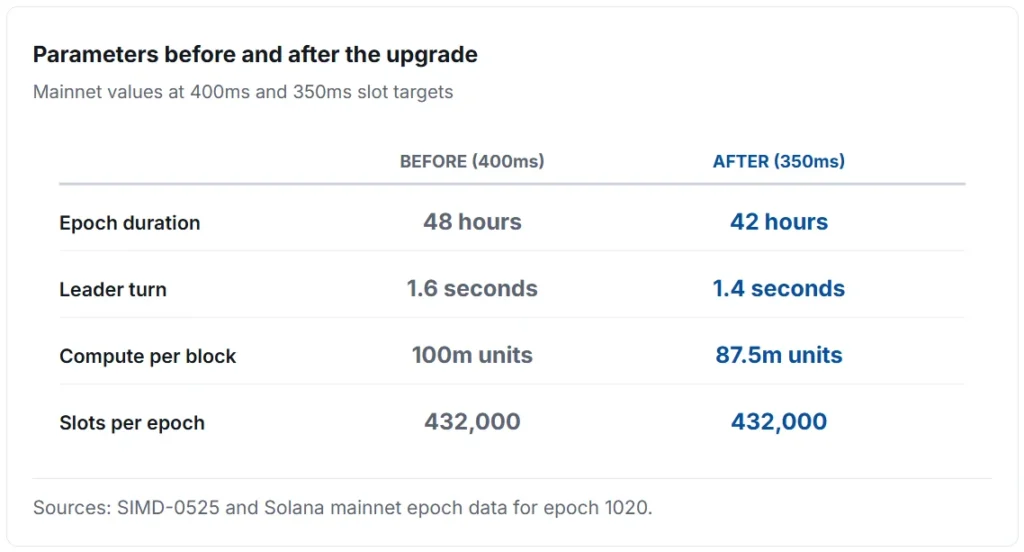
Epoch length now runs about 42 hours instead of roughly 48 hours.
Per-block compute fell from 100 million to 87.5 million units to hold throughput steady.
Solana has shortened its block interval for the first time since the network launched. The target slot time moved from 400 milliseconds to 350 milliseconds. Activation landed at epoch 1020 on 21 August 2026. The feature gate itself triggered at slot 440,208,000.
This change forms the opening step of SIMD-0525. That proposal, titled Reduce Slot Times, describes a staged path toward 200-millisecond slots.
What actually changed on chain
Several parameters moved together. Each epoch still contains 432,000 slots. Consequently, a shorter slot shortens the epoch itself. Epoch duration fell from roughly 48 hours to about 42 hours.
Leader windows are also compressed. A leader still receives four consecutive slots. That turn now lasts 1.4 seconds instead of 1.6 seconds. Shorter turns limit how long any single producer controls ordering.
Throughput stays flat by design
Faster blocks do not automatically mean more capacity. Per-slot work limits scale down in proportion. The block compute ceiling therefore dropped from 100 million units to 87.5 million. Wall-clock throughput remains roughly unchanged.
Issuance follows the same logic. The slots-per-year constant rises from 78.89 billion at 400ms to 157.78 billion at 200ms. As a result, staking rewards stay consistent in real-time terms.

Headroom explains the confidence
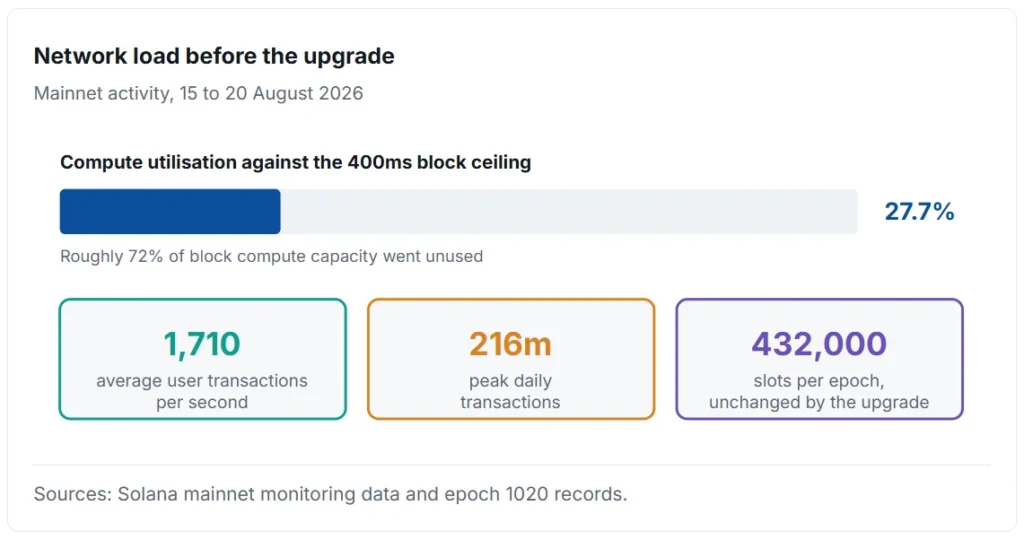
Mainnet was not running near its ceiling before the change. Average user transactions per second measured 1,710 between 15 and 20 August. Peak daily transactions reached 216 million. Compute utilisation sat at only 27.7% of the old limit.
That spare capacity gave developers room to tighten the schedule. Nevertheless, the rollout stays conditional. The network will not advance to 300ms if block skip rates climb too high.
Client diversity made it possible
Three production clients now secure the chain. Agave remains the reference Rust implementation. Jito-Agave, a widely deployed fork, runs alongside it. Firedancer, written in C by Jump Crypto, went live in December 2025.
Activation required a supermajority of stake on a compatible release. Adoption is published live, alongside client version distribution and block production by region. Each future step will need the same approval threshold again.
Validators carry the cost
Operators absorb the trade-off directly. Voting traffic per unit of wall-clock time increases with every reduction. Vote fees for non-Alpenglow validators double across the full path to 200ms.
The proposal offsets part of that burden elsewhere. For Alpenglow validators, the admission ticket falls from 1.6 SOL at 400ms to 0.8 SOL at 200ms. Daily admission cost therefore stays near 0.8 SOL despite shorter epochs.
Latency remains the bigger prize
Slot time is only one component of user experience. Network finality still takes about 12.8 seconds. The separate Alpenglow overhaul targets roughly 150 milliseconds. Combining both changes would transform settlement assumptions for trading applications.
Market makers stand to benefit first. Tighter blocks allow tighter quoted spreads. Meanwhile, developers gain finer time granularity for on-chain logic. Progress is tracked publicly on a live mainnet dashboard.