

Catenaa, Thursday, August 27, 2026-Shinhan Asset Management has joined Solana Foundation, Etherfuse and Orca to test issuing and distributing a tokenized Korean won fund, expanding its preparations for South Korea’s coming security-token market. https://en.sedaily.com/finance/2026/08/21/shinhan-asset-signs-four-way-pact-to-test-tokenized-won
The four parties signed a nonbinding memorandum of understanding covering a proof of concept for the entire tokenized fund process.
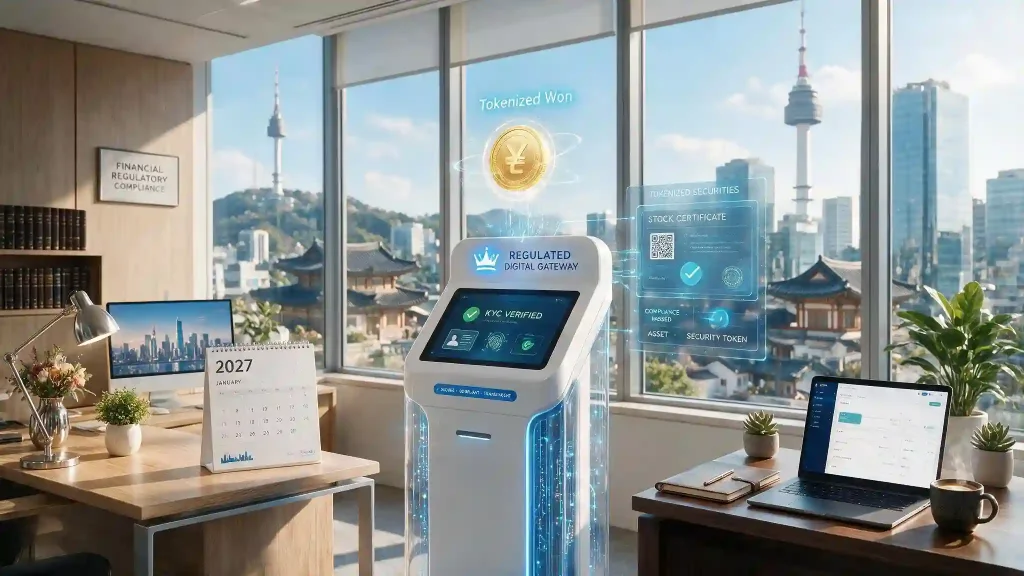
The proposed structure would use a won-denominated ultra-short-term bond fund managed by Shinhan as the underlying financial asset.
Overseas institutional investors would gain exposure through blockchain-based tokens representing holdings in the fund.
Shinhan said the project will examine whether a structure similar to BlackRock’s BUIDL tokenized fund can be adapted for Korean won assets.
The test is not a commercial product launch.
It will instead examine the technology, compliance processes and market infrastructure required before Shinhan could issue such products under applicable regulations.
Each participant brings a separate part of the planned infrastructure.
Solana Foundation represents the blockchain network on which the system can be tested.
Etherfuse specializes in issuing tokenized financial assets, while Orca supplies decentralized onchain liquidity infrastructure.
Shinhan contributes the underlying regulated investment product and asset-management structure.
Together, the firms plan to examine issuance, distribution, investor verification and secondary-market liquidity.
The review will include know-your-customer controls, anti-money-laundering requirements, blockchain operations and security audits.
It will also examine South Korean and overseas legal requirements, including foreign-exchange rules.
That makes the project broader than simply placing a fund token on a blockchain.
Shinhan is effectively testing how a conventional Korean investment product could connect with offshore blockchain capital while retaining regulated investor controls.
The timing reveals another aspect of Shinhan’s strategy.
On Aug. 14, only one week before the Solana agreement, Shinhan announced a separate memorandum with real-world asset network Plume.
That project also involves a won-denominated ultra-short-term bond fund and an offshore tokenization proof of concept.
Both initiatives reference the model created by BlackRock’s tokenized fund business.
The overlap suggests Shinhan is not yet committing its future tokenized products to a single blockchain architecture.
Instead, the asset manager appears to be testing multiple technical routes before Korean regulations become operational.
Such an approach could allow Shinhan to compare blockchain performance, compliance systems, liquidity access and investor distribution before selecting production infrastructure.
It also reduces dependence on any single network during an early stage of market development.
South Korea has already passed the legislation needed to establish a formal security-token market.
The National Assembly approved amendments to the Electronic Registration Act and Financial Investment Services and Capital Markets Act in January.
The changes legally recognize blockchain-based distributed ledgers as a method for recording and managing securities.
They are scheduled to take effect on Feb. 4, 2027, after regulators complete subordinate rules and market infrastructure.
The Financial Services Commission has formed a public-private consultative body to prepare the system.
Its work covers technical infrastructure, issuance, distribution and settlement.
Regulators are also examining tokenized versions of conventional instruments such as stocks, bonds and money market funds.
Shinhan’s proof-of-concept work therefore arrives less than six months before the new framework is scheduled to become effective.
The company said its goal is to have technical and operational capabilities ready once the rules permit commercial deployment.
The currency choice may be as important as the blockchain technology.
Most large tokenized money-market and Treasury products have so far been denominated in US dollars.
BlackRock has expanded its blockchain-based cash-management business through tokenized fund shares that can move between approved investor wallets.
Shinhan is testing whether Korean fixed-income assets can find similar demand from international investors.
A successful model could create a blockchain-based route for offshore institutions to hold won-denominated assets without limiting tokenization to dollar products.
That could matter as governments and financial institutions seek ways to bring domestic currencies and securities into global onchain markets.
It could also give Korean asset managers new distribution channels for local fixed-income products.
For Shinhan, however, the immediate objective remains technical validation rather than sales.
No final tokenized fund has been announced, and the memorandum does not bind the parties to launch one.
The larger signal is that Shinhan is building infrastructure before regulation arrives.
By testing both Solana-based and Plume-based structures, the asset manager appears to be preparing for a future in which tokenized Korean funds may operate across more than one blockchain ecosystem.