

August 28, 2026 – The broker widens its token menu from two coins to five, pushing a $13.04 trillion client base closer to spot crypto.
In Summary
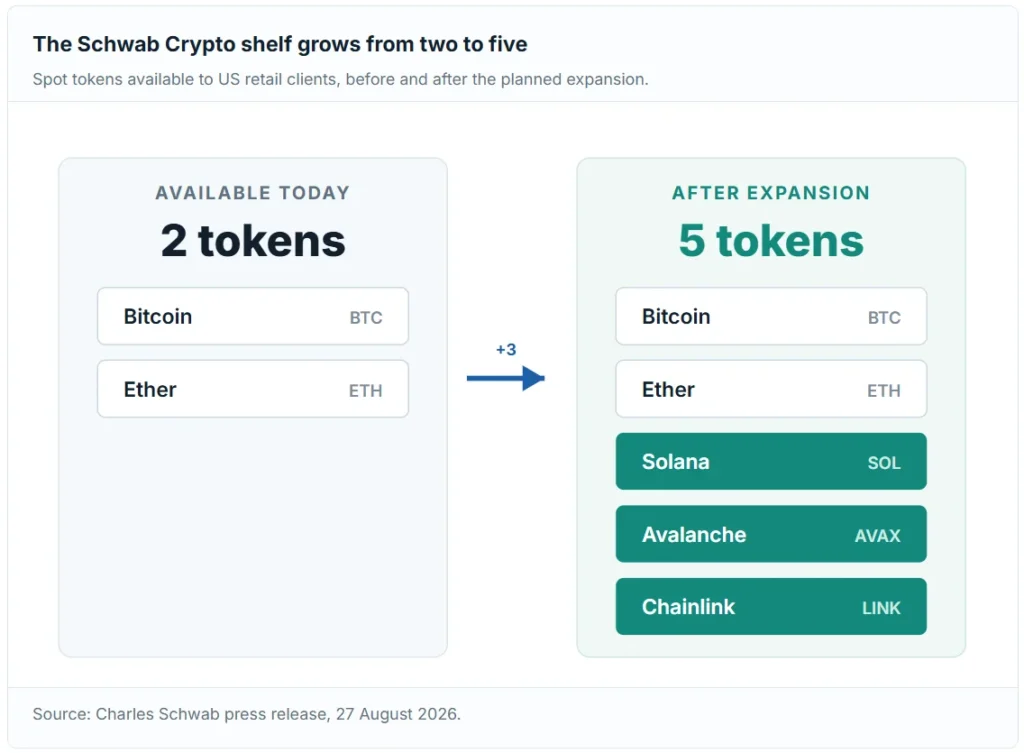
Schwab will add Solana, Avalanche, and Chainlink to Schwab Crypto accounts.
The menu grows from two tokens to five in the coming months.
Schwab crypto trades carry a fee of 0.75% of trade value with zero spread.
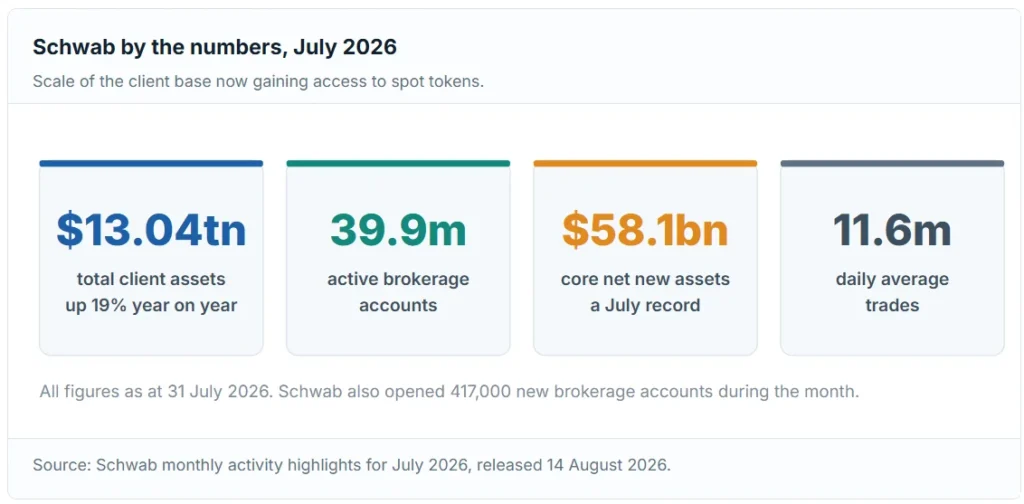
Client assets stood at $13.04 trillion in July, up 19% on the year.
The service is barred in New York and Louisiana, plus all US territories.
Charles Schwab has widened its token shelf. The broker said on 27 August 2026 that Solana, Avalanche and Chainlink will join its spot line-up. Bitcoin and Ether already trade there. So the Schwab crypto menu will grow from two assets to five. The firm expects the new tokens to arrive in the coming months. Notably, the broker gave no exact launch date.
A small menu change with a large audience
Scale gives this move its weight. Schwab held $13.04 trillion in client assets at the end of July. That base grew 19% from a year earlier. Moreover, the broker ran 39.9 million active brokerage accounts. New accounts came in at 417,000 during the month alone. That figure rose 11% from July 2025.
Trading activity also stayed brisk. Daily average trades reached 11.6 million in July. Core net new assets hit $58.1 billion, a record for the month. Such flows dwarf the deposit base of most crypto venues. In short, a token listing here reaches a mainstream audience.
How the account actually works
Schwab Crypto began rolling out in May 2026. The firm charges 0.75% of trade value with zero spread. A $250 minimum applies to the account. Trading runs through Charles Schwab Premier Bank, SSB. Clients reach it on the web, on mobile, and on the thinkorswim platform.
Coverage remains uneven across the country, however. The service works in every US state bar New York and Louisiana. It also stays close to US territories and to clients abroad. Support runs around the clock, which suits an asset class that never sleeps.
Why these three tokens
Each addition serves a different use case. Solana leans on high throughput and low fees. Avalanche targets subnets and tokenised funds. Chainlink supplies price feeds and cross-chain messaging to banks. Together, the trio broadens exposure beyond the two largest coins. Furthermore, each network already carries deep spot liquidity.
Joe Vietri, head of digital assets, framed the goal simply. Clients will gain “more choices to build a digital asset allocation” besides traditional holdings, he said. That language matters. Rather, it points to portfolio building, not to speculation.

Where crypto still costs more
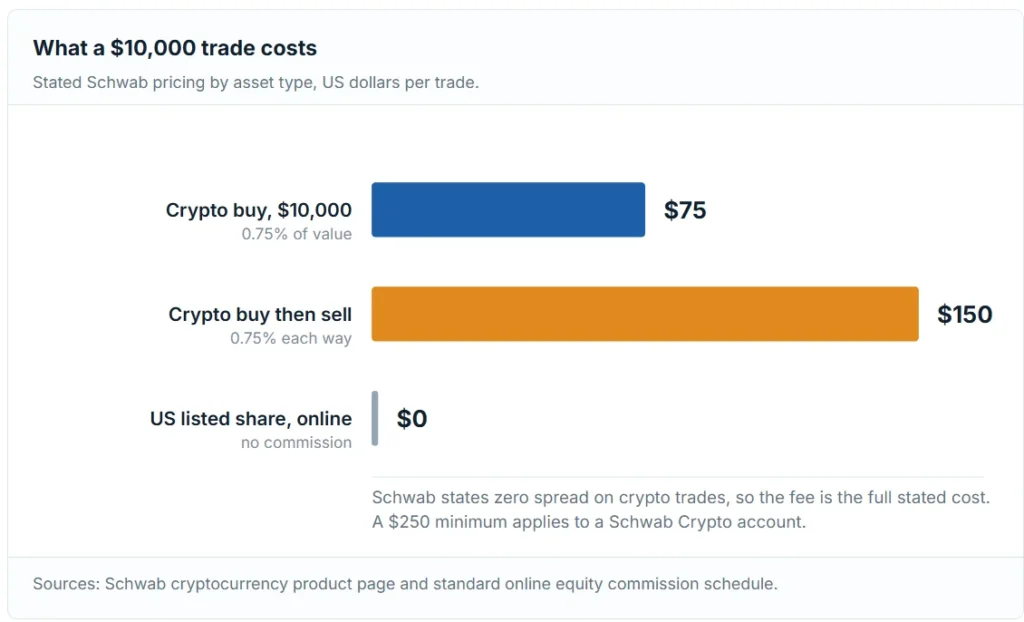
Cost still separates crypto from equities at Schwab. Online US stock trades carry no commission. A crypto trade of $10,000 costs $75 at the stated rate. Round trips therefore, cost $150 before any price move. Long-term holders may well shrug at that. Active traders, by contrast, will feel it quickly.
What it signals for the market
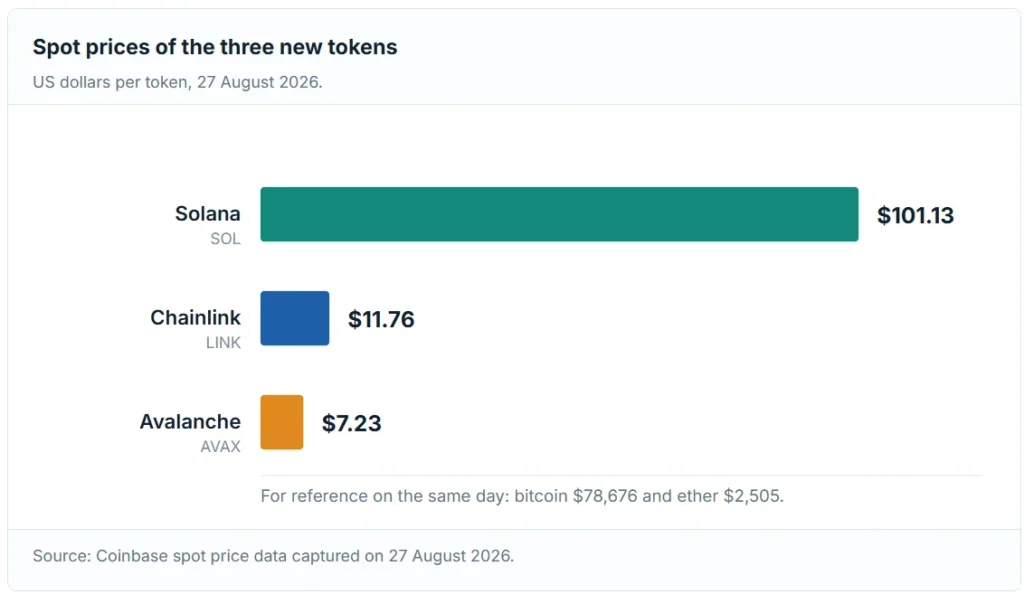
Large brokers rarely list tokens on a whim. Indeed, custody, compliance, and market surveillance all need sign-off first. Consequently, each new listing reads as a supervisory milestone. The step also lands in a soft market. Bitcoin traded near $78,676 on 27 August 2026, while Ether sat close to $2,505.
Weak prices make the timing notable. Schwab is building the rail, not chasing a rally. Meanwhile, client cash fell to 9.0% of total assets in July. Margin balances climbed to $169.9 billion. Risk appetite among clients, therefore, looks intact. Yet the crypto sleeve stays small against a $13.04 trillion base.
What to watch next
Three markers will show whether this works. First, watch the launch date for the new tokens. Second, track any change to that 0.75% headline fee. Third, look for New York and Louisiana approvals. Above all, watch whether Schwab reports crypto balances as a separate line.
The broader trend looks clear enough. Traditional brokers keep pulling spot crypto onto regulated rails. As a result, the gap between exchange apps and brokerage accounts keeps closing. Fees remain the last big difference. Still, that gap tends to narrow once volumes build.




