

Catenaa, Friday, July 31, 2026-Samsung Electronics plans to introduce native stablecoin support to Samsung Wallet, expanding the mobile payment platform beyond traditional banking cards and digital credentials as stablecoins move closer to everyday consumer use.
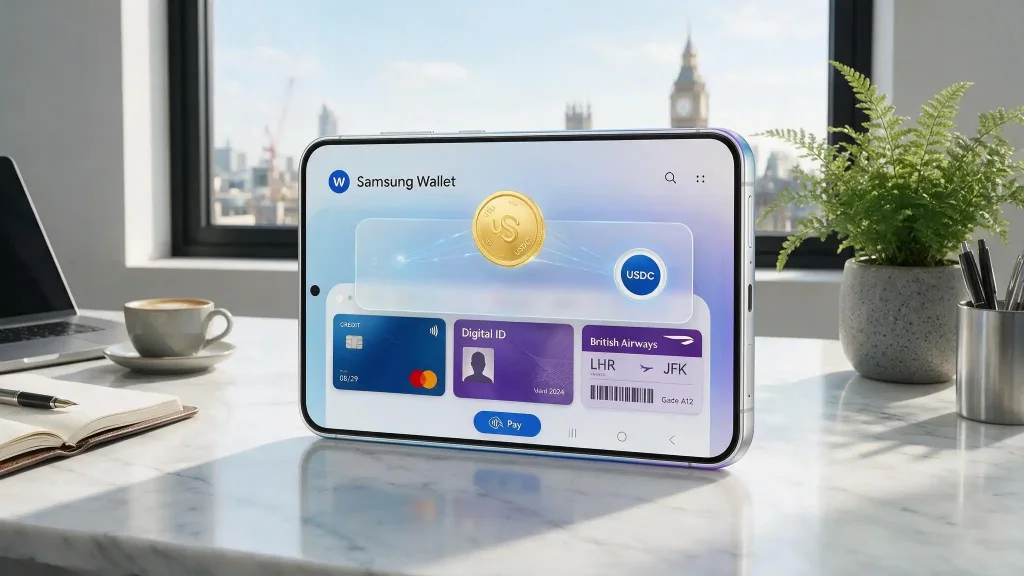
The announcement was made during the company’s Galaxy Unpacked event in London, where Samsung demonstrated a mockup of Samsung Wallet displaying USDC, although the company stopped short of confirming a launch date, blockchain network or official stablecoin partner.
Samsung said the new feature will allow Samsung Wallet to support digital assets alongside payment cards, identity documents, boarding passes and hotel keys already stored within the application.
The move positions one of the world’s largest smartphone manufacturers to integrate stablecoins directly into a consumer mobile wallet, reflecting growing interest in blockchain-based payment infrastructure among major technology companies.
Samsung did not disclose whether the service will operate under a custodial model, in which a third party manages users’ assets, or a non-custodial approach that gives users direct control of their private keys.
The announcement represents the latest stage in Samsung’s gradual expansion into digital assets.
The company introduced hardware-protected cryptocurrency storage through its Knox security platform in 2019 before adding support for major cryptocurrencies including Bitcoin, Ethereum, Tron and Stellar.
In 2021, Samsung enabled Galaxy users to connect compatible hardware wallets directly to supported devices, while a partnership with Coinbase announced in 2025 integrated cryptocurrency purchases into Samsung Wallet for eligible US users.
The latest stablecoin initiative extends that strategy from crypto asset storage toward practical digital payments.
Samsung’s announcement comes as stablecoins continue attracting increased attention from financial institutions, payment providers and technology companies.
Unlike cryptocurrencies whose prices fluctuate significantly, stablecoins are generally designed to maintain a fixed value by being backed with cash or short-term government securities.
That stability has made them increasingly attractive for payments, remittances and settlement services, particularly as governments develop regulatory frameworks for digital dollar-backed assets.
Samsung showcased Circle’s USDC during its presentation but did not confirm whether the stablecoin issuer has entered into a formal commercial partnership.
The stablecoin announcement coincided with Samsung’s introduction of the Galaxy Card, its first US credit card developed in partnership with Barclays and Visa.
The simultaneous launch reflects Samsung’s broader strategy of expanding Samsung Wallet into a comprehensive digital financial platform that combines conventional payment services with emerging blockchain-based financial technologies.
Industry analysts have increasingly viewed digital wallets as one of the most likely gateways for mainstream stablecoin adoption because consumers already use them for everyday transactions.
Samsung’s decision highlights how stablecoins are gradually moving beyond cryptocurrency exchanges and decentralized finance into consumer technology ecosystems used by millions of people.
Rather than positioning stablecoins as speculative digital assets, the company is framing them as another form of digital value that can coexist alongside traditional payment methods within a familiar mobile wallet.
If widely adopted, such integrations could accelerate stablecoin usage for retail payments, peer-to-peer transfers and cross-border transactions without requiring consumers to interact directly with cryptocurrency exchanges.
Samsung has steadily expanded its blockchain capabilities over the past several years, beginning with secure cryptocurrency storage through its Knox security platform before adding support for digital asset wallets and exchange integrations. At the same time, stablecoins have become one of the fastest-growing sectors of digital finance as financial institutions, payment companies and technology firms explore blockchain-based alternatives for faster and lower-cost transactions. As regulatory clarity improves in major markets, consumer technology companies are increasingly viewing stablecoins as a practical payment instrument rather than simply another cryptocurrency.