

Catenaa, Tuesday, August 25, 2026- Robinhood Chain has pushed its total value locked above $540 million after gaining more than 45% in August, but tokenized real-world assets are becoming a smaller part of the fast-growing network despite being its flagship use case.
Tokenized RWAs on the network reached about $32 million, up roughly 120% during August, according to data reported by The Block.
Yet their share of Robinhood Chain’s overall TVL has fallen dramatically.
RWAs represented nearly one-third of the network’s TVL on July 7. By Aug. 17, that share had dropped to about 6%.
The shift does not mean tokenized assets are shrinking. They are growing rapidly in absolute terms.
Instead, other parts of Robinhood Chain are expanding much faster.
Stablecoins have emerged as one of the strongest sources of growth.
Their combined market capitalization on Robinhood Chain reached about $640 million, up more than 22% during August.
Ethena’s USDe was responsible for much of the increase.
USDe supply on the network reached about $286 million, up nearly 50% from the beginning of the month. It accounted for roughly 44% of stablecoins on the chain.
USDG remains larger, with supply fluctuating around $330 million to $350 million.
But its growth has largely stalled.
That represents a sharp change from Robinhood Chain’s opening days, when USDG accounted for more than 90% of stablecoin supply.
The network is therefore becoming less dependent on a single house stablecoin as outside assets gain traction.
The numbers create an interesting contrast with Robinhood’s original positioning of the blockchain.
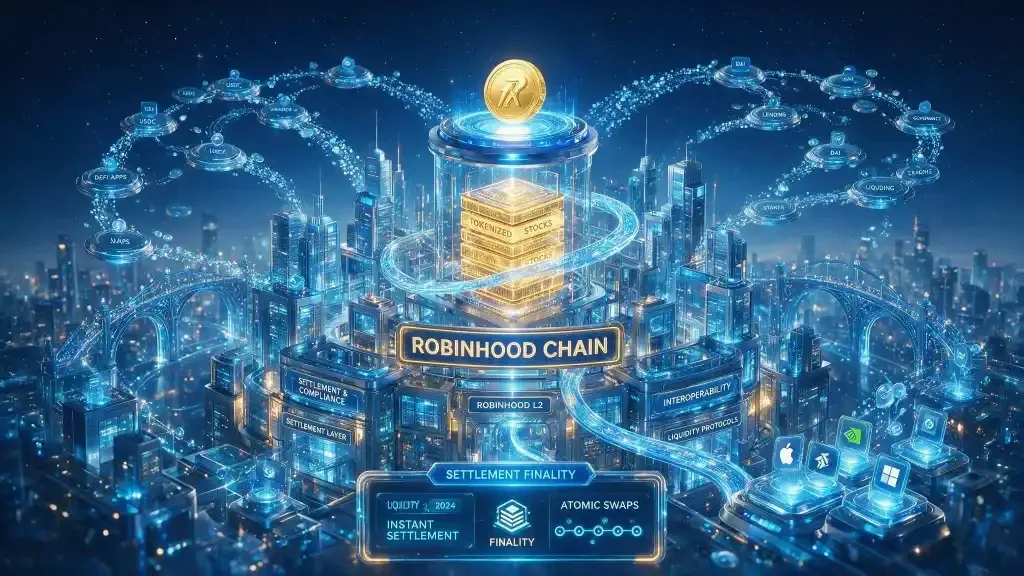
Robinhood Chain was built around bringing financial assets onchain, with tokenized stocks presented as one of its defining products.
The network supports tokens linked to companies and exchange-traded funds, giving eligible users blockchain-based economic exposure to traditional securities.
Robinhood’s documentation describes its Stock Tokens as tokenized debt securities rather than direct ownership of the underlying shares.
The company has been expanding the range of stocks available and promoting features associated with onchain finance, including wallet transfers and use within decentralized applications.
But since Robinhood Chain launched, total network TVL has grown about seven times faster than tokenized RWAs.
That suggests the chain’s early users are finding uses beyond its headline equity-tokenization proposition.
Stablecoin growth can help accelerate that shift.
Digital dollars act as trading assets, collateral and liquidity across decentralized finance.
As more stablecoins enter a blockchain, they can support decentralized exchanges, lending markets and other financial applications.
That activity can attract additional capital without requiring users to buy tokenized equities.
Robinhood Chain could therefore be developing into a broader DeFi ecosystem faster than it is developing into a dedicated tokenized stock market.
That would not necessarily conflict with Robinhood’s longer-term strategy.
A large stablecoin and DeFi base could eventually supply the liquidity needed for tokenized stocks to become more useful onchain.
The question is whether that supporting infrastructure ultimately drives greater use of RWAs or develops into an ecosystem largely independent of them.
Catenaa View
Robinhood Chain’s August figures expose an important distinction between building tokenized assets and building an onchain financial market around them.
Tokenized equities may have attracted attention to the network, but the capital is currently accumulating elsewhere much faster.
That matters because blockchain ecosystems tend to develop around liquidity.
Stablecoins can move between trading venues, serve as collateral, fund leveraged positions and connect numerous applications. A tokenized stock has a narrower initial role unless other financial products are built around it.
Robinhood could ultimately benefit from that imbalance.
A deep pool of stablecoins and active DeFi applications may create the infrastructure needed for tokenized stocks eventually to be borrowed against, exchanged, used as collateral or integrated into new financial products.
But the falling RWA share also creates an early reality check.
Launching a blockchain designed for tokenized Wall Street assets does not guarantee that those assets will dominate activity.
Users decide where capital flows.
For now, Robinhood Chain is growing rapidly, but the market appears to be turning it into something broader than the tokenized-equity network originally placed at the center of its story.
What Comes Next
The key metric will not simply be whether Robinhood Chain’s TVL keeps rising.
It will be whether tokenized equities begin reclaiming a larger share as more assets, trading venues and DeFi applications are added.
If they do, the current stablecoin expansion could prove to be the liquidity foundation for a much larger tokenized securities market.
If they do not, Robinhood may discover that the blockchain it built for stocks is evolving primarily into a general-purpose DeFi network.
Robinhood launched Robinhood Chain mainnet in July as infrastructure for onchain finance and tokenized real-world assets. The network supports Stock Tokens tied to U.S. companies and ETFs for eligible users outside the United States. Robinhood says its aim is to connect traditional financial assets with blockchain-based trading, lending and other applications. The network’s rapid early growth has brought large stablecoin balances and DeFi activity alongside its tokenized securities business.