

September 06, 2026 – The prediction venue now sells leveraged futures on bitcoin, gold, oil, and stock indices. However, a four-year-old enforcement order still keeps Americans on the sidelines.
In Summary
Polymarket opened its Perps market on 3 September with 10 contracts, rising to 67 within hours.
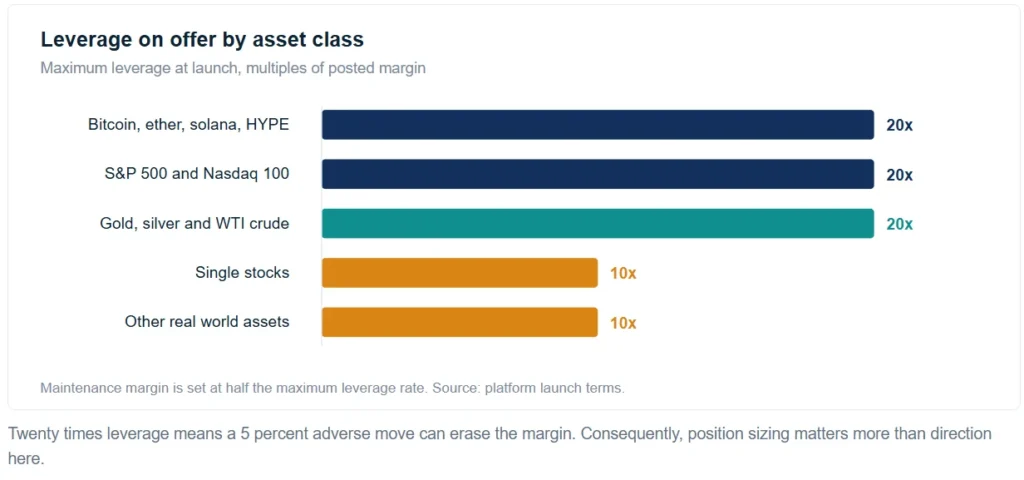
Leverage reaches 20 times on crypto, indices, and commodities, and 10 times on single stocks.
The funding rate is capped at 4 percent per hour in either direction.
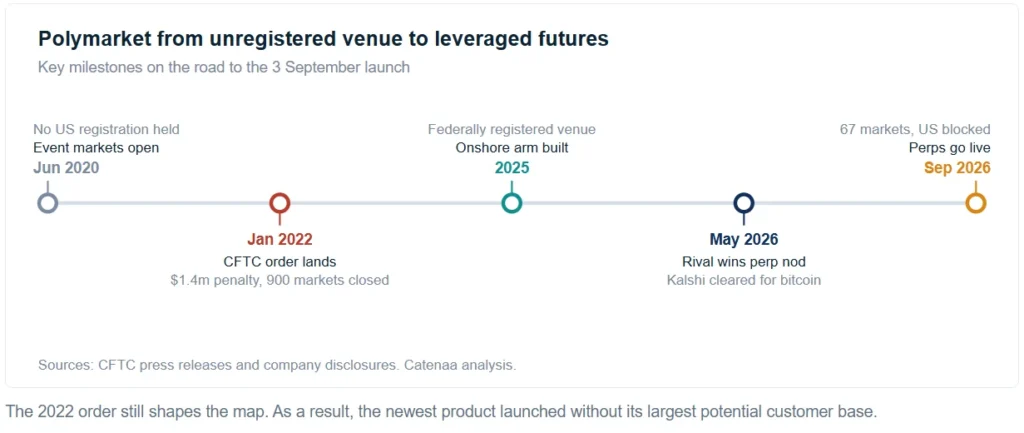
US residents are routed to Polymarket US because of a 2022 CFTC order and a $1.4 million penalty.
Kalshi won bitcoin perp approval on 29 May 2026, more than three months earlier.

A prediction venue grows a futures arm
Polymarket has moved past simple yes-or-no wagers. The platform opened a perpetual futures market on 3 September. It started with 10 contracts. Within hours, the list reached 67. Management branded the product Perps. It also claimed the deepest liquidity and lowest fees among crypto perp venues. As a result, the venue now competes directly with futures exchanges.
What launched, and on what
The menu spans far more than tokens. Bitcoin, Ether, Solana, and HYPE all trade. Gold, silver, and WTI crude sit beside them. Index products cover the S&P 500 and the Nasdaq 100. A tracker for SpaceX shares rounds out the list. That mix blurs the line between betting and broking.
How perps differ from event contracts
An event contract settles at zero or one. A trader picks an outcome and waits for the result. Perpetual futures behave in a very different way. They track a live price with no end date. Losses can therefore run without a natural stop. Margin calls replace the settlement date.
That shift changes the risk profile completely. It also changes who the platform serves. Election punters and macro hedgers want different tools. Perps suit active traders and market makers. Event contracts, by comparison, suit patient views.
The funding cap is the number to watch
Perpetual contracts carry no expiry date. A funding payment keeps the price tethered to spot. Longs pay shorts when demand runs hot. Shorts pay longs when it cools. Polymarket caps that rate at 4 percent per hour. The ceiling applies in both directions.
Read the cap as a stress limit rather than a normal cost. Crowded positioning can still get expensive quickly. A trader paying the full rate for a day faces a brutal bill. Therefore, holding periods should shorten when funding spikes. Risk teams will watch that gauge closely. In practice, most users will never pay the ceiling.
One listing stands out
A tracker for SpaceX shares sits on the menu. That contract offers exposure to a private company. Public markets provide no such access today. Pricing, therefore, leans on secondary market marks. Those marks move slowly and trade thinly. Consequently, the contract could drift from fair value. Oversight bodies tend to dislike that setup. Private company exposure also raises securities questions. Those questions sit with a different agency. Of course, offshore status limits that exposure for now.
Why Americans cannot touch it
US residents get routed away at the door. That restriction traces back to a 2022 enforcement case. Regulators fined Blockratize, the operator, $1.4 million. That order landed on 3 January 2022. Officials found an unregistered swaps venue running since June 2020. More than 900 markets had to wind down.
Cooperation earned the firm a reduced penalty. Since then, the company has built a separate onshore arm. Polymarket US holds federal registration. Any product there must clear the usual approval path. Perps have not appeared at that venue yet. Consequently, the two arms serve very different customers.
A crowded and fast moving field
Rivals reached this market first. Regulators cleared Bitcoin perps for Kalshi on 29 May 2026. That approval arrived more than three months earlier. Hyperliquid, meanwhile, dwarfs both venues. It traded $213.9 billion of notional over 30 days.
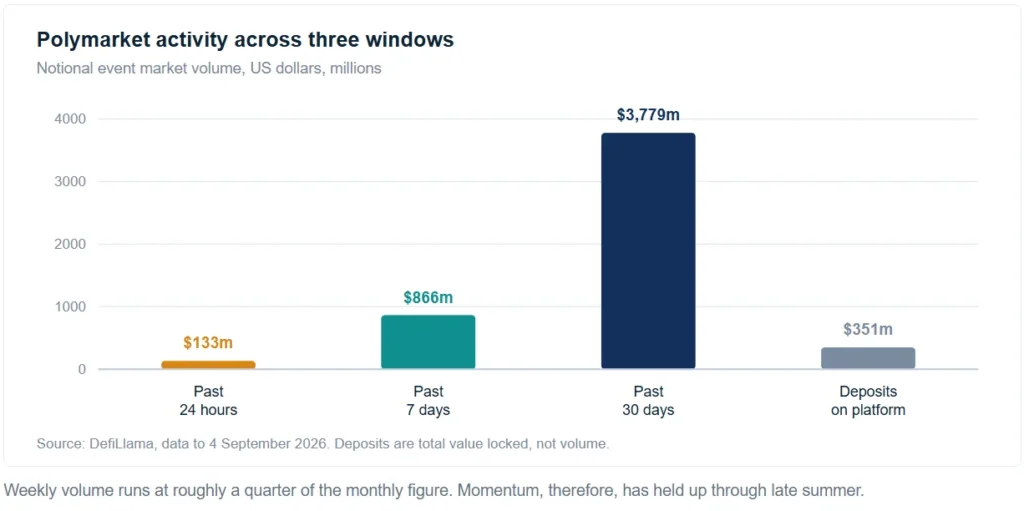
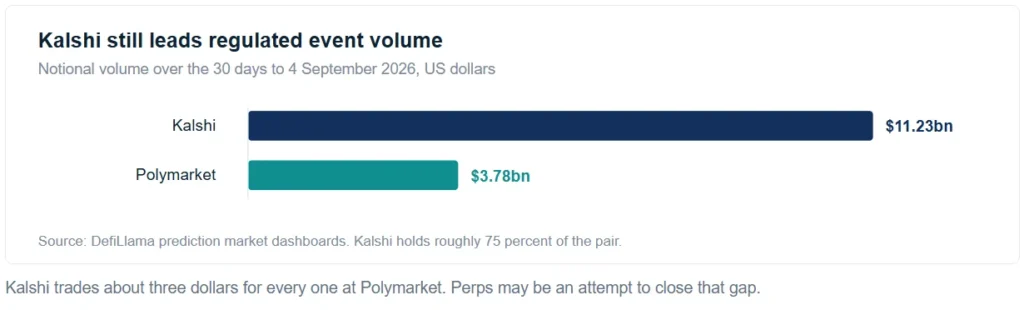
Event volumes tell a similar story. Kalshi handled $11.2 billion over the past month. Polymarket handled $3.8 billion. Deposits on the platform sit near $351 million. Fees, however, look healthy at $65.1 million over 30 days.
The fee logic behind the launch
Fee income explains much of the strategy. Event markets earn only on resolved volume. Perps earn on every turn of the book. High leverage multiplies that turnover. A small fee therefore, compounds quickly. Rivals have already proved the model works. Clearly, the firm wants a larger share of active flow.
Depth remains the open question. Management claims the best liquidity among perp venues. Independent data has not confirmed that claim yet. Order book depth matters most during stress. Thin books widen spreads and trigger forced selling. Users should test a small size before scaling up.
Regulation has not caught up
American rules were not drafted for contracts without an expiry. The CFTC opened a comment process in June. Questions covered round the clock trading and perpetual energy contracts. CME has sued the agency over a rival approval. On 3 September, officials asked a judge to dismiss that case.
Until the courts rule, onshore listings carry legal risk. Brokers will therefore move slowly. Clearing houses face the same caution. Offshore venues, by contrast, can iterate weekly. That speed gap explains much of the current land grab.
What to watch next
Three questions matter from here. First, whether funding rates ever reach the hourly cap under stress. Second, whether the onshore arm files for its own perps. Third, whether the CME lawsuit survives dismissal. Each answer shapes how fast prediction venues turn into exchanges.
Valuation talk adds pressure to all three. Reports place a recent funding round near a $21 billion figure. Investors clearly expect growth beyond election betting. Perps offer the fastest route to that growth. They also carry the heaviest regulatory baggage.
Traders should keep three practical points in mind. Leverage cuts both ways at 20 times. Funding costs can swamp a small edge. Access rules can change without much notice. Prudent sizing beats a strong view in this market. Above all, the product is young and untested.