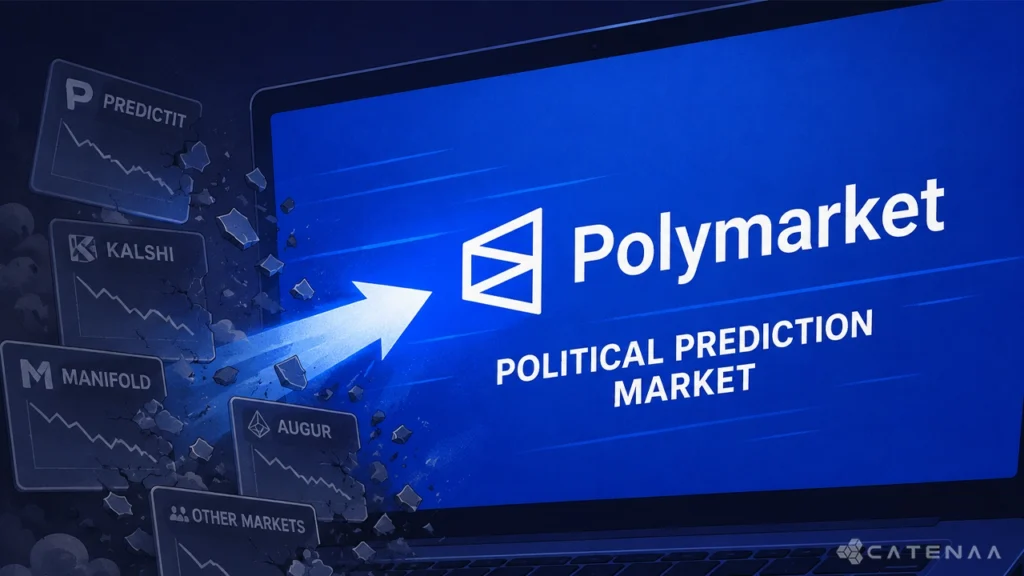


Catenaa, Friday, July 24, 2026- Polymarket has emerged as the dominant force in global political prediction markets, capturing an estimated 93% of trading volume in the sector as regulators intensify scrutiny of offshore crypto-based forecasting platforms.
The crypto-native prediction market recorded approximately $507 million in political trading volume during a recent week, far surpassing US-regulated rival Kalshi, which processed about $16.8 million over the same period. The disparity highlights Polymarket’s commanding position in a niche increasingly viewed as a barometer of political and geopolitical sentiment.
The platform’s rise comes as demand for prediction markets accelerates worldwide, with traders increasingly using event contracts to express views on elections, policy decisions and international developments.
Political contracts have become Polymarket’s defining business line, accounting for roughly one-third of the platform’s overall trading activity.
Its international platform, which excludes US users, reportedly generated around $9 billion in monthly trading volume in April 2026. By comparison, its US-regulated operation processed about $1.3 billion during the same month.
Across both Polymarket and Kalshi, monthly prediction market trading has expanded dramatically, approaching $24 billion in April 2026 after remaining below $5 billion in mid-2025.
While Kalshi continues to lead in overall trading volume across all categories, including sports and domestic event contracts, Polymarket remains the clear leader in political prediction markets.
The divergence reflects two competing approaches to prediction markets.
Polymarket has built much of its liquidity through an offshore model that offers broader market access outside US regulatory restrictions, while Kalshi operates within the framework established by the US Commodity Futures Trading Commission (CFTC).
The differing regulatory structures have significantly influenced user participation, market depth and liquidity.
Historically, cryptocurrency markets have demonstrated that platforms operating under lighter regulatory frameworks often attract greater trading volumes due to broader product offerings and fewer jurisdictional limitations.
Polymarket’s dominance illustrates how blockchain technology is reshaping event-based financial markets.
Prediction markets increasingly extend beyond election forecasting to cover macroeconomic events, geopolitical developments, monetary policy decisions and corporate outcomes, creating a new asset class where traders speculate on probabilities rather than price movements alone.
For institutional observers, the rapid growth suggests prediction markets are evolving into an increasingly influential source of market intelligence alongside traditional polling, forecasting models and derivatives markets.
However, continued expansion is likely to depend on how regulators balance financial innovation with market integrity and consumer protection.
Regulatory oversight has become the industry’s central challenge.
The CFTC launched an investigation into Polymarket in June 2026 examining broader concerns surrounding insider trading and market integrity within political and geopolitical event contracts.
The inquiry follows earlier enforcement action against the platform, which paid a $1.4 million settlement in 2022 related to regulatory compliance.
The investigation signals that authorities are paying closer attention to offshore prediction markets as trading volumes and market influence continue to expand.
Meanwhile, Kalshi’s strategy of operating within established US regulatory requirements could become a competitive advantage if tighter oversight limits the operational flexibility of offshore rivals.
The competition between Polymarket and Kalshi increasingly reflects a broader debate unfolding across the digital asset industry.
On one side are offshore platforms prioritizing liquidity, global access and rapid innovation. On the other are regulated exchanges building institutional credibility through compliance.
As prediction markets become more closely integrated into financial markets and political analysis, regulatory policy may prove just as influential as technology in determining which model ultimately prevails.
Prediction markets allow participants to trade contracts tied to the probability of future events, with prices reflecting collective market expectations. Blockchain-based platforms have expanded the sector by enabling decentralized trading and global participation. Polymarket has become the dominant platform for political event contracts, while Kalshi operates as a regulated US prediction market under CFTC oversight. Growing trading activity has attracted increased attention from regulators seeking to ensure transparency, market integrity and investor protection as prediction markets become a larger component of digital finance.