

July 29, 2026 – The firm has launched low-cost Ether and Solana products with staking features. Fee competition is intensifying, but temporary waivers complicate the cheapest-ETF claim.
In Summary
Morgan Stanley set a 0.14% annual expense ratio for both trusts.
Each trust launched with 50,000 seed shares and about $1 million.
Both products plan to stake part of their underlying digital assets.
The Solana trust may retain 95% of gross staking rewards.
Temporary fee waivers elsewhere can still produce lower current costs.
Morgan Stanley crypto ETFs entered the market with a sharp pricing message. The firm launched Ether and Solana products at 0.14% annually. Both products began trading on NYSE Arca on July 28, 2026. The tickers are MSSE for Ether and MSOL for Solana. Legally, both are exchange-traded trusts, not 1940 Act funds. The official launch statement confirms the fees, tickers, staking plans, and listing venue.
The launch matters because price competition now reaches staking-enabled crypto products. Investors can access two proof-of-stake networks through standard brokerage accounts. They avoid direct wallets, private keys, and exchange custody. However, they still face crypto volatility and product-level risks.
A low fee targets scale
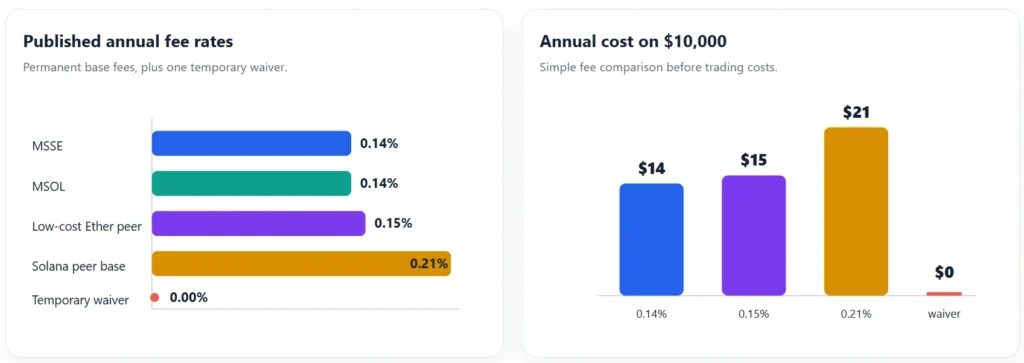
The 0.14% fee equals $14 yearly on a $10,000 holding. That compares with $15 at a 0.15% rate. It also compares with $21 at a 0.21% rate.
The difference looks small for retail investors. Yet it becomes significant across institutional allocations. A $100 million position costs about $140,000 annually at 0.14%. The same position costs $210,000 at 0.21%.
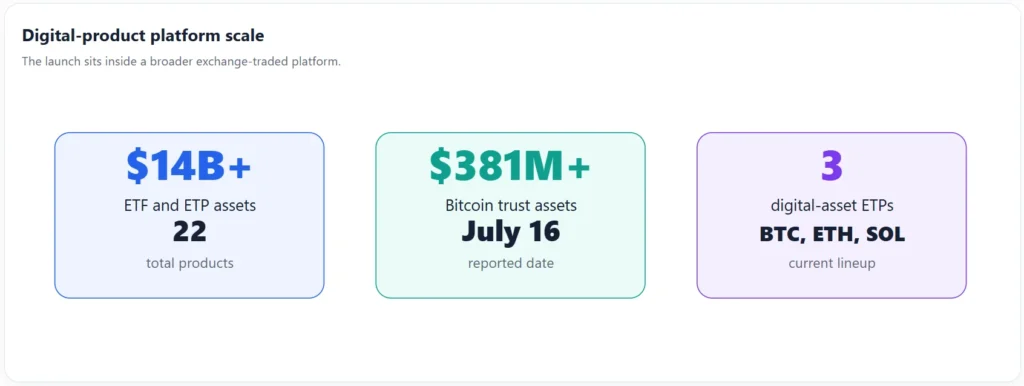
Morgan Stanley therefore appears willing to sacrifice early margin for distribution. Its broader ETF and ETP platform already exceeds $14 billion. The platform covers 22 products, including three digital-asset vehicles.
The firm’s Bitcoin trust also provides a useful signal. It held more than $381 million by July 16. That growth came only months after its launch. Therefore, the firm has evidence that its brand can attract crypto assets quickly.
Cheapest needs context
The permanent 0.14% fee undercuts several established products. For example, a regulatory filing for a low-cost Ether trust lists a 0.15% sponsor fee. That makes MSSE cheaper by one basis point.
However, headline comparisons require care. A competing Solana product introduced a temporary 0.00% sponsor fee. That waiver runs from July 28, 2026, through July 27, 2027.
Analytical point: MSOL is not the cheapest product by current net fee. It instead carries a lower permanent base fee.
Investors should compare permanent fees, temporary waivers, and staking deductions. They should also examine spreads and trading commissions. Those costs can exceed one basis point.
Staking changes the return equation
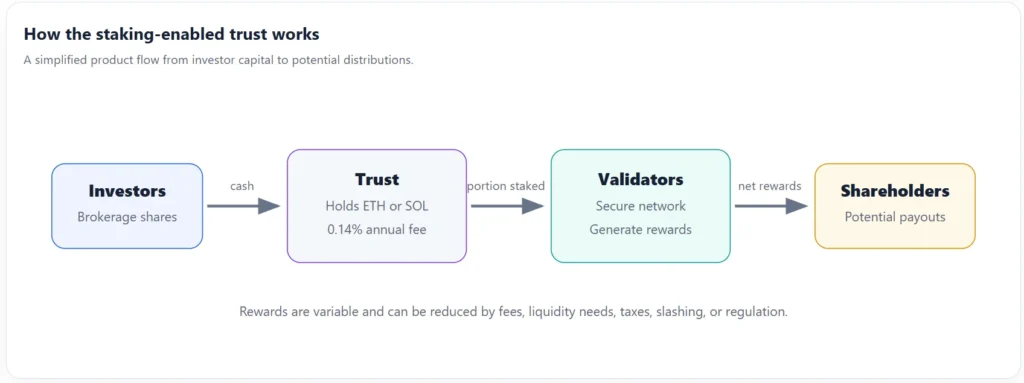
Traditional spot crypto products mainly track token prices. MSSE and MSOL add staking as a second return source. Staking helps secure proof-of-stake networks. In return, the network distributes rewards to participating validators.
The Solana trust filing allows the trust to stake up to 100% of its SOL under normal conditions. The trust may keep some SOL liquid for redemptions and expenses. Service providers expect to receive 5% of gross staking rewards. The trust retains the remaining 95%.
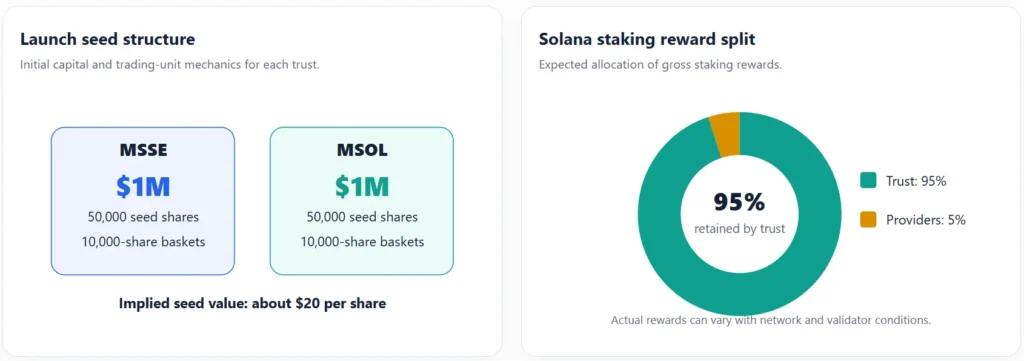
That structure can offset part of the 0.14% sponsor fee. Yet staking rewards are not guaranteed. Network conditions, validator performance, slashing, taxes, and regulation can reduce returns.
The Ether trust filing outlines similar operational questions. Assets can face activation or withdrawal delays. Those delays may become more important during heavy redemptions. Consequently, investors should not treat staking yield like fixed interest.
Seed size is modest
Each product started with 50,000 shares and about $1 million in seed capital. That equals an implied initial value near $20 per share. Creation and redemption baskets contain 10,000 shares.
The seed size supports orderly listing mechanics. However, it does not guarantee deep secondary-market liquidity. Bid-ask spreads, trading volume, and authorized-participant activity will matter after launch.
Morgan Stanley uses two institutional custodians for each trust. The structure spreads operational responsibilities across traditional and crypto-native infrastructure. Still, custody concentration remains a key industry risk.
What investors should watch
First, investors should track assets under management during the first month. Fast inflows could validate the low-fee strategy. Weak demand could show that price alone cannot overcome asset volatility.
Second, investors should review net staking distributions. Gross network rewards do not equal shareholder returns. Provider fees, liquidity reserves, taxes, and operating decisions affect the final amount.
Finally, investors should compare market prices with net asset value. New crypto products can trade at premiums or discounts. That gap may widen during volatile sessions.
Morgan Stanley crypto ETFs raise the competitive bar on fees and staking. The bigger test now involves liquidity, execution, and reward delivery. Those factors will determine whether low pricing creates durable market share.