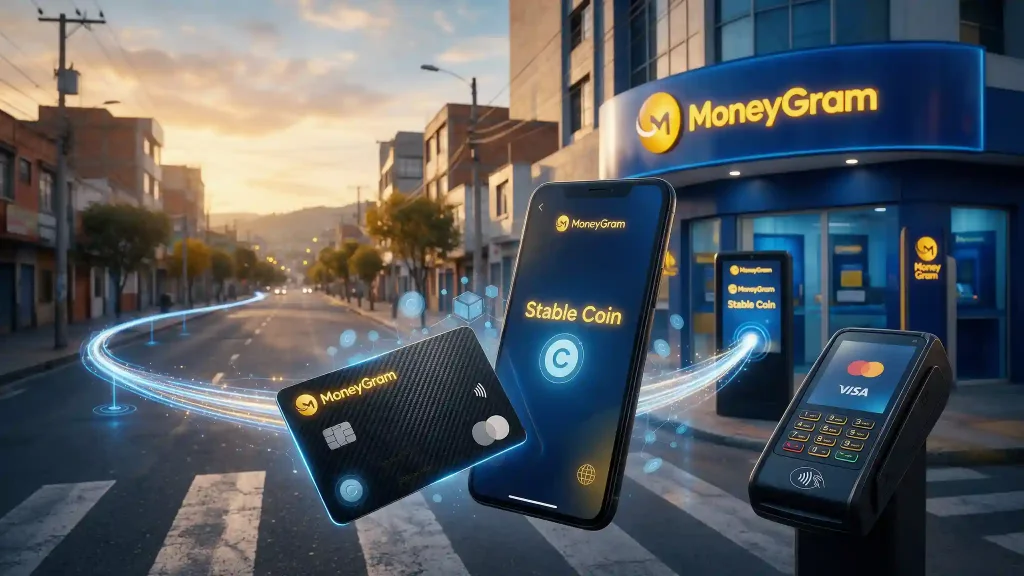


Catenaa, Friday, September 18, 2026- MoneyGram has launched its first stablecoin-backed Visa card in Colombia, extending its digital-asset strategy from international money transfers into everyday consumer payments.
The MoneyGram Card allows eligible customers to hold a stable-dollar balance and spend it wherever Visa is accepted.
Customers can also transfer funds from their MoneyGram balance and collect local currency at participating MoneyGram locations.
USDC is the first stablecoin supported by the card, MoneyGram told The Block.
The company plans to add support for its own dollar-pegged MGUSD stablecoin in the near future.
MoneyGram said the product differs from a conventional debit card because the underlying balance is held in stablecoins rather than in a traditional bank account or fiat-currency account.
The card is initially available digitally through the MoneyGram mobile app.
Users can apply, manage their balances and monitor spending through the app.
The digital card can also be added to mobile wallets for online purchases and contactless payments.
Customers must complete MoneyGram’s know-your-customer procedures and live in a market where the service is active.
Colombia is the first such market.
MoneyGram plans to expand the product across Latin America but has not identified the next countries.
The company developed the card with stablecoin payments infrastructure provider Rain.
Crossmint provides wallet technology, while transactions use the Stellar blockchain.
MoneyGram has worked with Stellar since 2021, when the companies introduced services allowing customers to convert cash into USDC and USDC into cash through MoneyGram’s retail network.
That relationship expanded in June when MoneyGram introduced MGUSD, its own dollar-pegged stablecoin designed for use across the company’s payments network.
MoneyGram said it has more than 60 million active customers across more than 200 countries and territories.
Its physical network includes nearly 500,000 retail locations.
That network gives the company a bridge between blockchain-based balances and cash, particularly in markets where consumers still depend heavily on physical currency.
The new product is MoneyGram’s first stablecoin-backed card, although the company previously offered conventional Visa debit cards.
Its earlier MoneyGram Account included physical and digital Visa debit cards issued by Pathward.
That product was discontinued in December 2025.
MoneyGram said the new card takes a different approach by combining stablecoin balances with payment and cash-access services.
The launch comes as traditional payment companies move deeper into stablecoins.
The supply of dollar-pegged stablecoins has grown to nearly $300 billion, according to market data cited by The Block.
Stablecoin transaction volumes have also reached trillions of dollars across major blockchain networks.
Payment companies increasingly view the assets as settlement infrastructure rather than solely as instruments for crypto trading.
MoneyGram plans to introduce a physical version of the card later in 2026.
That would allow customers to make purchases where digital cards are less widely accepted and withdraw cash from ATMs.
For MoneyGram, the Colombia launch tests whether stablecoins can move beyond remittances and become part of routine consumer spending.
If the Latin American rollout succeeds, the company could use its existing global network to extend the model into additional markets.