

Catenaa, Sunday, September 06, 2026-KuCoin Vice President Edwin Wong has outlined a four-part framework for assessing digital asset infrastructure as institutional participation places greater demands on governance, security and operational resilience.
Wong, who also heads risk control at the crypto exchange, presented the framework at the CYPHER ASIA Intelligent Crypto Finance Summit in Hong Kong.
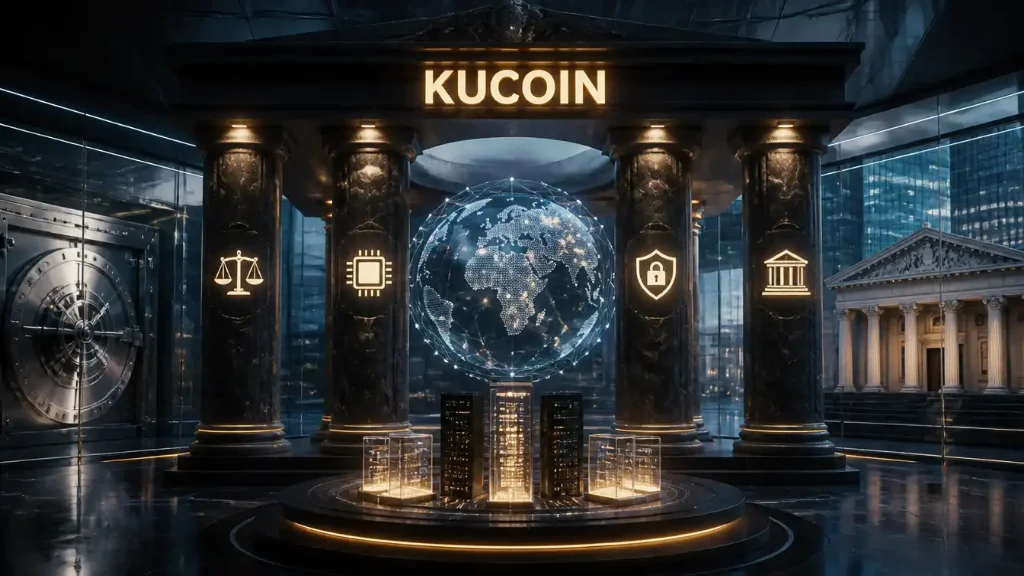
The model focuses on legal and regulatory trust, technological trust, security trust and what KuCoin describes as enduring trust.
His argument is that digital asset companies seeking institutional business increasingly need to demonstrate more than trading access, liquidity or customer growth.
Banks, asset managers and professional investors also assess whether platforms can operate reliably, protect assets, meet regulatory requirements and maintain controls during difficult market conditions.
The first pillar covers legal and regulatory trust.
Wong said institutions need clear rules and clearly allocated responsibilities before committing substantial capital to digital asset markets.
That requirement has become more visible as jurisdictions including Hong Kong, Singapore, the EU and the US develop formal licensing and market structures for crypto businesses.
Institutional investors generally face internal compliance requirements that retail traders do not.
Before using an exchange, custodian or tokenization platform, they may need to determine which entity holds assets, which regulator supervises it and what happens if a dispute or operational failure occurs.
Regulatory approval alone, however, does not establish that a platform can handle institutional-scale activity.
KuCoin’s second pillar focuses on technological trust, including whether systems can remain available and process transactions consistently during periods of high demand.
Crypto markets operate continuously, unlike many traditional securities markets.
Exchanges and custodians therefore need systems capable of functioning around the clock while handling market volatility, blockchain congestion and sudden increases in customer activity.
Operational failures can prevent customers from trading or withdrawing assets at precisely the periods when markets are moving most rapidly.
For institutional users, those interruptions can become risk-management problems rather than simple inconvenience.
The third pillar concerns security.
Wong argued that companies should demonstrate the effectiveness of their controls through measurable results and independent validation instead of relying on assurances.
That can include external audits, security testing, access controls, asset segregation and internationally recognized security certifications.
The cryptocurrency industry has experienced repeated exchange breaches, private-key compromises and failures of custody controls.
Those incidents have made cybersecurity one of the main barriers between traditional finance and digital assets.
Institutions holding customer or shareholder money cannot assess crypto custody in the same way as an individual investor managing a personal wallet.
They require documented controls around private keys, employee access, transaction authorization and disaster recovery.
KuCoin said it holds certifications including SOC 2 Type II and several ISO standards covering information security, privacy, business continuity and AI management.
Those certifications were cited by KuCoin in its announcement and should not be interpreted as guarantees against future security incidents.
Wong’s fourth pillar, enduring trust, concerns whether companies continue investing in compliance, infrastructure and accountability across different market cycles.
The issue has particular relevance in crypto because business conditions can change sharply between bull and bear markets.
Companies that expand aggressively during rising markets can face severe financial pressure when trading activity and token prices fall.
Institutional users therefore need to assess whether counterparties can maintain systems, staffing and compliance operations when revenues weaken.
The four-pillar model also argues against one company attempting to control every element of digital asset infrastructure.
Wong said asset issuance, custody, trading, risk management and market infrastructure require different areas of expertise.
A trusted financial system instead depends on clear responsibilities and cooperation between specialized participants.
That resembles the structure of traditional capital markets.
Asset managers do not normally perform every function involved in issuing, trading, clearing and safeguarding securities themselves.
Those responsibilities are distributed across exchanges, banks, custodians, clearing houses and other intermediaries.
Digital asset markets initially developed with more vertically integrated companies.
Some crypto exchanges combined trading, custody, lending, token issuance and other services within the same corporate structure.
That model can be convenient for users but can create conflicts if responsibilities and customer assets are not clearly separated.
Wong argued that institutional crypto infrastructure should place greater emphasis on asset segregation and clearly defined functions.
The discussion comes as Hong Kong continues expanding its regulated digital asset market.
The territory has introduced licensing for virtual asset trading platforms and is developing policy around tokenization and other blockchain-based financial products.
Hong Kong has also sought to attract financial institutions developing digital asset services while maintaining regulatory standards similar to those applied to established markets.
That approach could make the territory an important test of whether conventional financial institutions and crypto-native companies can operate within the same regulatory system.
Institutional adoption is also changing the criteria by which crypto platforms compete.
Retail markets historically emphasized token selection, trading fees and rapid product launches.
Institutional clients place heavier weight on custody, reporting, settlement, risk controls and compliance.
That creates pressure on exchanges to resemble financial infrastructure providers rather than simply trading venues.
KuCoin itself has been expanding its regulatory footprint.
The company said it has an AUSTRAC registration in Australia and a MiCA license in Austria.
It also said it serves more than 45 million users across more than 200 countries and regions and offers trading across more than 1,500 digital assets.
Those figures were supplied by KuCoin in the PR announcement.
The company also provides futures, institutional wealth-management services and Web3 wallets.
The broader question raised by Wong’s framework is whether crypto companies can meet institutional expectations without losing the speed and flexibility that helped the sector grow.
More regulation and stronger controls can increase operating costs.
They can also make large financial institutions more comfortable using digital asset infrastructure.
The next stage of institutional adoption may therefore depend less on attracting institutions to cryptocurrency and more on proving that crypto infrastructure can meet the standards institutions already expect from traditional markets.
KuCoin was founded in 2017 and has developed into a global cryptocurrency trading platform offering spot markets, derivatives, wallets and institutional services. Institutional participation in digital assets has increased as regulated ETFs, tokenized securities, stablecoins and blockchain-based settlement have moved closer to traditional finance. That shift has raised expectations around custody, asset segregation, cybersecurity, reporting and business continuity. Hong Kong has positioned itself as an Asian center for regulated digital assets through exchange licensing and tokenization initiatives, while other jurisdictions including the EU, Singapore and the US are also building formal rules. Crypto platforms seeking institutional customers increasingly compete not only on trading products and liquidity but also on whether their governance, technology and security systems can withstand the standards applied to conventional financial infrastructure.