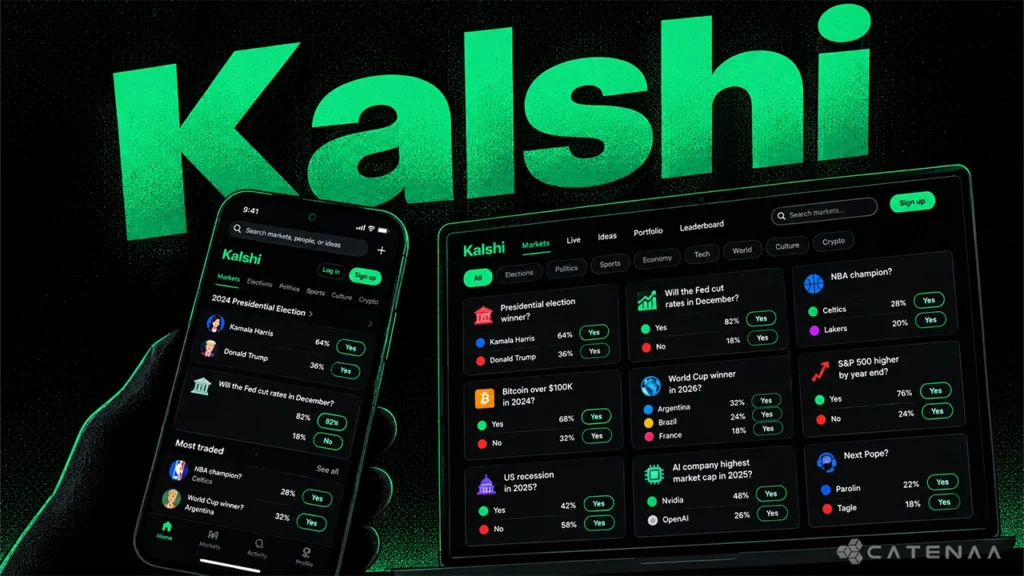


Catenaa, Saturday, September 05, 2026- Kalshi has reportedly reached an exclusive agreement with the US Tennis Association to become the prediction-market platform partner of the US Open, extending the industry’s rapid expansion into professional sports.
The agreement took effect immediately and was finalized after qualifying rounds for the tournament concluded last week, according to Front Office Sports, citing two people familiar with the arrangement.
Financial terms were not disclosed.
The US Open’s main draw began Sunday at the USTA Billie Jean King National Tennis Center in Flushing Meadows, New York.
The tournament is owned and operated by the USTA.
The organization had reportedly planned to consider prediction-market partnerships beginning in 2027. Those discussions were accelerated after Craig Tiley became USTA chief executive on July 20, according to the report.
One unusual element of the agreement involves advertising rights.
The USTA is reportedly preventing competing prediction-market companies from advertising at the tournament venue or during television coverage, including ESPN broadcasts.
That would give Kalshi a particularly strong form of category exclusivity if the arrangement operates as reported.
Neither Kalshi nor the USTA had formally announced the partnership when the reports emerged.
Kalshi was also not listed among official US Open partners as of Sunday afternoon.
Earlier Sunday, the company published an analysis of the women’s singles tournament that included language saying it was not affiliated with the US Open or WTA, according to Front Office Sports.
The timing suggests the agreement may have been completed very close to the beginning of the tournament.
Kalshi declined to comment to Front Office Sports, while the USTA and ESPN had not responded to the publication when its report was released. Kalshi also did not immediately respond to The Block.
The reported agreement marks another step in the increasingly close relationship between prediction markets and major US sports organizations.
Platforms including Kalshi and Polymarket have been signing partnerships traditionally associated with sportsbooks, fantasy-sports companies and other consumer betting brands.
Kalshi and Polymarket are already official partners of the NHL.
Polymarket has agreements with Major League Baseball and the New York Yankees.
Kalshi has separately announced partnerships with MLB teams including the Atlanta Braves, Boston Red Sox, Los Angeles Dodgers, San Diego Padres and San Francisco Giants.
Newer prediction-market operator Novig has also entered the sector through an agreement with the New York Mets.
Sports have become increasingly important to trading activity on prediction platforms.
Kalshi, Polymarket and Polymarket US generated a combined $41.2 billion in volume during August through the period covered by The Block’s data.
Kalshi accounted for about $33.7 billion of that total.
Sports contracts represent a large portion of Kalshi activity, while combination markets and parlay-style products have also grown.
Those products can allow users to trade on multiple outcomes within a single contract structure.
The rapid expansion has blurred the traditional distinction between prediction markets and sports betting.
Kalshi operates as a federally regulated designated contract market under the Commodity Futures Trading Commission rather than as a sportsbook licensed under individual state gambling laws.
The company argues that its event contracts fall under federal commodities regulation.
Several states disagree.
That disagreement has produced a series of court battles over whether states can apply gambling laws to Kalshi’s sports-related contracts.
The Ninth Circuit Court of Appeals dealt Kalshi a setback Friday in its dispute with Nevada.
The court ruled that Kalshi had not demonstrated that federal commodities law prevents Nevada from applying its gaming regulations to sports-event contracts.
The decision challenges Kalshi’s argument that CFTC oversight gives the federal government exclusive jurisdiction over the products.
A separate Third Circuit decision involving New Jersey reached a different result and prevented that state from regulating Kalshi’s sports contracts.
The conflicting decisions have deepened uncertainty over the regulatory status of prediction-market sports products.
A split between federal appellate courts can increase pressure for further judicial review or congressional clarification.
The dispute carries growing commercial importance as prediction markets move deeper into mainstream sports.
An exclusive partnership with the US Open could place Kalshi before a large international television and digital audience during one of tennis’ four Grand Slam tournaments.
Such deals also offer sports organizations another commercial category alongside sponsorships from financial services, technology and traditional betting companies.
For Kalshi, the value extends beyond visibility.
Official sports relationships can help prediction markets position themselves as established financial or entertainment platforms rather than fringe trading products.
The exclusivity reportedly offered by the USTA could make the arrangement particularly valuable by preventing rival platforms from purchasing advertising around the tournament.
It could also intensify competition between Kalshi and Polymarket.
The two companies have expanded rapidly as prediction markets move from election-focused contracts into sports, economics, entertainment and other events.
Sports may eventually become one of the industry’s largest categories because games occur continuously and generate large numbers of short-duration markets.
That creates frequent trading opportunities compared with political or economic events that may take weeks or months to resolve.
It also brings prediction platforms directly into territory historically controlled by regulated sportsbooks.
The distinction matters legally.
A sportsbook generally sets odds and accepts wagers against customers.
Prediction markets typically structure contracts in which participants trade against one another on whether an event will occur, with prices reflecting market-implied probabilities.
Regulators and courts are now determining how much that structural difference matters when the underlying event is a sporting contest.
Kalshi’s reported US Open agreement shows that sports organizations are not waiting for the legal debate to be fully settled.
Commercial partnerships are advancing while regulators, courts and prediction-market operators continue arguing over jurisdiction.
If the USTA arrangement is formally confirmed, it would give Kalshi one of its highest-profile sports partnerships yet.
It would also place the platform at the center of a major tennis event at the same time its legal model faces growing scrutiny from state gaming authorities.
Kalshi operates a CFTC-regulated prediction market where users trade event contracts tied to outcomes in politics, economics, sports and other categories. The company’s expansion into sports has drawn challenges from state gaming regulators who argue some contracts amount to sports wagering subject to state law. Kalshi maintains that its status as a federally regulated derivatives exchange places its event contracts primarily under CFTC jurisdiction. Courts have begun reaching different conclusions, with decisions involving Nevada and New Jersey creating uncertainty over the boundary between federal commodities oversight and state gambling authority. Polymarket has also expanded aggressively into sports partnerships, increasing competition between the two platforms as prediction markets move beyond elections and into mainstream entertainment. Rising volumes have made sports an increasingly important source of activity for the sector.