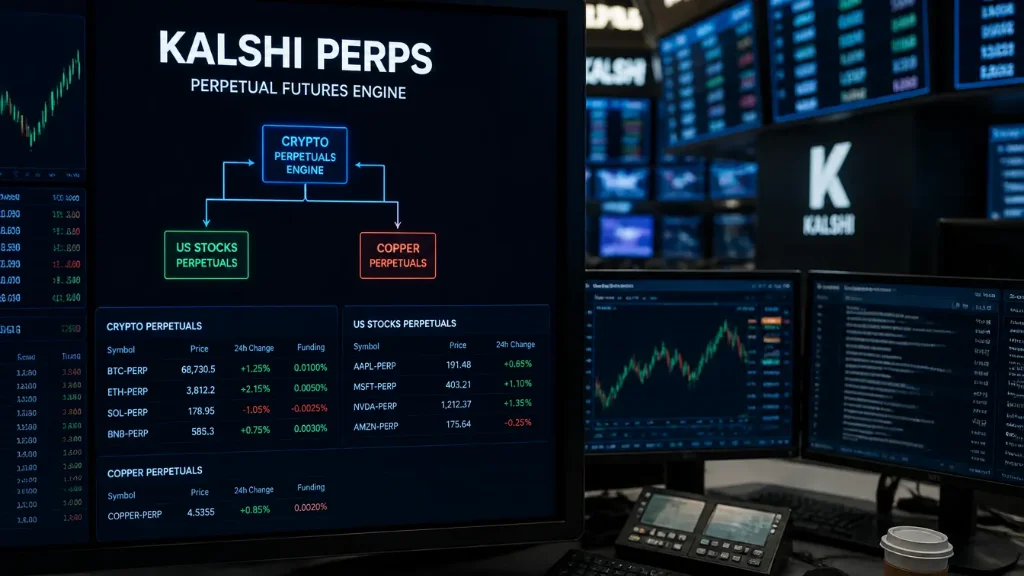


Catenaa, Monday, August 24, 2026-Kalshi is seeking US regulatory approval to launch perpetual futures tied to a broad stock index and copper, pushing a derivatives structure popularized by cryptocurrency markets deeper into traditional finance.
The CFTC-registered exchange filed separate applications Tuesday for its US500 and COPPERPERP contracts.
US500 would track the MerQube US Large Cap Index, which covers the 500 largest companies listed and based in the United States.
It is not an S&P 500 contract.
COPPERPERP would track the spot price of copper in US dollars per pound using the Pyth Network XCU/USD price feed.
Both products require Commodity Futures Trading Commission approval before Kalshi intends to list them.
Perpetual futures differ from conventional futures because they do not expire.
Traditional futures contracts have fixed settlement dates, requiring traders maintaining long-term exposure to regularly move positions into later contracts.
Perpetuals instead use periodic funding payments between long and short traders to keep the contract close to its underlying reference price.
That model became dominant in offshore cryptocurrency derivatives markets before gaining a regulated foothold in the United States this year.
The CFTC approved Kalshi’s Bitcoin perpetual futures contract in May, marking the first domestic approval of its kind.
Kalshi is now attempting to apply the same structure to traditional assets.
The move could turn perpetuals from a predominantly crypto trading instrument into a broader US derivatives product.
The proposed US500 contract would offer continuous exposure to the MerQube US Large Cap Index.
The index includes 500 large US companies and is weighted by float-adjusted market capitalization.
Kalshi proposes trading the contract 24 hours a day, five days a week.
Its funding mechanism would reference the live index during regular US equity market hours.
Unlike traditional quarterly stock-index futures, traders would not have to close or roll contracts as expiration approaches.
Kalshi argues that this could benefit institutions maintaining continuous equity exposure by reducing roll costs and operational requirements.
The structure could also offer another route for traders seeking leveraged exposure to broad US equities without owning the underlying stocks.
Copper would take the model into physical commodities.
Kalshi’s proposed COPPERPERP contract would also trade 24 hours a day, five days a week.
It would be cash-settled and linked to a Pyth Network copper price feed.
Kalshi argues that miners, manufacturers, merchants and industrial users can face continuing copper-price exposure that does not naturally end on the expiration date of a conventional futures contract.
A perpetual contract could therefore allow them to maintain a hedge without repeatedly rolling positions.
Copper presents different risks from Bitcoin.
Physical supply can tighten, and the market has historically experienced squeezes.
Kalshi said its proposed product would adopt the federal spot-month position limit used for COMEX copper futures.
The applications arrive while the legality of US perpetual futures is already being challenged.
CME Group sued the CFTC in June over the regulator’s decision to allow Kalshi and Coinbase to offer perpetual futures.
CME argues that products with these characteristics should be regulated as swaps rather than futures and says the CFTC improperly changed its regulatory approach.
The CFTC has rejected CME’s criticism and defended its decision.
The lawsuit initially focused on crypto perpetuals.
Kalshi’s latest filings potentially raise the commercial stakes because the products now move directly into markets where established futures exchanges have long operated.
A perpetual contract tracking large-cap US equities could compete with conventional equity-index futures.
Copper is also a major established futures market.
Kalshi built its name around event contracts that allow users to trade on outcomes ranging from elections to economic data.
Its expansion into perpetual futures points toward a much broader ambition.
The company is increasingly positioning itself as a general derivatives exchange rather than solely a prediction market.
Bitcoin opened that route.
Stocks and copper could show whether the CFTC is willing to extend the same regulatory treatment to assets with very different market structures.
The commission itself cautioned when approving Kalshi’s Bitcoin perpetual that the design might not be suitable for every asset class.
It encouraged exchanges to seek individual review for perpetual products involving other markets.
Kalshi is doing exactly that with its latest filings.
Catenaa View
The most important part of Kalshi’s applications is the migration of crypto market structure into traditional finance.
Perpetual futures were refined and popularized on cryptocurrency exchanges because crypto trades continuously and traders wanted leveraged positions without expiration dates.
Now the model is being tested against stocks and industrial commodities.
If approved, the distinction between crypto-native and conventional derivatives markets could narrow further.
Kalshi could offer traders one exchange structure spanning prediction markets, cryptocurrencies, stocks and commodities.
For established exchanges, that creates a new competitive challenge.
For regulators, it poses a larger question.
The CFTC approved Bitcoin perpetuals partly because Bitcoin’s continuous global spot market supported the funding mechanism used to keep the contract aligned with spot prices.
Equities and copper behave differently.
The commission must now decide whether perpetual futures can safely become a general-purpose US derivatives format rather than a special solution for crypto.
That decision could matter far beyond Kalshi.
The CFTC approved Kalshi’s Bitcoin perpetual contract May 29, opening regulated domestic trading of perpetual futures in the United States. The commission said the structure might not work for all asset classes and encouraged case-by-case applications. CME later sued the regulator, arguing perpetuals should be treated as swaps. Kalshi’s Aug. 18 filings seek approval to extend the model to a broad US stock index and copper.




