

September 06, 2026 – The president wants the biggest on-chain derivatives venue trading onshore. However, the road runs through a small Chicago exchange, two federal agencies, and a live lawsuit.
In Summary
Trump said his team is working to bring Hyperliquid onshore in a fully legal and compliant way.
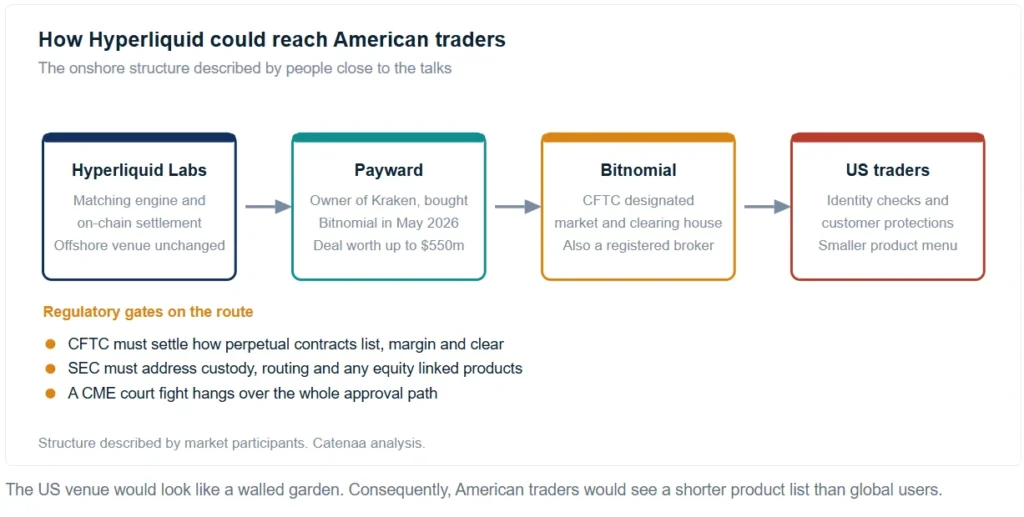
The likely design is a separate US product, not open access to the offshore order book.
Payward, the owner of Kraken, bought Bitnomial in May 2026 for up to $550 million.
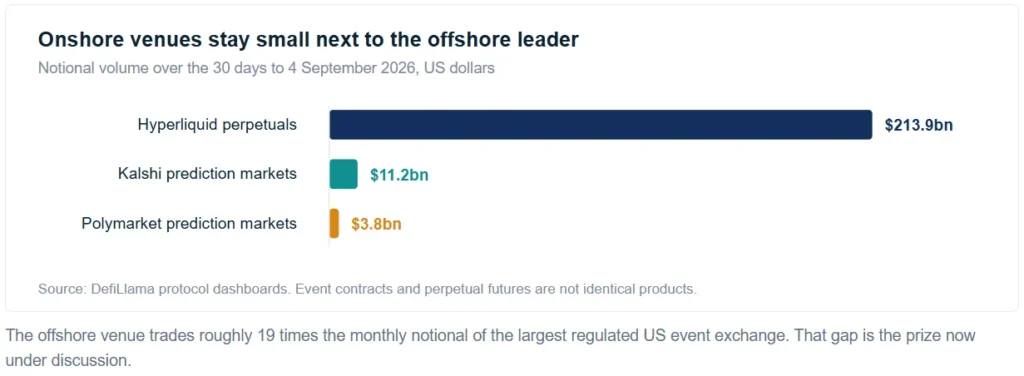
Hyperliquid holds about $14.1 billion in open interest and traded $213.9 billion over 30 days.
Lawyers see a 10- to 12-month rule path. CME is already suing the CFTC over a rival approval.

Washington opens a door it kept shut
President Donald Trump wants Hyperliquid trading on US soil. He said his team is working to bring the venue onshore. Any launch, he added, must be fully legal and compliant. The remark came on 4 September. It landed on a market that grew huge beyond the US’s reach.
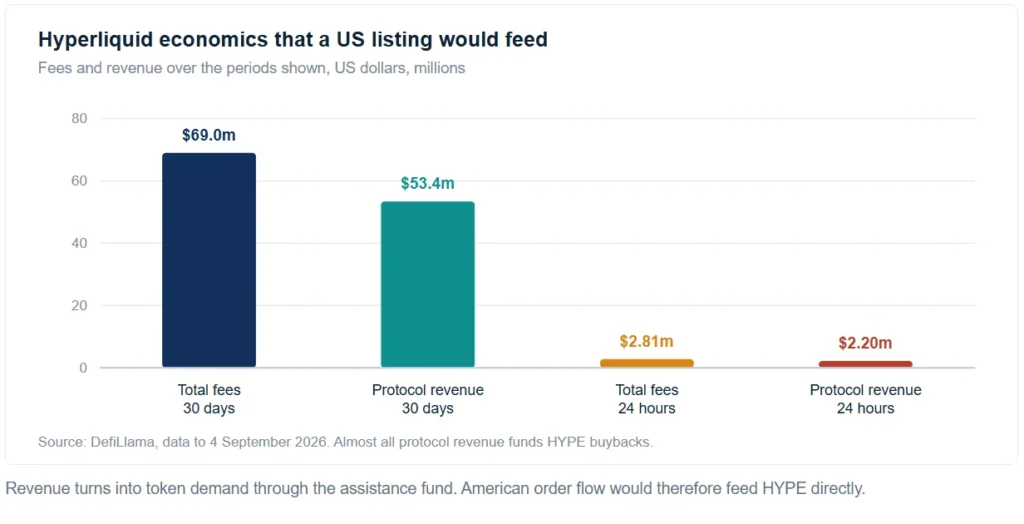
Size explains the sudden interest. Hyperliquid holds about $14.1 billion in open bets on perpetual futures. Traders pushed some $8.9 billion through it in one day. Volume over 30 days came close to $213.9 billion. Fees reached $69.0 million in that window. Of that sum, $53.4 million counted as protocol revenue.
What a perpetual future actually is
A perpetual future carries no end date. Traders hold the position while they post margin. A funding rate keeps the contract close to the spot price. Longs pay shorts when demand runs hot. Shorts pay longs when it cools. US futures law, by contrast, assumes a fixed expiry. That mismatch sits at the heart of the problem.
Leverage adds a second hurdle. Offshore venues often allow far more of it than US rules permit. Margin levels will therefore become an early battleground. Clearing houses must also hold enough capital against sudden moves. Crypto prices, after all, can gap hard overnight.
Why the timing matters
Rival venues are moving at speed. Kalshi won its bitcoin perp approval in May. Coinbase followed within months. Polymarket opened its own perp market on 3 September. Each week of delay hands ground to those rivals. Hyperliquid, for now, cannot bid for US flow at all.
The road runs through Chicago
Rule makers will not simply open the old order book to Americans. Instead, the plan builds a fresh US product on the same technology. Payward sits at the heart of that design. The firm owns Kraken. It bought Bitnomial in May 2026 for up to $550 million.
Bitnomial already holds designated contract market status. It can clear trades and act as a broker as well. Therefore it can list futures without fresh licences. That shortcut saves years of filings. A cold start, by comparison, would take far longer.
The rulebook still needs work
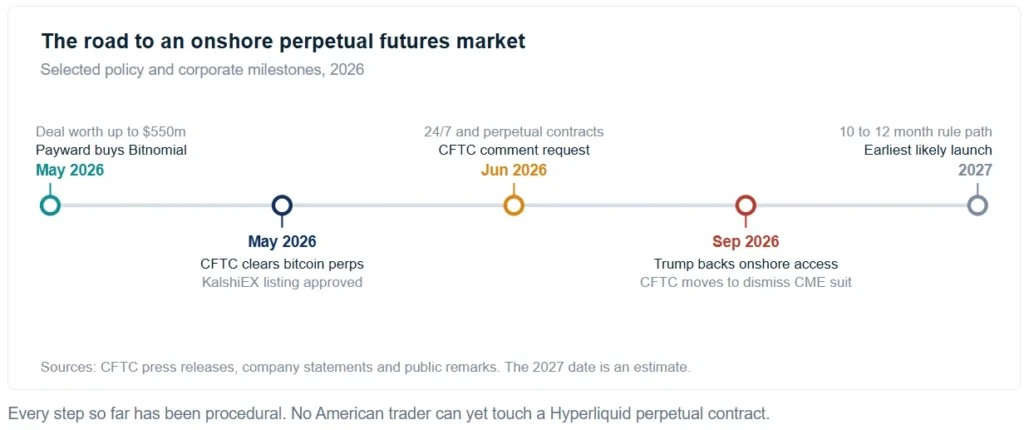
The Commodity Futures Trading Commission has begun to close the gap. In June, the agency asked for public comment on round-the-clock trading. It also asked about perpetual contracts on real commodities. Approvals have started as well. Regulators cleared bitcoin perps for KalshiEX in May 2026. Coinbase then listed its own contracts.
September brought another step. Coinbase filed notices with the Securities and Exchange Commission for single-stock perps. Custody rules and routing standards still need drafting. Both agencies must therefore sign off. Neither has set a public deadline.
Ashley Ebersole, once a senior counsel at the SEC, puts the process at 10 to 12 months at best, even with willing regulators.
A lawsuit hangs over the plan
Older exchanges dislike the shift. CME boss Terrence Duffy called crypto perps a disaster waiting to happen. His group then sued the CFTC over the Kalshi approval. On 3 September, the agency asked a judge to toss the case. Until that fight ends, banks and brokers will move slowly.
Consumer groups object for other reasons. Mark Hays of Americans for Financial Reform sees a long pattern of collusion. Meanwhile, the CFTC has grown bolder about federal primacy. In July, it was a KalshiEX rule change. It then ordered open trades to settle as normal.
State regulators add a second front. Several states have pushed back hard on event contracts. Federal officials have answered each case on preemption grounds. That pattern points to a slow and contested rollout. Legal risk, in short, will not vanish at launch.
What US traders would actually get
Expect a trimmed venue rather than a copy. Nicolai Sondergaard of Nansen Research sees fewer markets and lower leverage. Margin rules, size caps, and reporting duties all add friction. Even so, a legal venue reaches money that offshore sites cannot. Pension funds and registered advisers sit behind that wall. Fees would likely sit above offshore levels as well. Compliance work rarely comes free.
A split market may follow. Global users would keep deep books and high leverage. US users would get a shorter menu. Liquidity could then sit in two pools. Price gaps between them would invite arbitrage. Bitnomial would have to police that link daily.
The competitive fallout
Success would reshape the fee pool. US brokers earn nothing from offshore perps today. A binomial listing would change that quickly. Clearing fees, give-up fees, and data fees would all follow. CME reads the same map. Its lawsuit is therefore about revenue as much as risk. Margin at regulated futures venues sits well above crypto norms. An onshore perp would narrow that gap. Trading desks would spot the difference at once.
The token has already moved
Traders priced the story fast. HYPE hit a record $88.06 on 3 September. It then eased to $83.93 the next day. Weekly gains still ran near 4 percent. Market value sits close to $18.7 billion. That ranks the token among the ten largest.
Investors should stay careful all the same. Nothing has been filed, cleared, or booked. Rule changes could slip past the 2028 election. The political signal is loud. Paperwork, by contrast, has barely begun.