

September 07, 2026 – The first 13F filings put 30 institutions inside three young funds. The sums are modest, yet the names are not.
In Summary
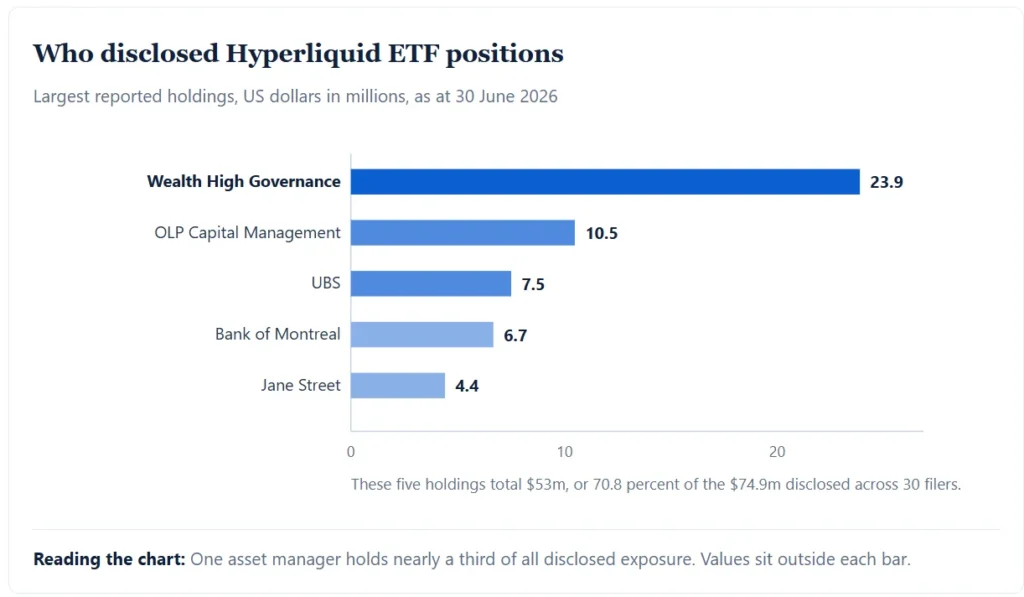
Thirty firms disclosed a combined $74.9m across the three US Hyperliquid ETFs.
The five largest holders made up $53m, or about 71 percent of that total.
UBS held $7.5m, Bank of Montreal $6.7m and Jane Street $4.4m.
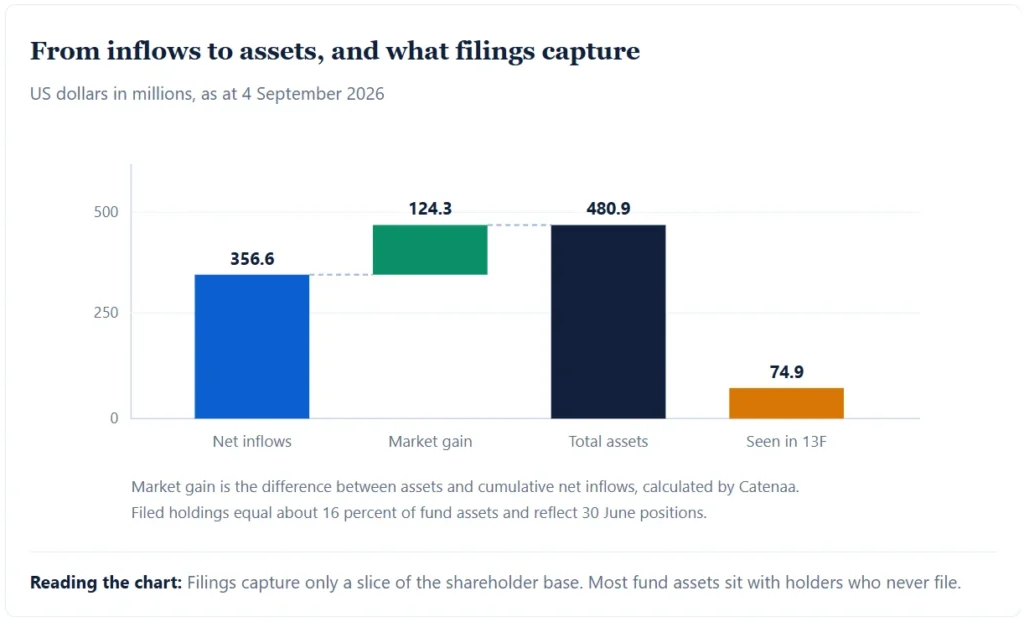
The three funds held about $480.9m in assets on 4 September 2026.
Filings cover 30 June, so they lag the market by more than two months.

Wall Street names have turned up in Hyperliquid ETFs. The sums look small. Their signal does not.
Thirty firms disclosed a combined $74.9m across three US funds. UBS, Jane Street, Bank of Montreal and Brevan Howard all appear.
Also, filings cover only the quarter to 30 June 2026. So the data already lags the market by more than two months.
What the filings actually show
US managers with $100m or more in listed securities must file Form 13F. Furthermore, the deadline falls 45 days after each quarter ends. Therefore reports for the June quarter landed by 14 August.
Rules matter here as well. Form 13F covers long positions in listed securities only. Short books, cash and offshore holdings, however, stay out of view.
So these numbers set a floor rather than a total. Direct token holdings never appear at all.
Timing adds a second limit. All three funds launched in May or June. Therefore the June quarter captured only weeks of trading, not a settled book. Indeed, some of these positions may already be gone.
Who bought and how much
At the top, one name leads by a wide margin. Wealth High Governance Asset Management held $23.9m, through 632,614 shares of the 21Shares fund.
OLP Capital Management came next at $10.5m. UBS followed with $7.5m, then Bank of Montreal at $6.7m. Jane Street held $4.4m.
In total, those five accounted for $53m, or about 71 percent of the disclosed sum.
The tail runs long and thin. Royal Bank of Canada, for example, showed just $22,068. Tower Research reported $1,103.
Discovery Capital, Brevan Howard, Balyasny and Boothbay also appear. Such tiny stakes usually mark exploratory positions rather than conviction.
Bank names carry a different meaning. Brokers often hold fund shares to face client orders. In other words, a bank line item need not signal a proprietary bet.
Three funds, three fee models
So far, US investors have three routes. All of them launched inside a single month.
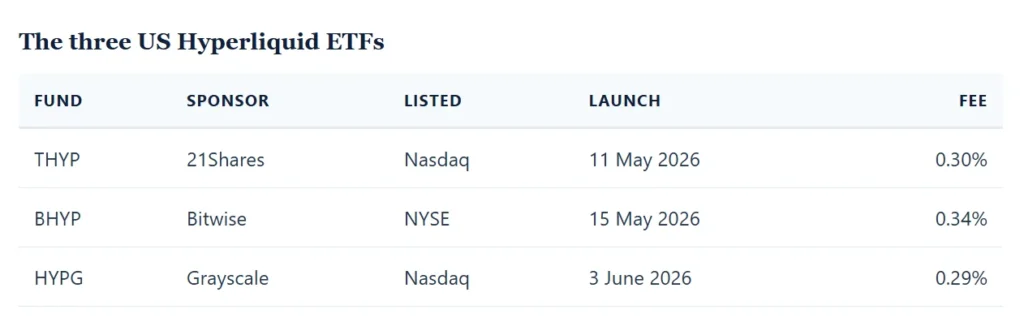
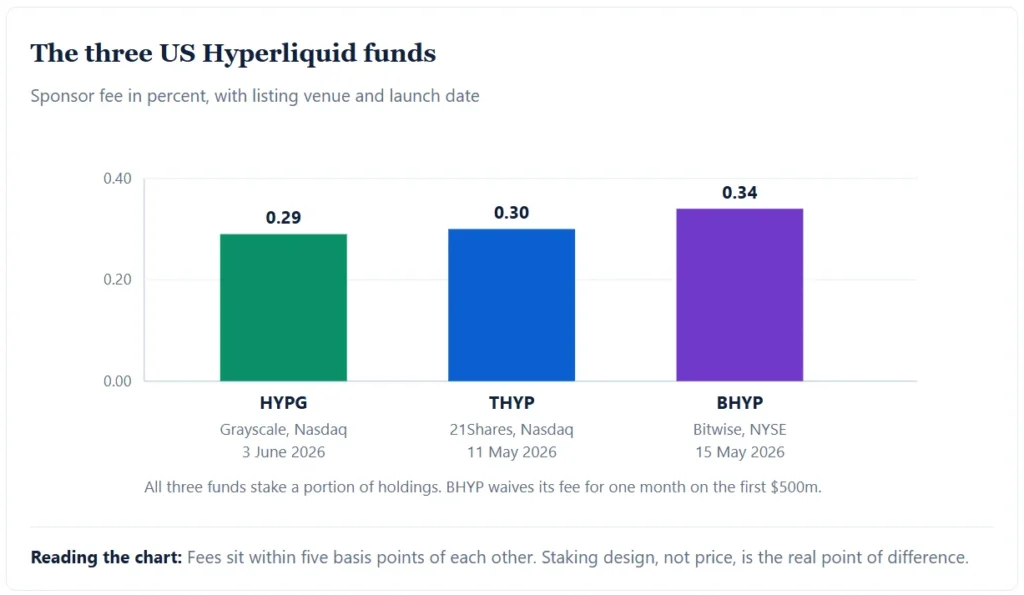
21Shares listed THYP on Nasdaq on 11 May 2026. It charges 0.30 percent and also stakes part of its holdings. Cash rewards reach shareholders at least quarterly.
Bitwise listed BHYP on NYSE on 15 May. Its fee is 0.34 percent, waived for one month on the first $500m. Bitwise stakes through its own desk rather than a third party.
Grayscale listed HYPG on Nasdaq on 3 June. At 0.29 percent it carries the lowest gross fee. Historical staking rewards have run near 2.2 percent a year.
Fee gaps are thin, so distribution decides the winner. Bitwise held the largest book at the June quarter end, with about $128m in net assets. It also held close to 1.96m HYPE at that date.
The funds have outgrown the filings
Assets tell a rather different story from the 13F data. The three funds held about $480.9m on 4 September 2026. Net inflows since launch reached about $356.6m.
So market gains supplied roughly $124m of the total, by Catenaa’s calculation.
Growth has not been smooth, though. July brought the first monthly net outflow, at $4.6m. Cumulative inflows sat near $280m in early August.
Disclosed 13F holdings therefore cover about 16 percent of fund assets. Retail buyers and non filing accounts, therefore, hold the rest.
Why the token keeps climbing
HYPE traded near $88.53 on 6 September. It gained 3.9 percent on the day and 6.2 percent across the week. Notably, a record high of $89.60 came hours earlier.
Market value now stands near $19.7bn, which ranks ninth among tokens. Circulating supply is 222.4m against a one billion cap.
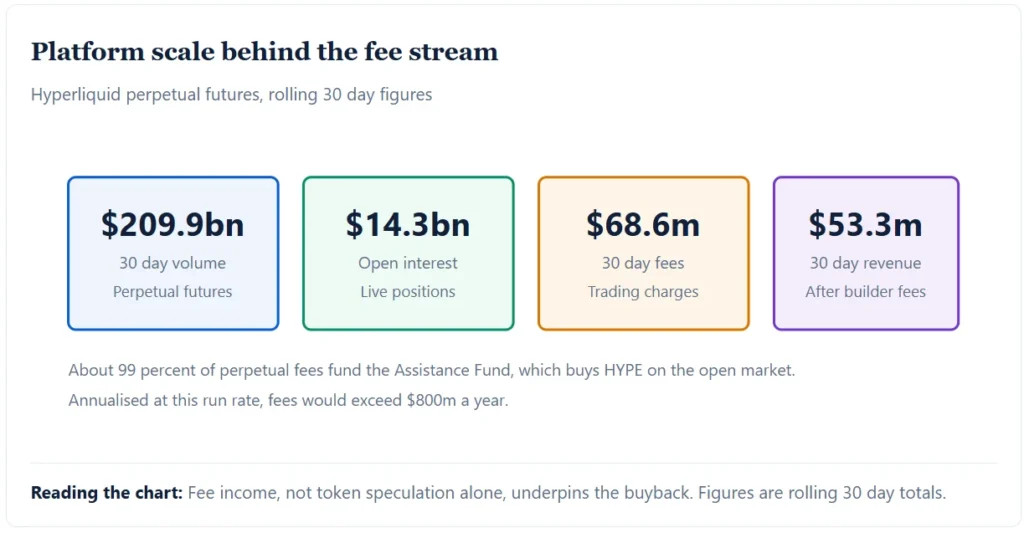
Buybacks explain part of that strength. Hyperliquid routes 99 percent of perpetual fees to its Assistance Fund. That fund then buys HYPE in the open market.
Staking adds a second bid. Funds lock tokens to earn rewards, which trims free float. As a result, supply on exchanges tightens as fund assets grow.
The exchange behind the token
Volume explains the fee pool. Hyperliquid handled about $209.9bn in perpetual futures over 30 days. Meanwhile, open interest sat near $14.3bn.
Fees over the same window then reached $68.6m. Revenue came to $53.3m.
Such figures rival mid tier centralised venues. However, the platform runs onchain and outside US registration.
That gap creates the core risk. Rule changes could hit volumes quickly, and fees with them.
What it means for allocators
Three points stand out for institutions. First, exposure now arrives in a familiar wrapper. Second, staking yield lands inside the fund rather than a private wallet. Third, custody sits with regulated banks.
Basic risks remain, of course. Fees, tracking error and staking lockups all bite. Prices can fall as fast as they climbed.
Liquidity deserves care as well. Staked tokens sit locked for a set period. So if redemptions spike, funds must sell unstaked assets first.
Position size, of course, tells its own story. A $7.5m stake at a bank of that scale is a rounding error. Such holdings often reflect client facilitation rather than a house view.
What to watch next
September quarter filings arrive by 16 November. In turn, they will show whether these names added or exited.
Watch the flow data too. A run of monthly outflows would test the buyback story fast.
Policy is the third variable. US rules on onchain derivatives keep shifting. Any move to license or restrict offshore perpetual venues would reach the fee pool directly.
For now the picture is simple. Institutions have opened the door, yet they have barely stepped through it.