

September 12, 2026 – A finance ministry draft would scrap the twelve-month tax-free rule. Coins bought before 31 December 2026 would keep it.
In Summary
A German finance ministry draft would end tax-free crypto sales.
Gains would face a flat 26.375% charge from 2027.
Coins bought on or before 31 December 2026 keep the old rule.
Platforms already report user transactions to the tax office.
The draft still needs cabinet, Bundestag, and Bundesrat approval.

Germany has run the friendliest crypto tax rule in Europe for years. Hold a coin for twelve months, then sell it, and the gain escapes tax entirely. That rule now faces the exit.
A working draft from the Federal Ministry of Finance would move crypto into the capital income regime. Gains would then attract the flat withholding tax. Reports of the draft emerged on 8 September 2026. Officials had prepared the text in mid-August. Furthermore, the ministry has not yet published it in full.
From section 23 to section 20
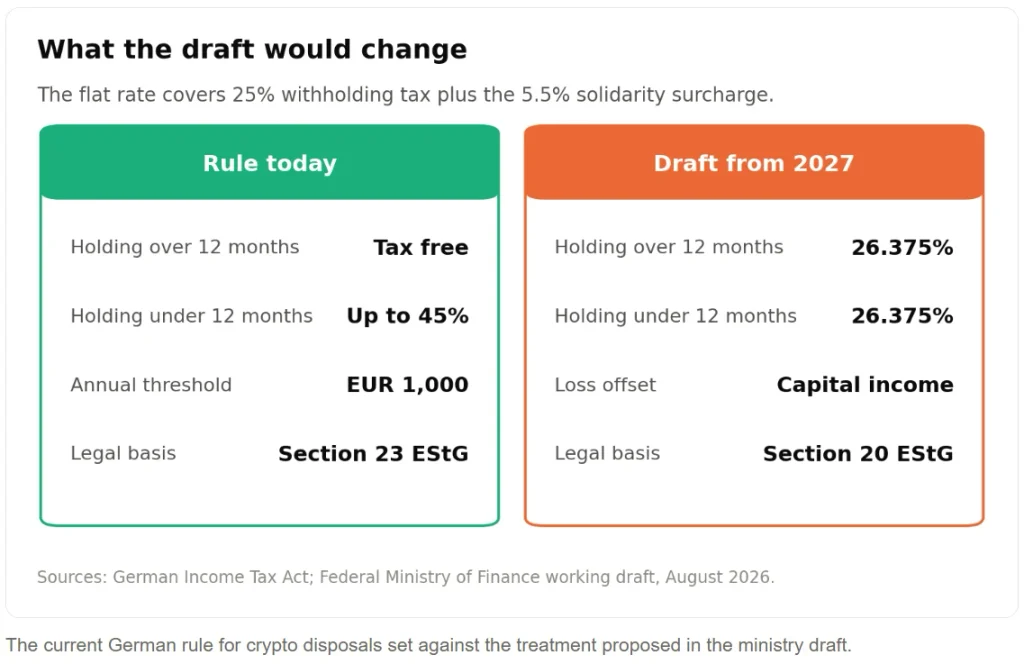
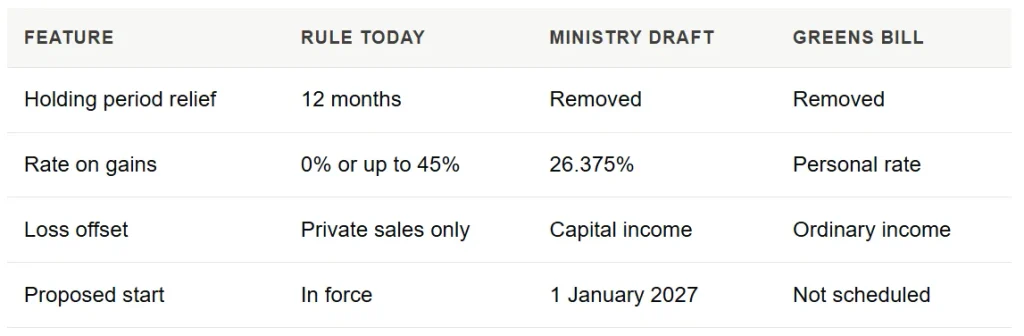
Today, crypto sits under section 23 of the German Income Tax Act. That provision governs private disposal transactions. Sell within twelve months, and the profit joins your ordinary income. Personal rates climb to 45%. Hold beyond a year, however, and nothing is due.
A yearly threshold of EUR 1,000 also applies. Cross it by one euro and the whole gain becomes taxable. That threshold rose from about EUR 600 in 2024. Ministry guidance issued in March 2025 confirmed the approach and set out record-keeping duties.
Under the plan, digital assets would move into section 20 instead. Gains would face a 25% withholding tax plus the 5.5% solidarity surcharge. Together, those charges equal 26.375%. Church members would pay a little more.
One feature favours investors. Losses could offset other capital income, such as share profits. Under the present private-sale rules, crypto losses only shelter crypto gains.
The 31 December deadline
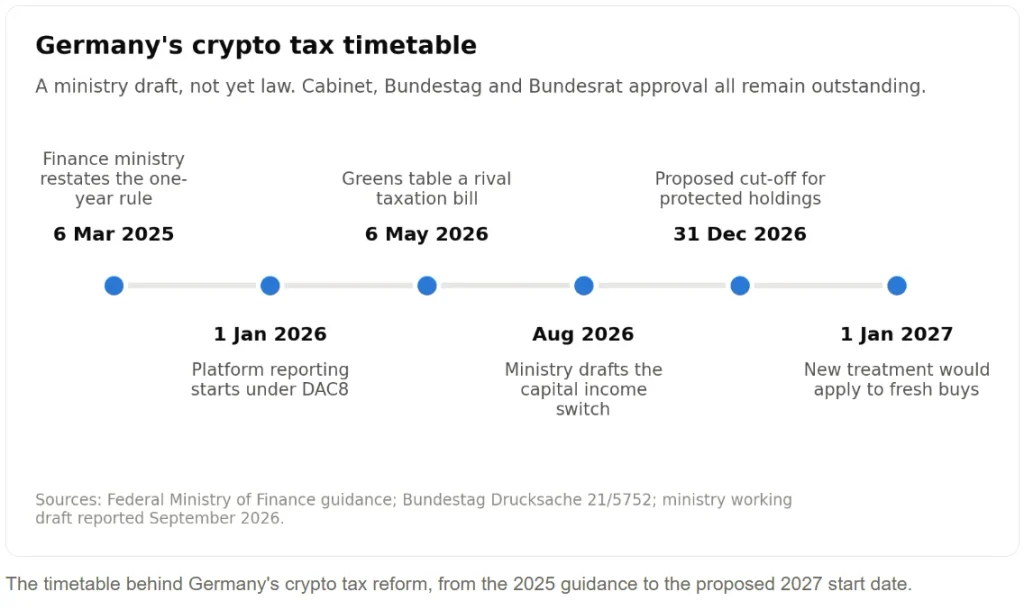
Grandfathering sits at the heart of the plan. Coins acquired on or before 31 December 2026 keep the twelve-month rule. Purchases after that date fall under the new regime. Consequently, German investors face a dated decision, not an abstract one.
Buying before the new year, therefore, preserves a valuable option. Selling after the new year triggers the flat charge on anything bought later. Tax advisers expect heavy year-end activity across German exchanges. Likewise, custody providers anticipate a rush of transfers.
Withholding would begin later. Platforms would deduct the tax at source from January 2028, according to the draft. Until then, investors would declare gains themselves. In practice, that gap gives platforms a full year to build systems.
What it costs in cash
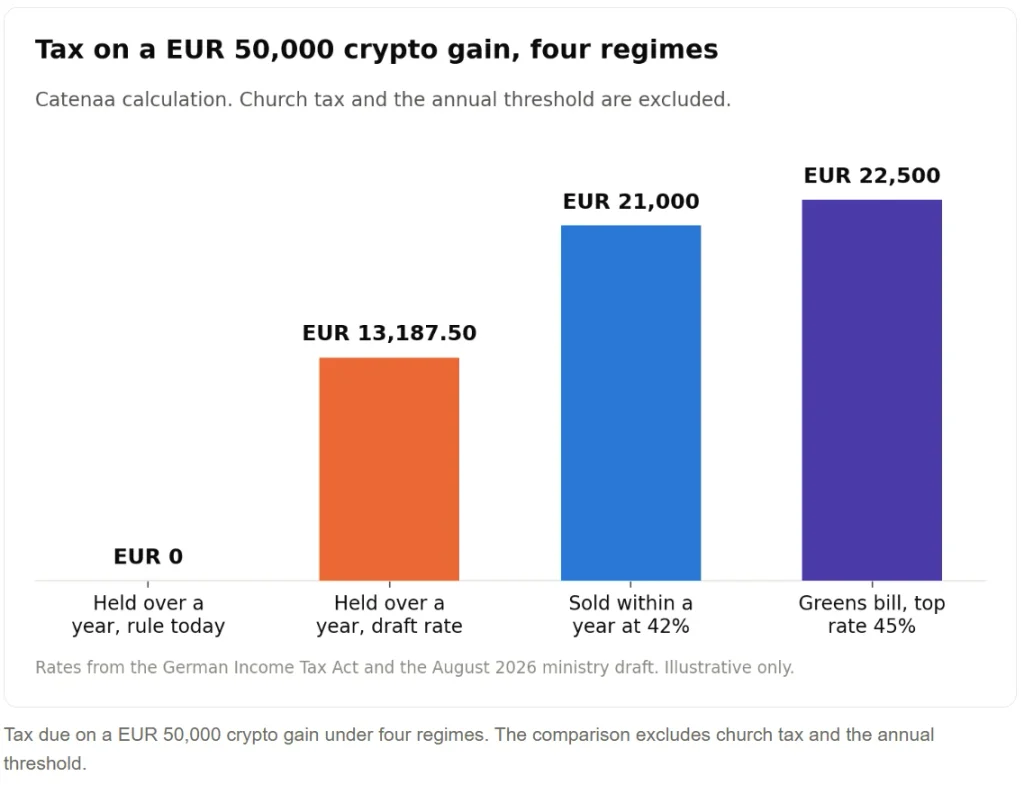
Numbers make the shift concrete. Take a gain of EUR 50,000 on coins held for two years. Under today’s rule, the holder owes nothing. The draft would instead cost that holder EUR 13,187.50.
Compare that with a short-term sale now. A taxpayer in the 42% bracket would owe EUR 21,000 today. Meanwhile, a rival bill from the Greens, tabled on 6 May 2026, would apply personal rates to every sale. At the 45% top rate, that reaches EUR 22,500. Parliament has not scheduled that text for a vote.
The Greens set out their reasoning in Drucksache 21/5752. Their text removes the holding period outright. So the ministry draft is harsher than today’s and milder than the Greens’ version. Long-term holders lose the most. Active traders would actually gain because the flat rate sits below their marginal rate. In short, the draft rewards turnover and punishes patience.
Timing meets a bruised market
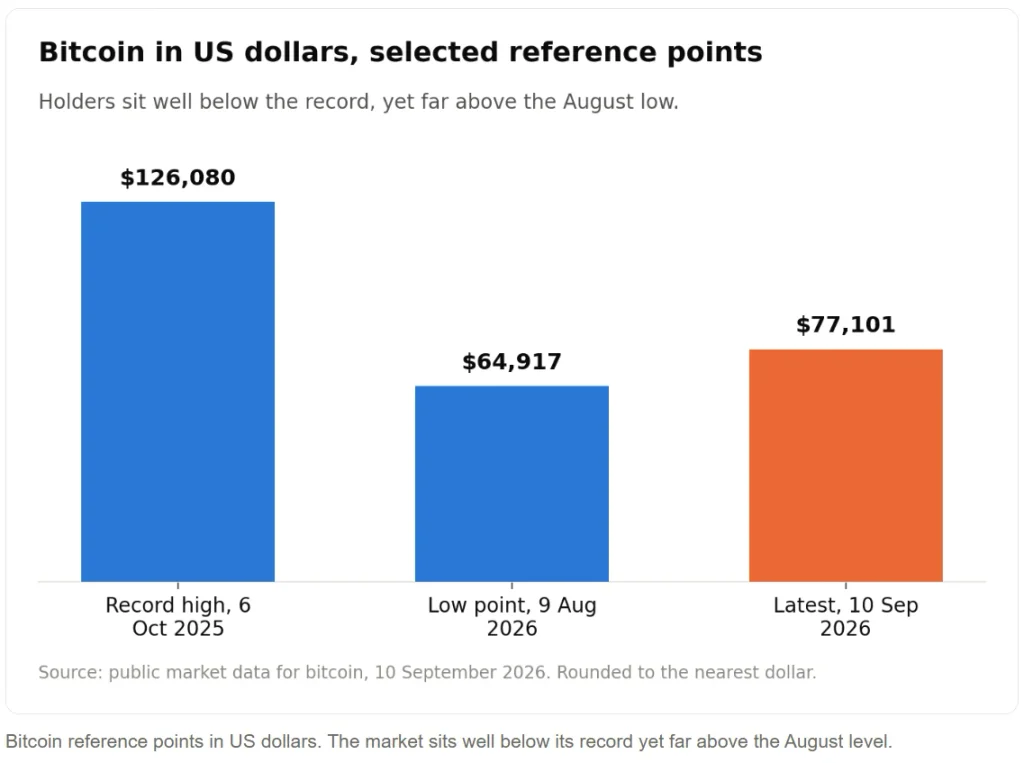
Prices complicate the picture. Bitcoin traded near $77,100 on Thursday, or about EUR 66,400. That level sits roughly 39% below the record of $126,080 set on 6 October 2025. Yet it stands about 22% above the level of one month earlier.
Many German holders therefore sit on paper losses from the 2025 peak. Crystallising those losses before 2027 brings limited benefit, because private-sale losses only offset private-sale gains. After the change, by contrast, losses would shelter other capital income.
The tax office already sees the transactions. Parliament adopted a crypto reporting law in November 2025, implementing the European DAC8 directive. Service providers now report user activity to the authorities. Consequently, the old assumption of privacy has gone.
That transparency changes the arithmetic. Reporting gaps once made enforcement slow and patchy. Today, the exchange files the data instead. Therefore, the reform arrives with enforcement already in place.
How far this can travel
Nothing has settled yet. A working draft carries no legal force at all. Cabinet approval comes first, then readings in the Bundestag and the Bundesrat. Details often shift during that journey.
Industry groups will fight the cut-off date hardest. They argue that retroactive treatment of existing holdings breaches legitimate expectations. Supporters reply that shares have always faced the flat rate. Equal treatment across asset classes gives the ministry a strong argument.
Watch three markers over the coming months. First, whether the cabinet adopts the text this autumn. Second, whether the cut-off moves from 31 December. Third, whether staking and lending income join the same regime. Each change would reshape the calculation for German investors.
Europe is watching too. Austria already taxes crypto at 27.5% as capital income. Should Berlin follow, the bloc’s largest economy would tax crypto exactly like shares. Other capitals would then find the same move easier to justify.