

Catenaa, Friday, August 28, 2026-Franklin Templeton is preparing to place its blockchain-recorded money-market fund inside conventional investment funds after SEC staff cleared a regulatory obstacle to the arrangement.
The asset manager plans to use shares of the Franklin OnChain US Government Money Fund inside traditional mutual funds and exchange-traded funds, Bloomberg reported Thursday.
The development could make tokenized securities part of ordinary fund portfolios without investors having to buy a crypto-linked product or operate a blockchain wallet themselves.
However, the regulatory action is narrower than an SEC approval of tokenized funds.
The Securities and Exchange Commission’s Division of Investment Management issued Franklin Templeton a no-action letter on Aug. 12.
Staff said it would not recommend enforcement action under certain Investment Company Act custody rules if Franklin funds invest in the OnChain fund under the safeguards described in the company’s request.
The SEC explicitly said the letter is an enforcement position only. It does not represent a Commission rule or legal conclusion, and the Commission neither approved nor disapproved the letter.
Bloomberg described the relief as what Franklin says is the first US regulatory clearance allowing digitally native investment products to sit within conventional funds.
The proposed structure allows Franklin’s registered funds to invest cash balances in its OnChain money-market fund.
The funds could also use the tokenized money-market shares for securities-lending collateral, according to Franklin’s SEC request.
That creates a new connection between blockchain-based securities and investment products that most investors would consider traditional.
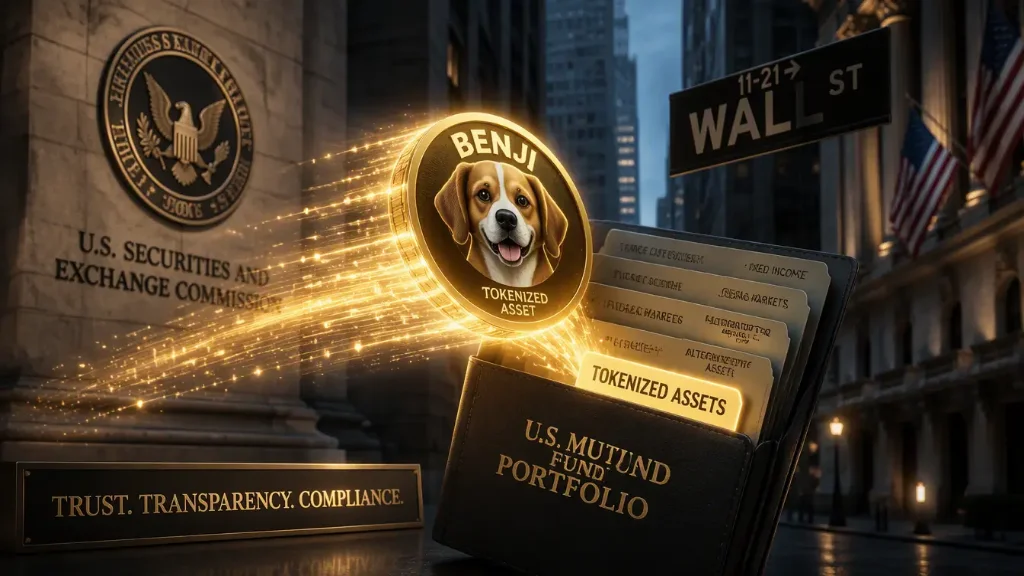
A mutual fund or ETF investor would not necessarily receive a BENJI token in a personal wallet.
Instead, the conventional fund itself could own shares of Franklin’s tokenized money-market fund as part of its portfolio.
The distinction matters.
It means blockchain technology can move into mainstream fund infrastructure without requiring the end investor to change how shares are bought, held or sold.
The asset at the center of the arrangement is the Franklin OnChain US Government Money Fund, ticker FOBXX.
Franklin launched the fund in April 2021.
It became the first US-registered mutual fund to use a public blockchain as its official system for processing transactions and recording share ownership, according to Franklin Templeton.
Its shares are represented through Franklin’s BENJI system.
The fund invests at least 99.5% of its assets in US government securities, cash and repurchase agreements fully collateralized by government securities or cash.
It had about $753 million in net assets as of June 30, according to Franklin’s fund data.
Franklin said its wider BENJI tokenized-fund suite had reached about $1.98 billion in assets by April 29.
The OnChain fund currently uses Stellar as its primary public blockchain, although Franklin can support other eligible networks for some accounts.
The SEC relief addresses a problem created by rules written for securities that could be physically held.
Rule 17f-2 includes requirements associated with assets held in physical custody, including securities placed in a vault.
Those provisions do not map neatly onto fund shares recorded through blockchain infrastructure.
Franklin’s transfer agent, Franklin Templeton Investor Services, maintains the official ownership record for the OnChain fund through an integrated system.
Private shareholder data remains in an internal book-entry system, while blockchain records contain transaction and other anonymous shareholder information.
The transfer agent links the records in real time to form the official shareholder file.
The SEC staff agreed not to recommend enforcement over several physical-custody requirements if Franklin follows a series of controls.
Those include separate blockchain wallets for investing funds, board oversight, transaction confirmations, daily reconciliation and independent accountant checks.
Franklin must also maintain administrative controls capable of correcting unauthorized transactions, freezing or migrating wallet records and restoring ownership records when necessary.
Franklin told the SEC that conventional funds want the flexibility to use the OnChain fund for cash management because it offers operational features unavailable through their current cash-management vehicle.
Those features include hourly net asset value calculations, intraday trading, faster processing and the possibility of lower operating costs.
Franklin also cited stronger data security.
Those functions help explain why tokenization is moving beyond crypto-focused investment products.
A blockchain-recorded money-market fund can still own conventional Treasury and government-backed assets.
What changes is the infrastructure used to record and move the fund shares.
Franklin has already tested another use for BENJI.
In February, it expanded a program allowing eligible institutional Binance clients to use tokenized money-market fund shares as off-exchange collateral while the assets remain in regulated custody.
The latest SEC relief moves that model closer to Franklin’s own conventional fund business.
The investor effect may be the most far-reaching part of the development.
Until now, tokenized funds have largely been marketed as distinct blockchain products aimed at digital-asset users or institutions deliberately seeking onchain exposure.
Franklin’s proposed structure takes another route.
The blockchain asset becomes an underlying portfolio component rather than the product investors intentionally seek out.
A conventional ETF could therefore use a tokenized money-market fund for cash management while the ETF itself continues trading normally through a brokerage account.
The investor may see no practical difference in how the ETF is purchased.
Blockchain would operate beneath the investment product rather than being the reason for buying it.
That represents a different phase in tokenization.
Instead of persuading mainstream investors to migrate into blockchain products, asset managers can begin inserting blockchain-recorded securities into familiar investment structures where the technology performs an operational function.
Franklin has spent years developing that approach.
The firm told the SEC Crypto Task Force in 2025 that regulators should allow tokenized assets to be used for the same purposes as equivalent non-tokenized assets.
The Aug. 12 no-action letter moves Franklin closer to that objective.
It does not amount to broad SEC authorization for every asset manager or every tokenized security.
But under the conditions laid out by staff, Franklin can begin connecting its blockchain fund directly to conventional registered investment funds.
For mainstream investors, tokenization could therefore arrive not as a new asset class they consciously select, but as infrastructure operating quietly inside funds they already own.