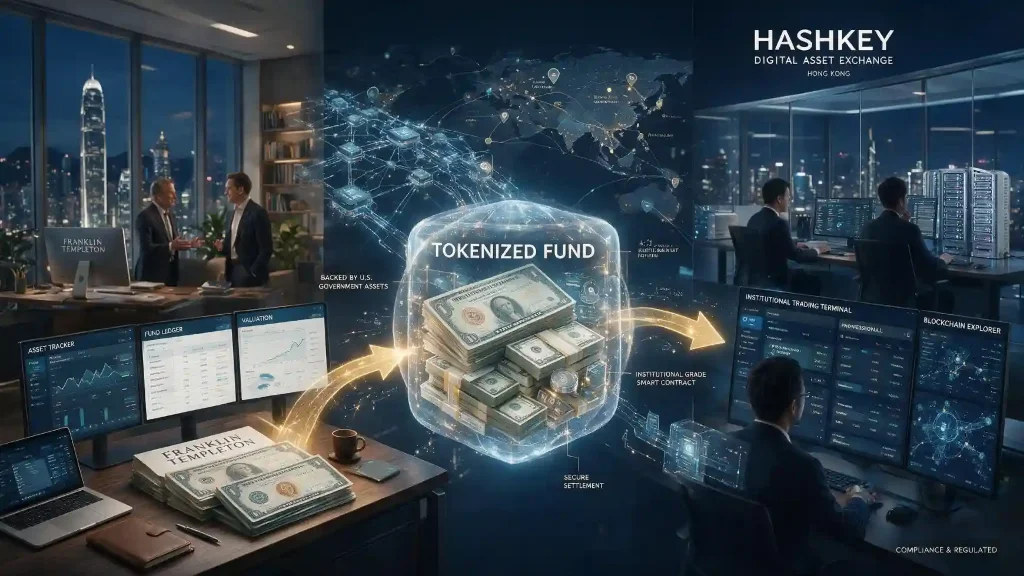


Catenaa, Thursday, August 27, 2026- Franklin Templeton has partnered with Hong Kong-based HashKey Exchange to distribute a tokenized US government money market fund in Asia, expanding the asset manager’s blockchain-based investment products in the region.
HashKey said Monday that the Franklin OnChain US Government Liquidity Fund had been added to its Earn platform.
The fund primarily invests in US government money market instruments and US dollar cash assets while using blockchain infrastructure for record-keeping and distribution.
Access is limited to professional investors and is not available to the general public in Hong Kong.
The arrangement gives Franklin Templeton another distribution channel for tokenized traditional financial assets as institutional interest in real-world asset tokenization increases.
Franklin Templeton has been building its digital asset business across Asia through regulated financial centers.
The company launched the Franklin OnChain US Government Money Fund in Hong Kong in November 2025.
That product was introduced as part of initiatives connected to the Hong Kong Monetary Authority’s Fintech 2030 program.
The new HashKey partnership expands distribution rather than simply creating another standalone blockchain product.
HashKey operates digital asset businesses across several jurisdictions, including Hong Kong, Singapore, Tokyo, Dubai and Bermuda.
Franklin Templeton said the companies could eventually extend their collaboration beyond tokenized money market funds into other tokenized investment products.
That could give the asset manager access to a wider network of professional investors as regulated digital asset markets develop across Asia.
Tokenized money market funds have become one of the fastest-growing segments of real-world asset markets.
They generally combine conventional short-term investments, such as US Treasury securities and cash instruments, with blockchain-based ownership records.
Investors receive exposure to traditional financial assets while gaining some of the operational advantages associated with tokenized securities.
Those can include faster transfers, programmable settlement and easier integration with digital asset platforms.
The underlying investment remains conventional.
In Franklin Templeton’s case, the fund is primarily backed by US government money market instruments rather than cryptocurrencies.
That distinction has helped tokenized Treasury products attract institutions seeking blockchain-based infrastructure without assuming direct cryptocurrency price exposure.
HashKey provides the regulated digital asset distribution layer in the partnership.
Professional investors using its platform can access the Franklin Templeton fund through an environment already designed for digital assets.
That could lower the operational barrier between conventional investment funds and blockchain-based markets.
Institutional investors have historically had to manage crypto assets and traditional securities through separate infrastructure.
Tokenized funds offer a way to connect those systems.
A professional investor may eventually be able to hold tokenized government securities alongside digital assets within the same broader financial platform.
That model is becoming increasingly important as banks, asset managers and exchanges experiment with using tokenized securities as collateral or settlement assets.
The broader real-world asset market has expanded rapidly.
Tokenized real-world assets reached about $38.2 billion as of Aug. 23, according to RWA.xyz data cited by The Block.
That was up from approximately $20.6 billion a year earlier.
Tokenized US Treasury debt accounted for about $15.6 billion of the total.
The figures show why established asset managers are moving more aggressively into blockchain-based distribution.
Treasury products have become particularly attractive because they combine a familiar, regulated underlying asset with the ability to operate through digital infrastructure.
They also give crypto-native investors access to yield generated by conventional government securities.
Franklin Templeton has been among the traditional asset managers most active in blockchain-based funds.
Its strategy increasingly treats tokenization as financial infrastructure rather than a separate cryptocurrency product.
That approach could become more important as institutions begin using tokenized assets for collateral, treasury management and settlement.
Money market funds are a logical starting point.
They are relatively liquid, invest in short-duration assets and are already widely used by institutions to manage cash.
Placing ownership records on blockchain infrastructure can make those assets easier to move between digital financial systems.
The HashKey arrangement gives Franklin Templeton a route to test that model with professional investors in one of Asia’s more developed regulated digital asset markets.
Hong Kong has sought to establish itself as a regional center for regulated digital assets and tokenization.
Authorities have introduced licensing frameworks for digital asset platforms while supporting experiments involving tokenized deposits, funds and securities.
That regulatory environment has attracted banks, asset managers and blockchain companies seeking a controlled route into digital finance.
Franklin Templeton’s expansion fits that strategy.
The fund is not being offered as an unrestricted retail crypto product.
Limiting access to professional investors allows the companies to expand institutional use while operating within Hong Kong’s regulatory framework.
The partnership may eventually extend beyond money market products.
Franklin Templeton said it expects to explore additional tokenized assets through HashKey’s international platform.
That could include other investment funds or financial instruments adapted for blockchain-based ownership and settlement.
The broader industry is already experimenting with tokenized bonds, private credit, equities and fund interests.
For traditional asset managers, the attraction lies partly in distribution.
A tokenized investment product can potentially reach investors through digital asset platforms rather than relying solely on conventional fund channels.
For crypto platforms, regulated funds provide assets backed by established financial instruments rather than purely digital tokens.
The partnership highlights the increasing overlap between traditional finance and blockchain markets.
Crypto exchanges once concentrated almost entirely on bitcoin, ether and other native digital assets.
Platforms are now adding tokenized versions of conventional financial products.
At the same time, global asset managers are using blockchain networks to distribute products that would previously have existed only within conventional securities infrastructure.
Franklin Templeton and HashKey sit on opposite sides of that convergence.
One brings established asset management and US government securities exposure.
The other brings regulated digital asset distribution and blockchain-native investors.
Their partnership shows how tokenization is moving from experimentation toward commercial distribution.
The immediate product remains limited to professional investors.
But as the real-world asset market approaches $40 billion, competition is increasingly shifting toward which institutions can connect traditional assets to blockchain markets at scale.