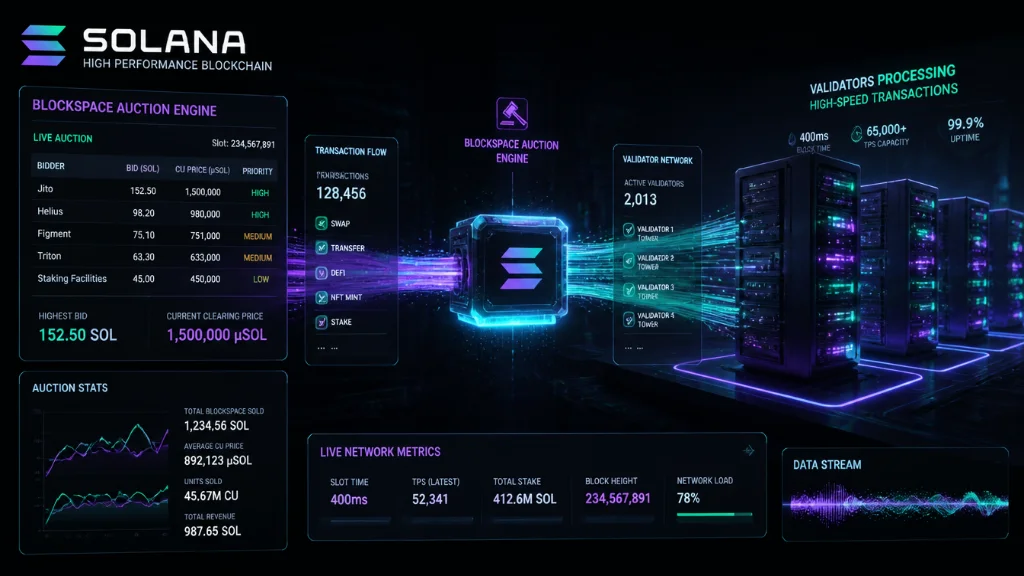


Catenaa, Tuesday, September 01, 2026-Blockchain infrastructure company Flowra has launched an open order-flow auction for Solana that allows searchers to compete for transaction inclusion while giving validators greater control over how blocks are assembled.
The Seoul-based company said Monday that its Open Orderflow Auction, or OOA, is available to Solana validators and searchers.
Flowra said the system is designed to replace some closed order-flow arrangements with transparent bidding for blockspace.
The company is also introducing programmable block policies that allow individual validators to set transaction-inclusion rules without requiring changes to the underlying Solana protocol.
The system targets Solana’s market for maximum extractable value, commonly known as MEV.
MEV refers to additional value that can be captured by controlling how transactions are selected, ordered or included in a blockchain block.
Searchers identify profitable transaction combinations and compete to have them included.
Flowra’s model allows registered searchers to submit bids openly rather than relying solely on private relationships or closed transaction channels.
Validators can then select block-building opportunities through the auction.
Flowra argues that greater competition could improve pricing for valuable order flow and allow validators to retain a larger portion of the resulting revenue.
The approach draws partly from changes already seen on Ethereum.
Ethereum developed a competitive block-building ecosystem in which specialist builders compete to construct blocks and offer them to validators.
That separation created a market around transaction ordering and MEV.
Flowra is adapting elements of that concept to Solana, whose architecture differs substantially from Ethereum.
Solana processes transactions at higher throughput and with much shorter block intervals.
Those characteristics place greater demands on block-building systems because transaction selection and bidding must occur with very little latency.
Flowra said Solana’s speed makes it suitable for a competitive blockspace market if the supporting infrastructure can operate quickly enough.
Flowra reported improved block utilization during early testing involving one validator.
The company said a Flowra-enabled configuration increased compute units per block by 20.6%.
The validator moved from 84% of the Solana network average for compute utilization to 101%, according to Flowra.
The company also reported higher block fees than comparable validator software, 100% block production and 99.999% block-engine uptime during the test.
Those results were based on a single validator and were supplied by Flowra.
They do not yet establish how the system will perform across a broad group of validators or during periods of heavy network congestion.
A wider rollout will provide a stronger test of whether open bidding consistently improves validator economics.
Flowra’s second major feature gives validators more control over block construction.
Its Programmable Block Policy allows validators to define rules governing which transactions they are willing to include.
Those rules can address operational preferences or compliance requirements.
For example, an institutional validator operating under sanctions restrictions could configure screening at the block-building level.
Flowra recently announced work with compliance infrastructure provider Honeypot to introduce sanctions and risk screening through the system.
The rules apply through Flowra’s block-building infrastructure rather than through a protocol-wide change to Solana.
That distinction means individual validators can choose policies without imposing the same restrictions on every validator in the network.
The feature may attract attention because transaction filtering remains a sensitive issue in public blockchain networks.
Institutional operators can face legal obligations that require sanctions screening or other controls.
Permissionless blockchain supporters, meanwhile, often oppose infrastructure that could restrict valid transactions based on external rules.
Flowra’s model places that decision with individual validators.
One validator could apply a compliance policy while another could operate under different rules.
That resembles a broader trend in blockchain infrastructure, where developers are trying to accommodate regulated institutions without changing the base protocol for all users.
Arbitrum recently introduced a separate optional filtering capability for customized Orbit chains, although the technical architecture and use case differ from Flowra’s validator-level system.
Validator economics are central to the project.
Validators earn compensation for helping process transactions and maintain a blockchain network.
MEV can create an additional source of revenue, but how that value is divided among users, searchers, builders and validators depends heavily on market structure.
Closed order-flow arrangements can concentrate access among a smaller number of participants.
An open auction could allow more searchers to compete for the same blockspace.
In theory, stronger bidding competition should increase the amount searchers are willing to pay validators for valuable transaction placement.
Whether that occurs consistently will depend on participation.
An auction with few searchers may not produce meaningfully better price discovery than existing arrangements.
Flowra said it is onboarding institutional-grade validators before a broader expansion.
That suggests the company is initially focusing on operators that may place greater value on revenue optimization, auditability and transaction-policy controls.
For institutional validators, the ability to document why particular transactions were accepted or rejected may also become important.
Flowra said its architecture is designed to make block-building decisions verifiable and auditable.
Those characteristics could become more valuable if regulated financial institutions begin operating larger amounts of blockchain infrastructure.
The launch arrives as Solana developers continue working to increase network performance.
The ecosystem is preparing for shorter slot times, with a staged roadmap intended eventually to reduce slots from about 400 milliseconds to 200 milliseconds.
Faster block production could increase the pressure on systems competing to assemble transactions efficiently.
At the same time, Solana’s trading ecosystem has grown rapidly across decentralized exchanges, token markets and other high-frequency applications.
That creates more opportunities for MEV.
It also increases the importance of determining how that value is distributed.
A transparent market for order flow could potentially reduce concentration if enough independent searchers and validators participate.
Flowra’s Open Orderflow Auction is now available, but its broader impact will depend on adoption.
The company must attract both validators willing to use its block-building system and searchers willing to compete through the auction.
Liquidity matters in order-flow markets just as it does in token markets.
More bidders can improve competition.
More participating validators can give searchers a reason to submit better bids.
If that network effect develops, Flowra could introduce a more competitive layer into Solana block construction.
If participation remains limited, existing order-flow channels may retain their advantage.
The project nevertheless highlights how competition within blockchain networks is moving deeper into infrastructure.
The issue is no longer only how quickly Solana can process transactions.
It is also who gets to build its blocks, how transaction order is priced and how much of the resulting value returns to validators.