


September 17, 2026 – Circle and Coinbase lost more than 10% after the Senate vote, far more than Bitcoin. Their filings show why rules and rates hit these firms harder.

In Summary
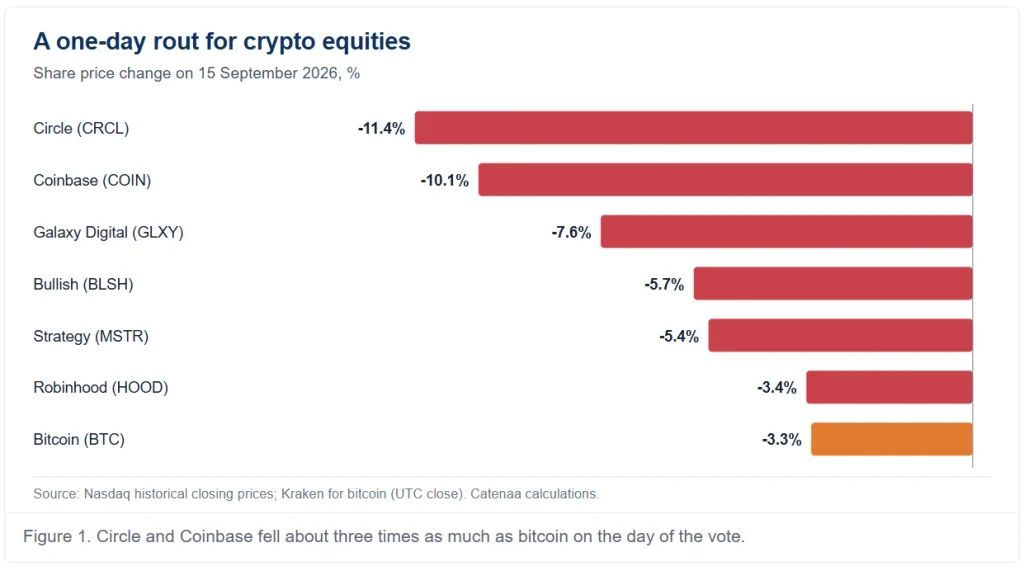
Circle fell 11.4%, and Coinbase fell 10.1% after the Senate vote on 15 September.
Bitcoin dropped only 3.3%, so listed firms took the bigger regulatory hit.
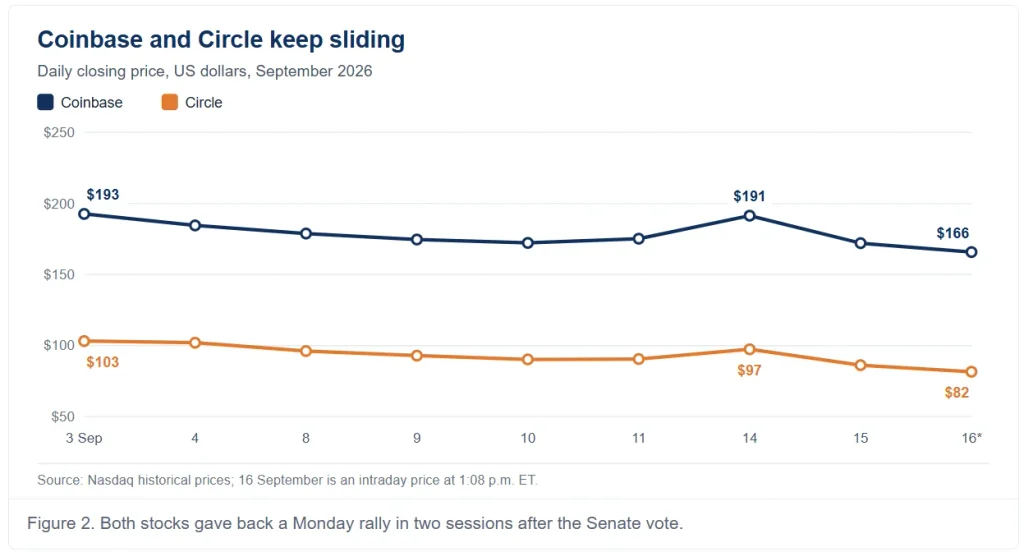
Both stocks fell further on 16 September, extending two-day losses past 13%.
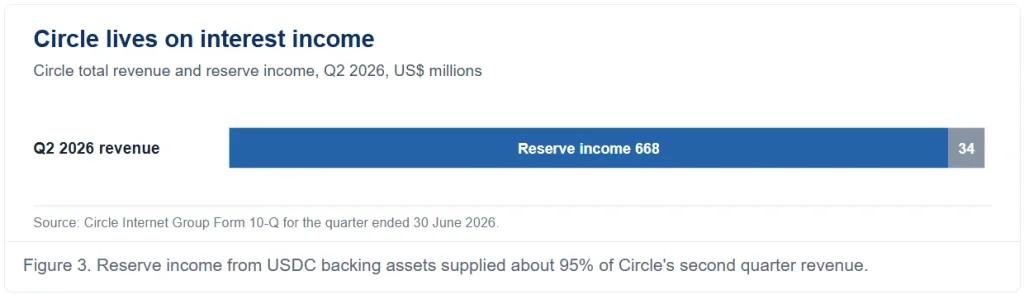
Reserve income made up 95% of Circle’s second-quarter revenue.
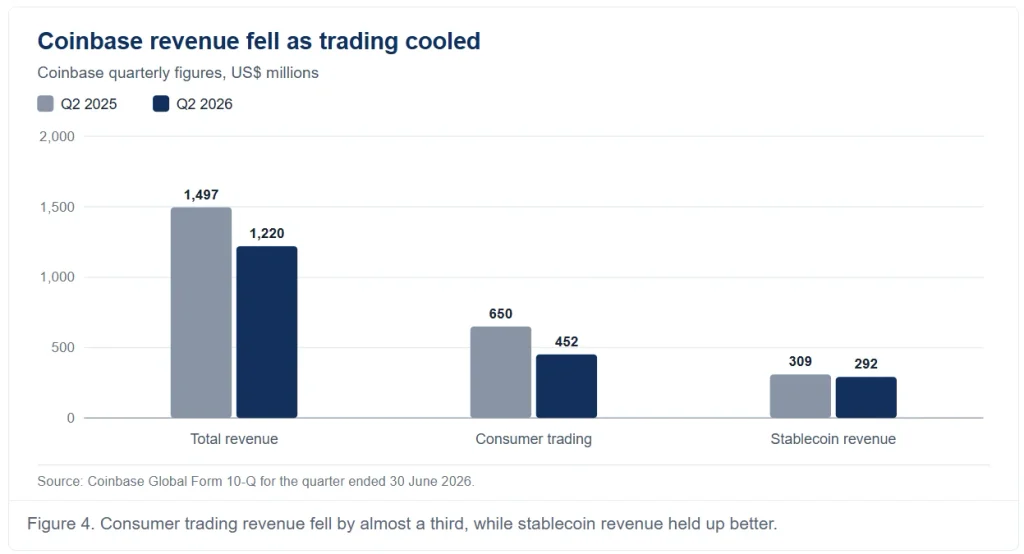
Coinbase revenue fell 19% in the second quarter as consumer trading slowed.
Crypto stocks sold off hard after the US Senate blocked the CLARITY Act on Tuesday. Circle and Coinbase each lost more than 10% in a single session. By contrast, bitcoin fell only 3.3%.
The gap tells investors something important. Listed crypto firms carry more regulatory risk than the tokens they trade. Moreover, the selling continued into Wednesday as the Federal Reserve prepared its rate decision.
How far crypto stocks fell
The Senate roll call shows the motion to open debate failed 49 to 50. It needed 60 votes. Shares reacted within hours. Circle closed down 11.4% at $86.30, based on Nasdaq price data.
Coinbase dropped 10.1% to $172.11, according to its historical prices. Galaxy Digital fell 7.6%, and Bullish lost 5.7%. Meanwhile, Strategy slid 5.4%, and Robinhood eased 3.4%.
The losses deepened on Wednesday. By 1:08 p.m. Eastern time, Coinbase traded near $165.88, down another 3.6%. Circle fell a further 5.4% to $81.62. Over two sessions, the stocks have lost 13.4% and 16.2%, respectively.
The longer picture looks even rougher. Coinbase now trades about 59% below its 52-week high of $402.16. Similarly, Circle sits almost 49% below its high of $159.47.
Robinhood also lost ground again, falling 4.6% on Wednesday for a two-day decline of 7.8%. Strategy, which holds bitcoin on its balance sheet, now trades about 66% below its 52-week high of $365.21.
Why equities fell harder than tokens
Bitcoin trades on global demand, so a US bill matters only at the margin. Listed firms, however, depend directly on US rules. They need clear paths for token listings, custody, and new products.
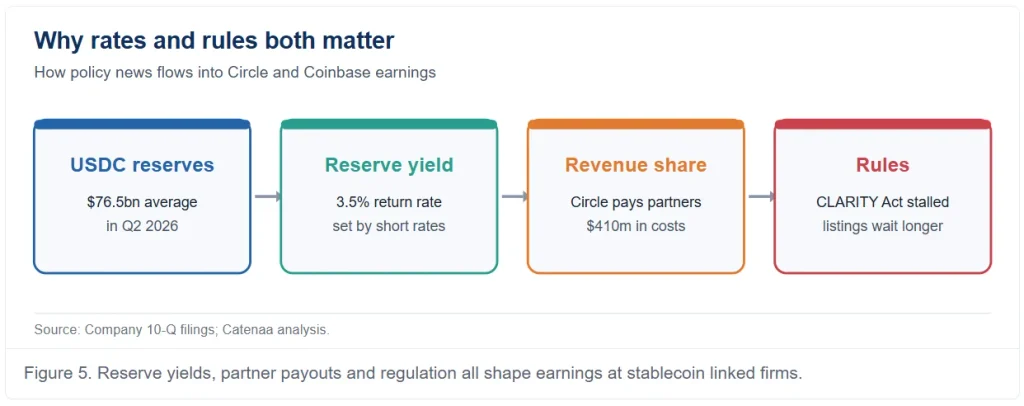
The CLARITY Act promised that clarity. It would have split oversight between the SEC and the CFTC. Therefore, its failure pushes back the timeline for firms that planned new US launches.
Business models also differ across the sector. Coinbase earns fees when customers trade, while Circle earns yield on reserves. Yet both need regulatory approval before new US products can grow.
Circle’s business runs on interest rates
Circle’s latest quarterly filing shows how much it depends on short-term rates. Reserve income reached $667.7 million in the second quarter. That made up 95% of total revenue, with reserve income of $701.3 million.
The company earned a reserve return rate of 3.5%, down from 4.1% a year earlier. At the same time, average USDC in circulation grew to $76.5 billion from $61.0 billion. So higher volume offset lower yields.
USDC supply kept growing too. Circulation reached $73.3 billion at the end of June, up 19% from $61.3 billion a year earlier. In addition, USDC held on Circle’s own platform rose to $12.4 billion from $6.0 billion.
Distribution and transaction costs reached $410.4 million, about 59% of revenue. Much of that goes to partners that help distribute USDC. Even so, Circle reported net income of $48.2 million, compared with a $482.1 million loss a year earlier.
Coinbase faces a trading slowdown
Coinbase shows a different weakness. Its second quarter report shows total revenue of $1.22 billion, down 19% from a year earlier. Consumer trading revenue fell 31% to $451.7 million.
Stablecoin revenue provided some cushion at $292.1 million. That figure equals about 24% of total revenue. However, the company still posted a net loss of $359.5 million for the quarter.
Staking income also shrank. Blockchain rewards revenue dropped to $83.3 million from $144.5 million a year earlier. Meanwhile, institutional trading revenue rose to $100.1 million from $60.8 million, a rare bright spot.
The Fed decision cuts both ways
A Fed rate hike could help Circle’s income. On average, USDC of $76.5 billion, each extra quarter point adds roughly $191 million a year in gross reserve income. That estimate is a Catenaa calculation before partner payments.
On the other hand, higher rates tend to cool demand for risky assets. That could weigh on trading volumes at Coinbase and Robinhood. As a result, rate news may split the sector rather than lift it.
What investors should watch
First, watch for a new Senate deal or a second cloture vote. Second, track regulators, since the SEC and CFTC can still issue rules on their own. Finally, keep an eye on USDC supply, which drives Circle’s revenue base. The next quarterly filings will also show whether trading volumes recovered in the third quarter.