


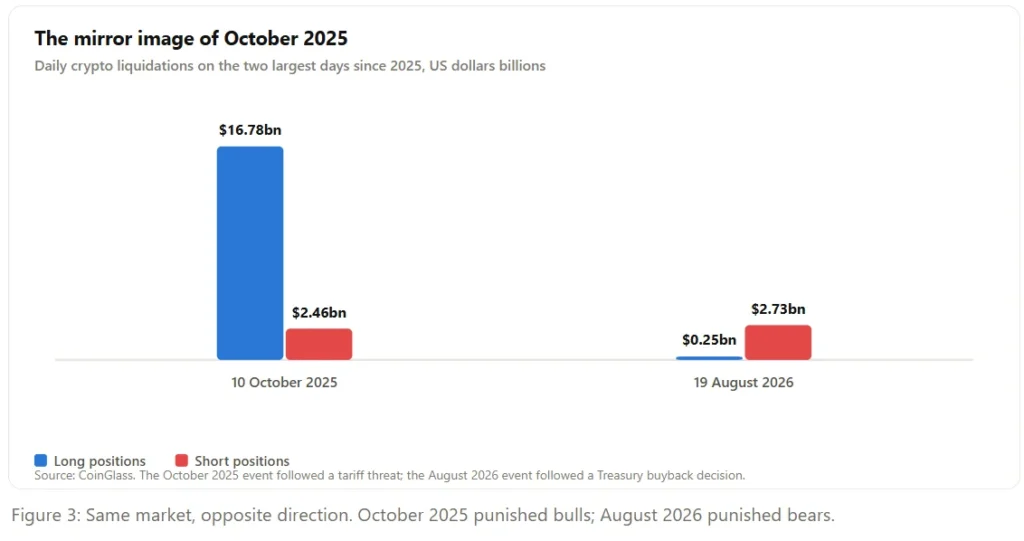
August 22, 2026 – Bearish traders absorbed about 92% of all liquidation value. The session mirrored October 2025, when leveraged buyers were the ones wiped out.
In Summary
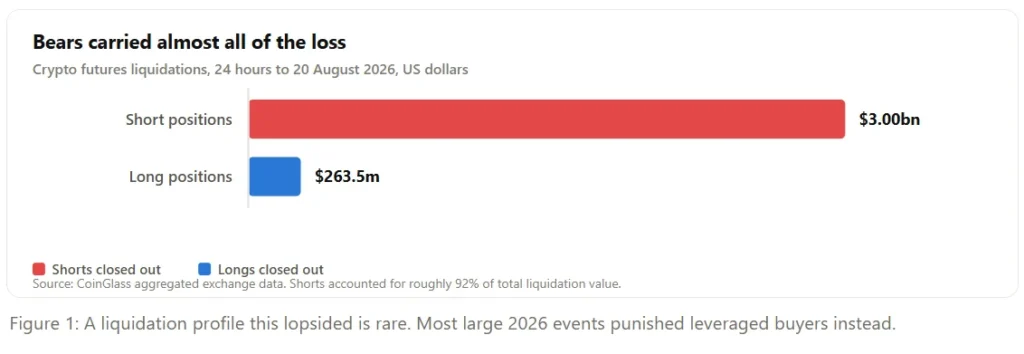
About $3 billion of short positions were liquidated in 24 hours, against $263.5 million of longs.
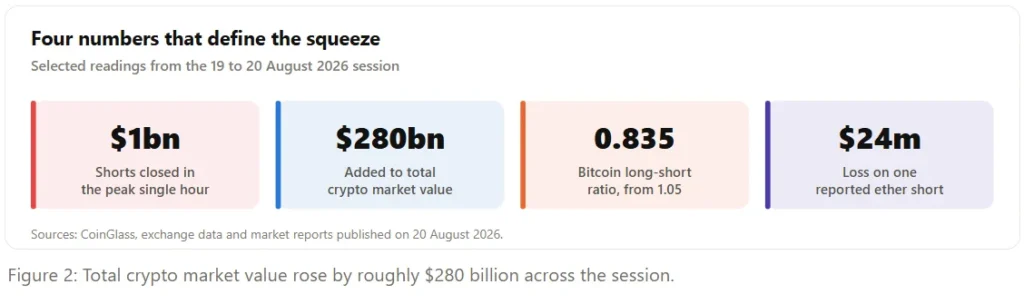
More than $1 billion of shorts closed in a single hour at the peak of the move.
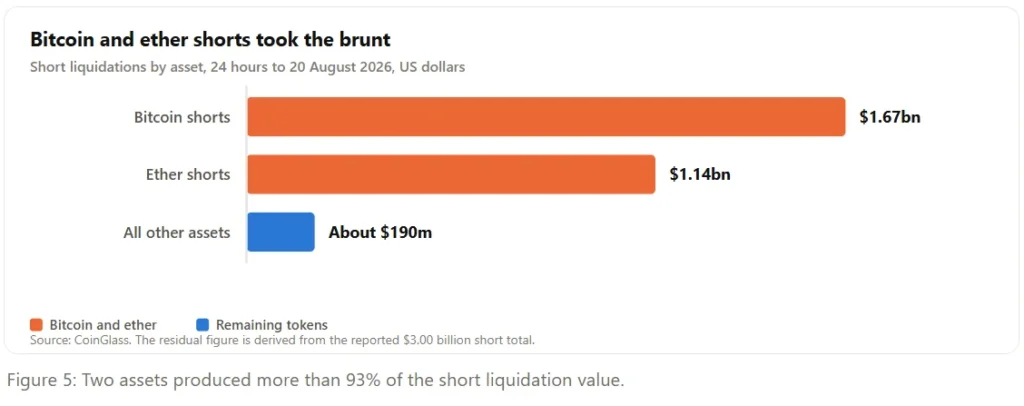
Bitcoin shorts lost $1.67 billion and ether shorts lost $1.14 billion.
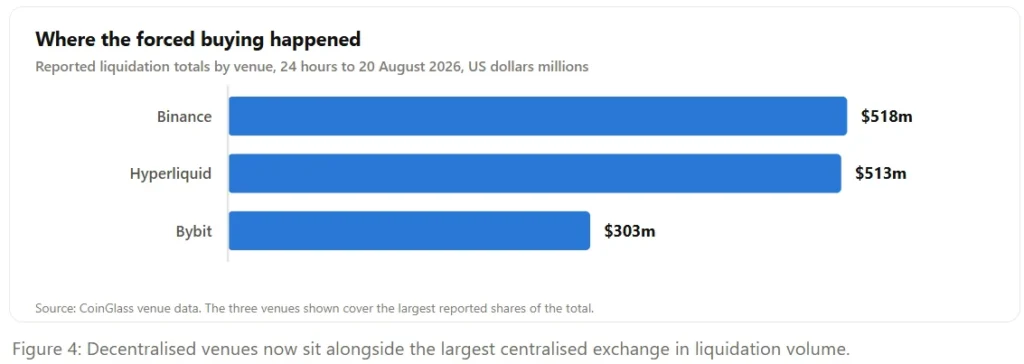
Binance, Hyperliquid and Bybit reported the largest venue totals, led by $518 million on Binance.
The 19 August total was the biggest daily liquidation figure since the October 2025 crash.
Crypto short liquidations hit a one-day record
Crypto short liquidations reached a scale rarely seen. Traders betting against the market suffered a brutal day on Wednesday. Roughly $3 billion of short positions were closed out in 24 hours. Long liquidations totalled only $263.5 million.
Indeed, the imbalance is stark. Shorts absorbed about 92% of the damage. In one hour alone, more than $1 billion of bearish bets were force-closed.
Naturally, bitcoin drove the move. The token climbed past $71,000, while ether jumped roughly 19% toward $2,300.
How a squeeze actually works
In simple terms, short sellers borrow exposure and profit when prices fall. Exchanges require collateral against that position. When price rises sharply, that collateral erodes.
Once margin runs out, the exchange closes the trade automatically, without warning. Closing a short means buying. Therefore, forced covering adds demand exactly when the market is already rising.
Each wave of buying pushes price higher, which triggers the next wave. That feedback loop explains why the biggest hour saw over $1 billion of closures.
Furthermore, crowding makes the loop worse. Bearish bets had built up during six weeks of flat prices. Many sat at similar levels, so they failed together.
The trigger came from the bond market
Positioning explains the size, yet not the spark. On 19 August the Treasury said it would at least double long-end buyback operations to $4 billion each. Long-dated yields fell in response.
Crypto has traded alongside long-duration assets all year. Consequently, a signal of official support for the bond market lifted digital assets too. Many traders were positioned for the opposite outcome.
The reverse of October 2025
For context, the comparison with last autumn is instructive. On 10 October 2025, liquidations reached $19.24 billion in a single day. Longs accounted for $16.78 billion of that figure.
By contrast, the 19 August 2026 session ran the other way. Shorts lost $2.73 billion, while longs lost just $248.1 million. It was the largest daily total since that October crash.
Which venues and assets took the hit
Meanwhile, losses spread across the major perpetual futures venues. Binance reported about $518 million, closely followed by Hyperliquid at $513 million. Bybit accounted for roughly $303 million.
Bitcoin shorts made up $1.67 billion of the total. Ether shorts added $1.14 billion. One reported trader lost $24 million on a single ether position within seconds.
What the aftermath looks like
Typically, squeezes clear crowded positioning quickly. The bitcoin long-short ratio fell to 0.835 from about 1.05 on Tuesday. Fewer bears remain to fuel a further chase.
In addition, spot demand appeared. US spot bitcoin funds took in about $517 million, while ether funds added $189 million. Real buying therefore supported part of the move.
Nevertheless, caution is warranted. Prices lifted by forced covering often retrace once the flow stops.
Liquidity is the other worry. Order books thin out during violent moves, so the next seller can push price a long way. Traders who chase such rallies rarely get good fills.
What comes after the crypto short liquidations
Above all, funding rates come first. Both bitcoin and ether sat near 0.010%, which is close to neutral. A sharp climb would signal fresh leverage on the long side.
Open interest is the second marker, and it rebuilt fast. It rose more than 9% market-wide, so new positions replaced the old ones. Such rebuilds can set up the next unwind.
Finally, watch the macro calendar. Treasury buyback operations run until 4 November, and the next guidance follows soon after.
The lesson holds beyond this week. Leverage decides how far a move travels, even when news decides the direction.