

August 28, 2026 – Borrowers can now pledge bitcoin or USDC against a conforming home loan across all 50 states and the United Kingdom.
In Summary
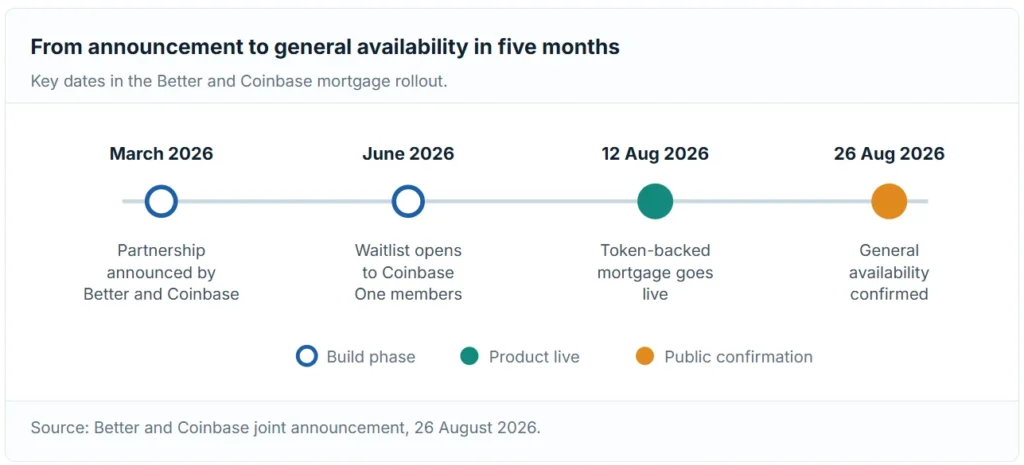
Better and Coinbase made their token-backed mortgage generally available on 12 August 2026.
Borrowers pledge bitcoin or USDC instead of selling it to raise a deposit.
The first lien remains a standard conforming loan under Fannie Mae rules.
Coinbase One members get a 1% lender credit, capped at $10,000.
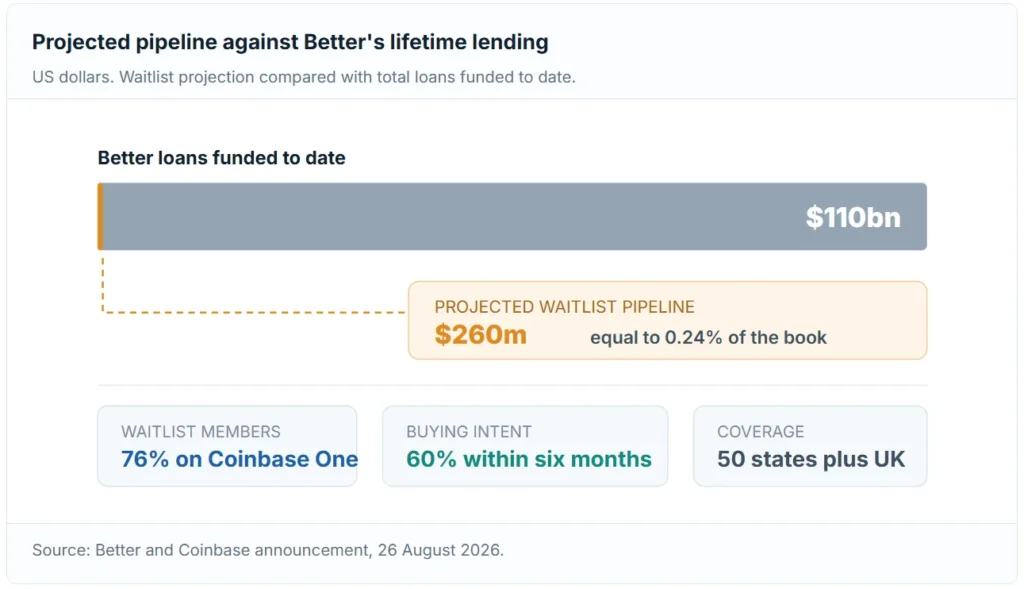
Waitlist demand pointed to more than $260 million of projected loan volume.
Crypto collateral has reached the American mortgage market. Better and Coinbase confirmed general availability of their token-backed mortgage on 26 August 2026. The product went live on 12 August. Coinbase One members can pledge Bitcoin or USDC rather than sell it. The first lien is a plain conforming loan.
How the structure actually works
The design keeps the mortgage itself conventional. Better originates a standard conforming loan under Fannie Mae guidelines. Crypto sits alongside as pledged collateral. Borrowers therefore avoid a taxable sale of their holdings. That single feature drives the whole proposition. Selling crypto to fund a deposit can trigger a tax bill.
Coverage runs wide from day one. The product works in all 50 US states and in the United Kingdom. Moreover, it spans conforming loans, refinances, and home equity lines. FHA, VA, and jumbo options also sit inside the same rebate scheme. Better handles origination, while Coinbase supplies the member base.
The member credit and where it stops
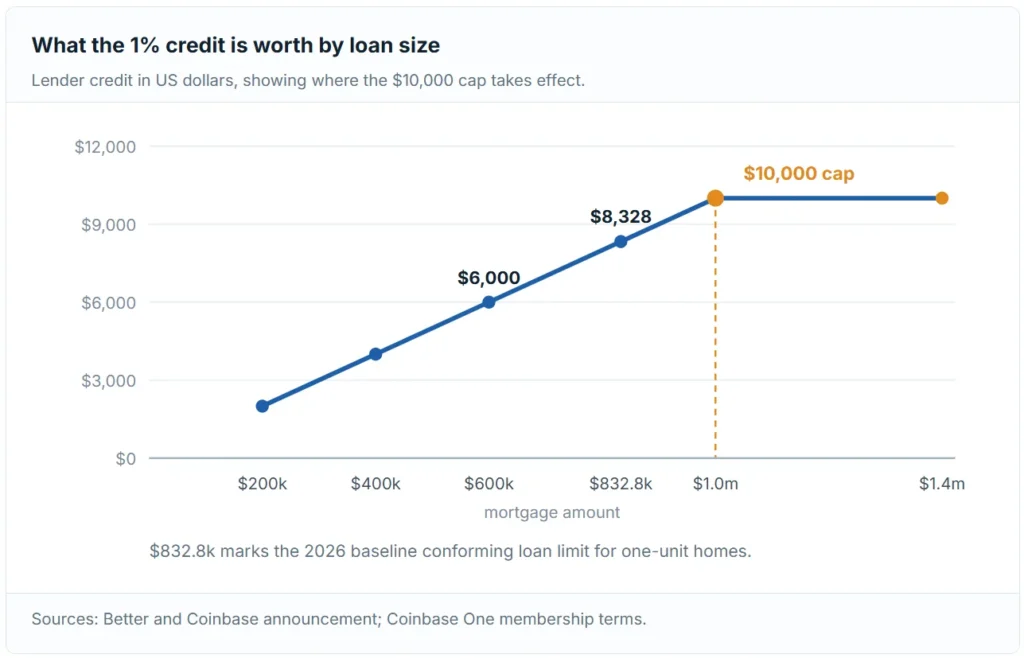
Coinbase One members receive a lender credit worth 1% of the mortgage. That credit is capped at $10,000. It lands against closing costs and appears on the closing disclosure. So the cap binds on any loan above $1 million. Below that level, the benefit scales directly with loan size.
Membership itself is not free, however. Coinbase One starts at $4.99 a month and runs to $299.99 for the top tier. Even the cheapest tier costs under $60 a year. Against a $6,000 credit, that maths looks easy.
Why borrowers want this
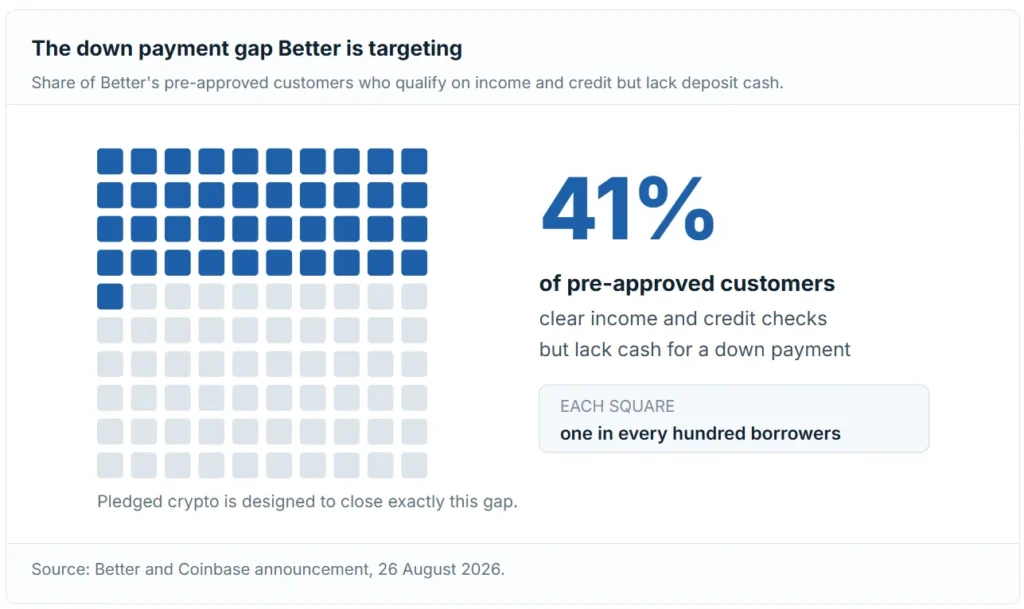
Down payments remain the real barrier. Better says 41% of its pre-approved customers clear income and credit tests. Those same borrowers still lack the cash for a deposit. Crypto holdings often sit idle in that gap. Pledging them, therefore, converts paper wealth into buying power. In short, the asset stays invested while the house gets bought.
Ziggy Jonsson, chief technology officer at Better, put it plainly. The partnership aims at “expanding access to homeownership by meeting borrowers where they are,” he said. Ben Shen of Coinbase framed it as extending existing member trust.

Demand signals look real but small
The waitlist gave the clearest read. Some 76% of respondents already held Coinbase One memberships. Furthermore, 60% said they planned to buy within six months. Projected loan volume topped $260 million. That number sounds large in isolation.
Scale changes the picture, though. Better has funded more than $110 billion of loans to date. The projected pipeline is less than a quarter of one percent of that book. In short, this is a product launch, not yet a business line.
The risk nobody should skip
Pledged collateral moves in price. Bitcoin traded near $78,676 on 27 August 2026. That level sits far below its 2025 peak. A sharp fall could trigger collateral calls mid-loan. USDC avoids that problem, yet it earns no upside either. Borrowers should model a deep drawdown before signing.
Loan limits add a second constraint. The 2026 baseline conforming limit is $832,750 for one-unit homes. High-cost areas stretch to $1,249,125. Buyers above those thresholds need the jumbo route instead.
What to watch next
Three questions decide whether this scales. First, watch the published loan-to-value terms on pledged crypto. Second, track how margin calls work during a drawdown. Third, look for other lenders copying the structure. Above all, watch whether Fannie Mae keeps buying these loans.
The broader shift is already visible. Crypto is moving from a trading balance to a financing input. As a result, the line between exchange and lender keeps thinning. Regulators will notice that before borrowers do. Meanwhile, the tax treatment of pledged tokens is worth checking.




