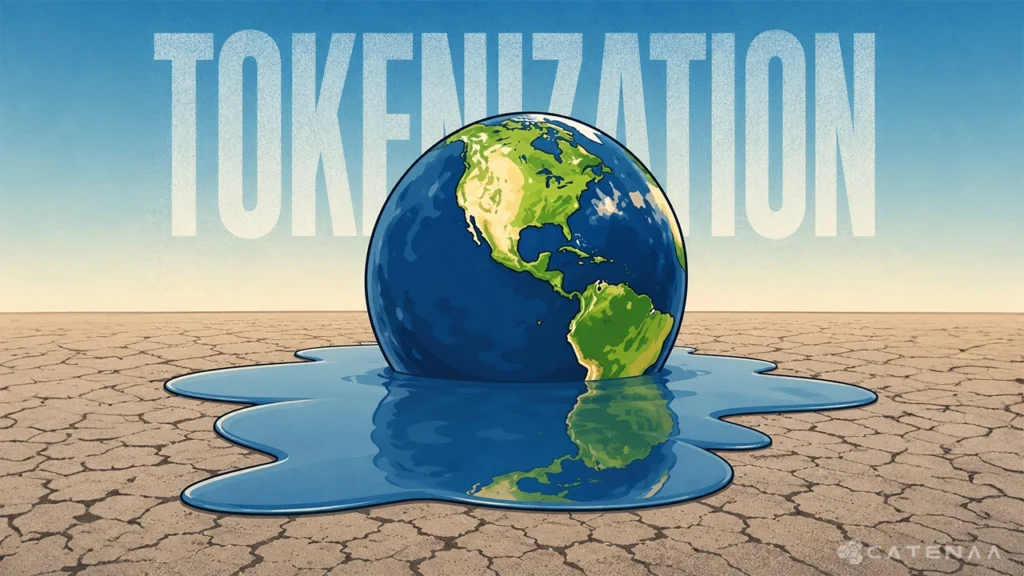


Catenaa, Thursday, July 30, 2026-The rapid growth of tokenized real-world assets is expanding beyond traditional financial products, with blockchain developers increasingly exploring climate-risk solutions that could make weather-related financial protection more accessible to businesses, farmers and other sectors exposed to extreme weather.
While tokenization has largely focused on digitizing government bonds, money market funds, private credit and real estate, industry participants are now examining whether blockchain infrastructure can also support financial products designed to hedge weather-related risks through automated, transparent settlement.
The first wave of real-world asset tokenization has concentrated on improving the efficiency of capital markets by placing conventional financial instruments on blockchain networks.
Governments, banks and asset managers have introduced tokenized securities to accelerate settlement, improve transparency and broaden investor access.
A growing number of developers, however, believe the technology’s long-term value may extend beyond investment products into financial tools that address practical economic challenges.
One emerging area is climate-risk management, where weather volatility continues to generate significant losses for agriculture, transportation, energy and small businesses worldwide.
Weather derivatives are financial contracts that compensate buyers when measurable weather conditions exceed predetermined thresholds, such as insufficient rainfall, prolonged heat or unusually mild winters.
Large corporations have used these instruments for decades to manage operational risks, particularly in the energy and agricultural sectors.
However, the market has remained relatively small because contracts are often customized, difficult to trade and largely limited to institutional participants.
As a result, many smaller businesses and farmers remain exposed to weather-related financial losses without affordable hedging options.
Developers believe blockchain technology could improve the accessibility of weather-risk products by combining smart contracts with verified meteorological data.
Under such a model, contracts could automatically execute payments once trusted weather information confirms that predefined conditions have been met, reducing administrative delays, disputes and settlement risks.
Tokenization could also enable fractional participation, allowing smaller businesses to purchase climate-risk protection that would otherwise be unavailable through conventional financial markets.
Several pilot projects are already exploring how trusted weather information can be delivered securely to blockchain networks, addressing one of the key technical challenges known as the oracle problem.
Despite growing interest, blockchain-based weather finance remains at an early stage.
Reliable external data sources, regulatory frameworks, standardized contract structures and sufficient market liquidity will all be required before such products can achieve meaningful adoption.
Industry observers also caution that blockchain technology cannot reduce the physical impacts of climate change itself.
Instead, its potential lies in improving how financial risks associated with increasingly volatile weather are measured, transferred and managed.
The evolution of tokenization suggests the industry may be entering a second phase of development.
Rather than focusing solely on digitizing existing investment assets, blockchain networks are increasingly being evaluated as infrastructure for solving operational and financial challenges across the real economy.
If weather-linked financial products mature, tokenization could expand into agriculture, logistics, insurance, energy and disaster-risk financing, demonstrating that blockchain’s value extends beyond investment markets into broader economic resilience.
Real-world asset tokenization has become one of the fastest-growing sectors in digital finance, with governments, financial institutions and asset managers increasingly issuing tokenized versions of bonds, private credit, funds and other conventional assets. Industry forecasts suggest the market could reach several trillion dollars over the next decade, although current adoption remains concentrated in traditional financial instruments. New experiments involving trade receivables, agricultural assets, supply-chain finance and climate-risk products indicate that tokenization is gradually moving beyond capital markets into practical applications that support businesses and communities facing everyday economic challenges.