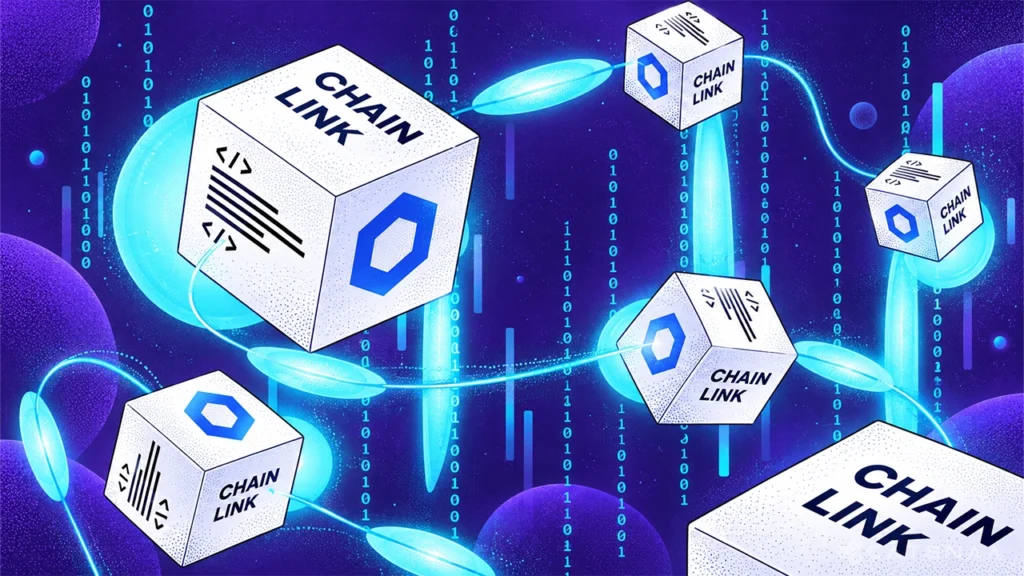


Catenaa, Monday, September 07, 2026- Chainlink added nine integrations across five blockchain networks in its latest weekly deployment cycle, showing continued demand for its oracle and interoperability services.
The integrations span several Chainlink products used by decentralized applications for functions such as asset pricing, automation, proof of reserves and cross-chain communication.
Chainlink’s services are designed to provide smart contracts with information and connectivity that blockchains cannot reliably supply on their own.
The five-chain spread also reflects the increasingly multi-chain structure of the crypto market.
Developers now build across Ethereum, Layer 2 networks, alternative Layer 1 blockchains and specialized application chains, creating demand for tools that can operate across different environments.
Oracle services remain especially important in decentralized finance.
Lending protocols use price feeds to value collateral and trigger liquidations, while derivatives platforms rely on external reference data for settlement.
Stablecoin systems and tokenized real-world assets can also depend on off-chain data such as reserve balances or valuations.
The latest integration count, however, should not be treated as proof of equivalent growth in economic activity.
Individual deployments can vary widely in scale, from a small application using a single data feed to infrastructure supporting substantial liquidity.
Actual transaction activity, usage and the value secured by each integration are more useful measures of impact.
The same caution applies to the LINK token.
More integrations can increase use of Chainlink services, but they do not automatically translate into an immediate rise in LINK demand or price.
Token performance depends on fee structures, staking, payment models and broader market conditions.
The latest update is therefore best viewed as an adoption signal rather than a market-price catalyst.
Chainlink has also expanded beyond traditional price feeds into services aimed at cross-chain messaging and broader financial infrastructure.
That could become more important as tokenized assets and institutional blockchain applications require reliable connections between different networks and external data sources.
Cross-chain systems remain a sensitive area because bridges and messaging protocols have been frequent targets for exploits.
Providers therefore compete not only on reach but also on security and operational reliability.
Chainlink’s continued rollout across multiple networks suggests developers are still willing to use a common infrastructure layer even as the blockchain market becomes more fragmented.
The stronger test will be whether those integrations develop into applications with sustained users, liquidity and transaction volume.
A large number of integrations with little activity would have limited economic value.
Deployments supporting major lending markets, stablecoins or institutional assets would carry greater weight.
The latest figures show breadth of adoption, but not yet the depth of usage behind each integration.
Chainlink was launched as a decentralized oracle network connecting smart contracts with information outside their native blockchains. Its services have since expanded into automation, proof-of-reserve systems and cross-chain communication. As developers increasingly build across several blockchain ecosystems, Chainlink has positioned itself as a common infrastructure provider. Its integration announcements are often watched as a measure of adoption, although deployment counts alone do not show revenue, transaction volume or the effect on the LINK token.