

Catenaa, Friday, July 24, 2026- Cardano has activated its Van Rossem hard fork, completing the blockchain’s first major protocol upgrade approved entirely through its onchain governance system and advancing the network toward faster transaction processing, lower smart contract costs and stronger security.
The upgrade went live on July 18 at the beginning of a new epoch, moving the network to Protocol Version 11 without reported downtime. Rather than introducing a new governance model, the hard fork enhances the existing Conway ledger era by improving smart contract execution, strengthening ledger integrity and adding new cryptographic capabilities for developers.
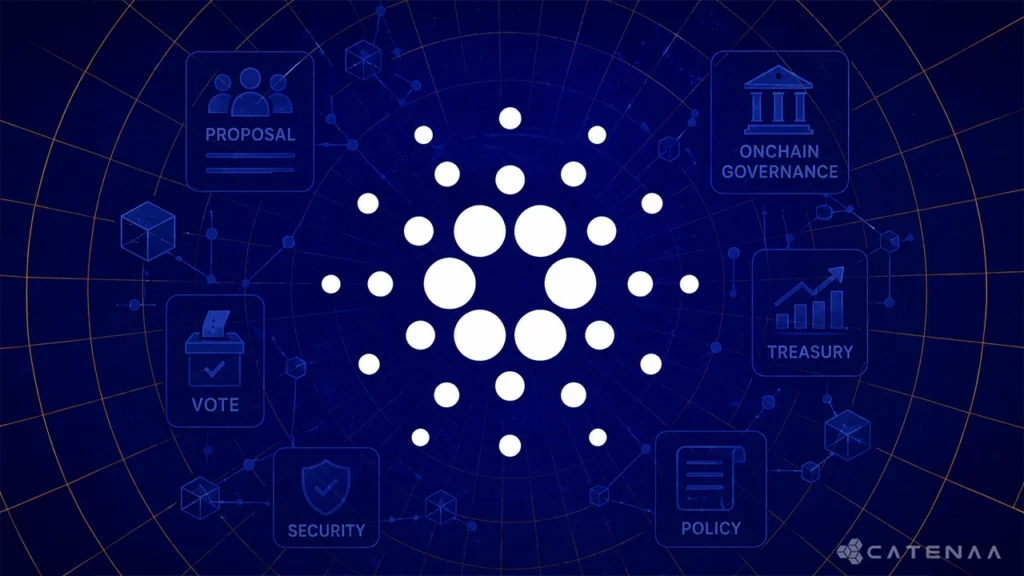
The activation represents a turning point for Cardano’s decentralized governance framework. Unlike previous upgrades coordinated primarily by founding developer Input Output, Van Rossem progressed from proposal to implementation through community voting under the network’s constitutional governance process.
The protocol upgrade incorporates five Cardano Improvement Proposals designed to improve developer efficiency and network performance.
Among the most notable changes is the introduction of multi-scalar multiplication over the BLS12-381 cryptographic curve, enabling applications to verify large numbers of digital signatures more efficiently. The enhancement is expected to benefit developers building zero-knowledge proof systems, multisignature wallets and enterprise compliance applications.
Additional protocol improvements introduce native array support for onchain data, optimize multi-asset processing, improve list manipulation functions and add modular exponentiation as a built-in operation. Together, these enhancements reduce computational overhead and lower the execution costs of Plutus smart contracts.
Security also received a significant upgrade. Stake pool operators are now required to use unique Verifiable Random Function keys, preventing key reuse across multiple pools and eliminating a potential attack vector. The network has also strengthened ledger consistency rules to improve synchronization as transaction volumes increase.
Van Rossem is the first major Cardano protocol upgrade to complete the full governance process established under the Conway era.
Delegated representatives approved the proposal with 77.63% support, comfortably exceeding the required 60% threshold. Stake pool operators backed the upgrade with 52.7% approval, narrowly surpassing the required majority, while the Constitutional Committee voted overwhelmingly in favour.
The voting process concluded five days before activation, demonstrating the network’s ability to coordinate protocol changes without relying on centralized decision-making.
The milestone reinforces Cardano’s long-term strategy of transitioning governance authority from founding organizations to token holders and elected representatives, making protocol evolution increasingly community driven.
Beyond the technical enhancements, the upgrade could reshape how developers view Cardano as a smart contract platform.
Lower execution costs and improved scripting efficiency may reduce barriers for decentralized application developers while expanding support for advanced cryptographic applications. The changes also position Cardano to compete more aggressively with high-performance blockchain networks seeking enterprise and institutional adoption.
Perhaps more importantly, Van Rossem serves as the technical foundation for the forthcoming Ouroboros Leios upgrade.
Leios is expected to introduce parallel transaction processing capable of increasing throughput by between 30 and 65 times current levels, with a long-term objective of exceeding 1,000 transactions per second.
By completing Van Rossem first, Cardano removes several architectural constraints that could otherwise limit Leios’ implementation.
While the protocol upgrade proceeded smoothly, market participants responded cautiously.
ADA traded modestly lower following activation, while trading volume declined sharply, suggesting investors are waiting for measurable increases in network activity before reassessing the blockchain’s valuation.
Onchain analytics, however, point to growing confidence among large holders.
Wallets containing between 100,000 and 100 million ADA have increased their combined holdings to the highest levels seen since 2023. These addresses now control more than one-quarter of the circulating supply, indicating continued accumulation despite subdued short-term market sentiment.
The divergence between whale accumulation and muted trading activity suggests institutional and long-term investors may be positioning ahead of future network developments rather than reacting to the hard fork itself.
For Cardano, Van Rossem represents more than another software upgrade.
It demonstrates that one of the cryptocurrency industry’s largest blockchain networks can implement complex protocol changes through decentralized governance while maintaining uninterrupted operations.
Whether the milestone ultimately strengthens Cardano’s competitive position will depend less on the upgrade itself than on what follows. Increased developer activity, stronger decentralized finance adoption, higher transaction volumes and successful deployment of Leios will determine whether the governance milestone translates into sustained ecosystem growth.
Cardano launched in 2017 as a proof-of-stake blockchain designed around peer-reviewed research and formal software development methods. The network has gradually expanded its capabilities through successive protocol upgrades introducing staking, smart contracts and decentralized governance. The Conway era established the framework for community-led governance, allowing delegated representatives, stake pool operators and the Constitutional Committee to participate directly in protocol decisions. The Van Rossem hard fork is the first major upgrade completed entirely under that governance model, marking a significant step in Cardano’s decentralization roadmap while preparing the network for future scalability improvements.