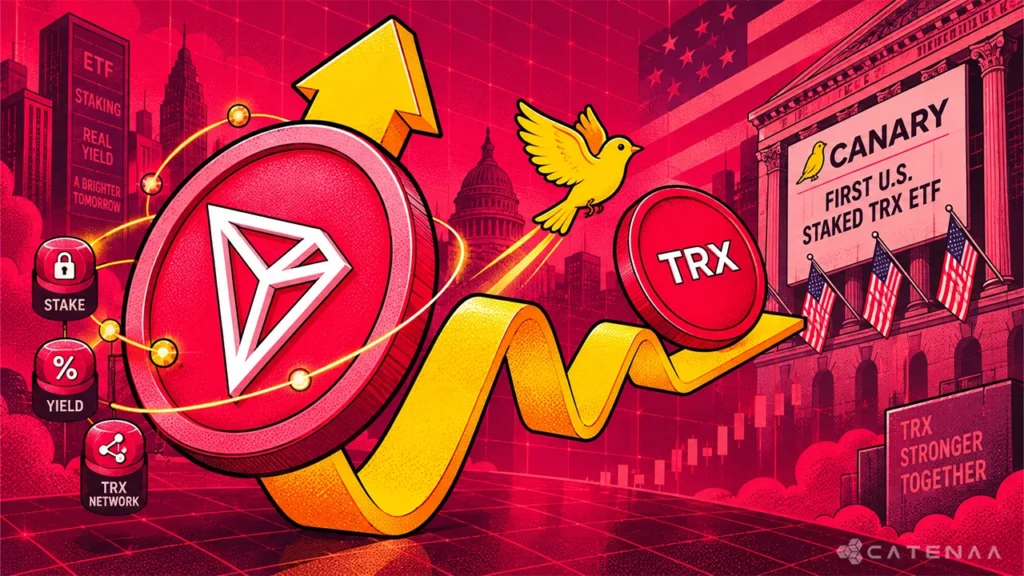


Catenaa, Monday, September 14, 2026- Canary Capital launched the first US exchange-traded fund tied to staked TRX on Wednesday, giving traditional-market investors regulated exposure to the Tron blockchain’s native token and its staking rewards.
The Canary Staked TRX ETF began trading under the ticker TRXS, expanding the growing range of crypto-linked investment products available through conventional brokerage accounts.
The fund is designed to track exposure to TRX while also participating in the Tron network’s proof-of-stake system.
Canary Capital said staking rewards generated through the process will be reflected in the fund’s net asset value.
That structure differentiates TRXS from products that merely track the market price of a digital asset.
Investors could gain exposure both to movements in the price of TRX and to rewards generated by staking the token through the network.
Tron founder Justin Sun described the launch as another sign of growing institutional recognition of the blockchain and its role in digital payments.
He said the ETF offers investors another route into a network already being used for large-scale financial activity.
TRX had a market capitalization of about $32.1 billion at the time of the launch, according to The Block.
That made it the eighth-largest cryptocurrency by market value.
The ETF arrives as fund managers increasingly look beyond bitcoin and ether for products tied to other large blockchain networks.
Canary Capital has already launched crypto ETFs connected to HBAR, Litecoin and XRP during the past year.
TRXS extends that strategy into products that combine token-price exposure with network-generated yield.
The staking component could become an important point of distinction as competition increases among digital-asset ETF issuers.
Proof-of-stake networks allow token holders to commit assets to network operations in exchange for rewards.
Those rewards can potentially increase the return generated by an investment vehicle beyond changes in the underlying token’s market price.
They also introduce additional variables.
Staking yields can fluctuate, and returns depend on network conditions, validator performance and the amount of tokens participating in staking.
For investors, the ETF structure removes the need to personally acquire TRX, manage a crypto wallet or undertake staking directly.
Instead, exposure can be obtained through a traditional investment account.
Canary Capital is also emphasizing Tron’s role in stablecoin transactions.
The blockchain has developed into a widely used network for transferring stablecoins, particularly in markets where users seek relatively low transaction costs and rapid settlement.
Canary Capital Chief Executive Steven McClurg said increasing global stablecoin adoption has strengthened Tron’s position as infrastructure for digital payments and settlement.
He said investors are increasingly examining the networks supporting blockchain-based financial activity rather than focusing only on individual tokens.
That argument places TRXS within a broader investment thesis around payment infrastructure.
Stablecoins have become one of the largest practical uses of public blockchains, with users transferring dollar-linked tokens across borders, exchanges and payment platforms.
Networks capable of processing those transactions at scale can generate greater demand for their native tokens through fees, staking and network participation.
Canary’s ETF attempts to translate part of that activity into a conventional securities product.
The launch also reflects a wider change in the US crypto investment market.
The first generation of crypto ETFs focused mainly on gaining exposure to the market price of digital assets.
Newer products are beginning to incorporate features native to blockchain networks, including staking.
That could make proof-of-stake assets more attractive to certain investors because the underlying tokens can generate network rewards while being held.
However, staking-linked ETFs are structurally more complicated than products that only hold an asset.
Fund operators must manage staking participation while maintaining liquidity for creations, redemptions and market trading.
The value of staking rewards can also vary over time.
TRX itself remains closely linked to the activity taking place across the Tron network.
Higher transaction activity and stablecoin usage can increase interest in the network, while weaker crypto markets or reduced blockchain activity can weigh on demand.
The launch of TRXS gives investors another way to express a view on that ecosystem without interacting directly with decentralized infrastructure.
For Canary Capital, the product also adds another network to an expanding lineup of crypto ETFs.
The firm’s recent launches suggest asset managers are moving toward a broader market in which multiple blockchain ecosystems can be packaged for traditional investors.
The debut of TRXS could test whether demand extends beyond the largest cryptocurrencies and whether investors value staking income as part of an ETF structure.
If the model gains traction, other proof-of-stake networks could become candidates for similar products.
For Tron, the launch places TRX alongside a growing group of digital assets receiving dedicated exchange-traded investment vehicles in the United States.
It also connects the network’s staking economics directly with a traditional-market product for the first time.