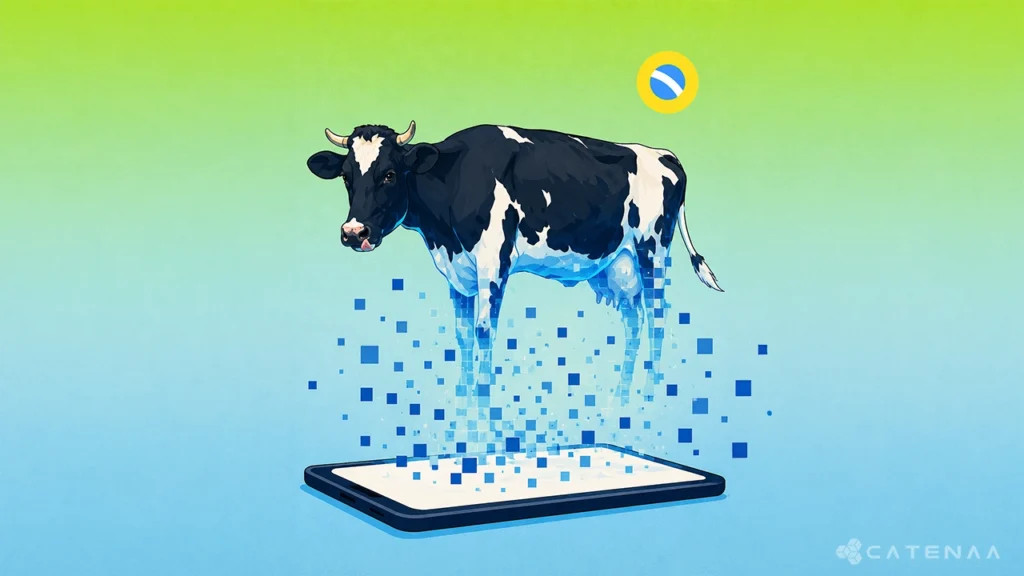


Catenaa, Thursday, July 30, 2026-Dairy farmers in Brazil’s Paraná state have raised nearly $20,000 in financing by tokenizing livestock on the country’s B3 stock exchange, marking what is believed to be the world’s first use of blockchain-based cattle tokenization to secure agricultural credit.
The pilot, developed by Brazilian agricultural technology company Cowmed, allows farmers to use dairy cows as digital collateral for loans, offering an alternative source of financing as tighter bank lending standards make credit more difficult to obtain.
The project involved the tokenization of 10 dairy cows, whose digital representations were registered on Brazil’s national stock exchange to support a credit facility backed by the livestock.
Each animal is equipped with an artificial intelligence-powered Smarty Collar that continuously monitors its health, location and behavior. The data is converted into an encrypted digital identity linked directly to the financing agreement.
By creating a unique, verifiable record for every animal, the system allows lenders to confirm ownership and monitor collateral without requiring physical inspections.
The technology also prevents the same animal from being pledged against multiple loans and includes mechanisms that allow a deceased animal to be replaced with another eligible cow.
The initiative is designed to address one of agriculture’s longstanding challenges: access to affordable credit.
Small farming businesses often struggle to obtain financing because traditional collateral can be difficult to value, verify and monitor. Tokenizing livestock creates a digital record that can be tracked throughout the life of a loan, giving lenders greater confidence in the underlying collateral.
Cowmed said the approach simplifies the lending process while providing farmers with another financing option during a period of tighter credit conditions.
The project also highlights how tokenization is expanding beyond financial securities into productive real-world assets.
While much of the digital asset industry’s attention has focused on tokenized funds, bonds and equities, the Brazilian initiative demonstrates that blockchain can also be used to finance agricultural businesses by digitizing physical assets that were previously difficult to use as collateral.
The combination of blockchain records and real-time monitoring technology creates a transparent system that reduces fraud risks while improving confidence among lenders.
Cowmed currently monitors about 100,000 dairy cows across more than 1,000 farms, representing livestock valued at more than $395 million.
The company estimates that up to 20% of those farms could eventually adopt the tokenized financing model, potentially unlocking $77.6 million in additional agricultural credit.
Industry forecasts suggest tokenized real-world assets could grow into a multi-trillion-dollar market over the next decade as businesses increasingly digitize physical assets to improve financing, ownership and settlement.
The Brazilian pilot illustrates how blockchain technology is beginning to solve practical financing challenges outside traditional financial markets.
Rather than creating a new investment product, the initiative uses tokenization to improve access to working capital for farmers who face borrowing constraints under conventional lending models.
If the approach proves scalable, similar models could be applied to other agricultural assets, equipment and commercial inventories, expanding the role of tokenization in the real economy beyond financial markets.
Real-world asset tokenization involves converting ownership rights or financial claims associated with physical assets into blockchain-based digital tokens. While early adoption focused on investment products such as bonds, funds and real estate, tokenization is increasingly being applied to operational assets including invoices, trade receivables, commodities and agricultural products. By creating transparent, verifiable digital records, blockchain technology can reduce fraud, improve collateral management and expand financing opportunities for businesses that have traditionally faced limited access to credit.