

August 31, 2026 – The fund took under 10 months to reach the milestone. It now accounts for more than half of every dollar invested in American Solana funds.
In Summary
BSOL held $1.017 billion in assets on 26 August 2026.
The fund launched on 28 October 2025 and was listed on the NYSE.
It holds 9.33 million SOL and stakes the entire position.
Staking rewards averaged about 7% annualised at launch.
All US Solana funds together hold roughly $1.7 billion.
The management fee is 0.20% after an introductory waiver.
A Solana fund has passed the billion-dollar mark for the first time. Bitwise reported assets of $1.017 billion on 26 August.
The fund trades on the New York Stock Exchange as BSOL. It took under 10 months to get there. So Solana now has a fund large enough for big investors to use.
How the fund is built
Bitwise launched BSOL on 28 October 2025. It was the first Solana product in the United States. Two design choices set it apart.
First, the fund stakes every token it holds. Bitwise runs this in-house, working with the validator firm Helius. Its registration filings set out the arrangement.
Second, the rewards stay in the fund. They lift net asset value rather than paying out as income. Rewards ran near 7% a year before launch. So they more than cover the 0.20% fee.
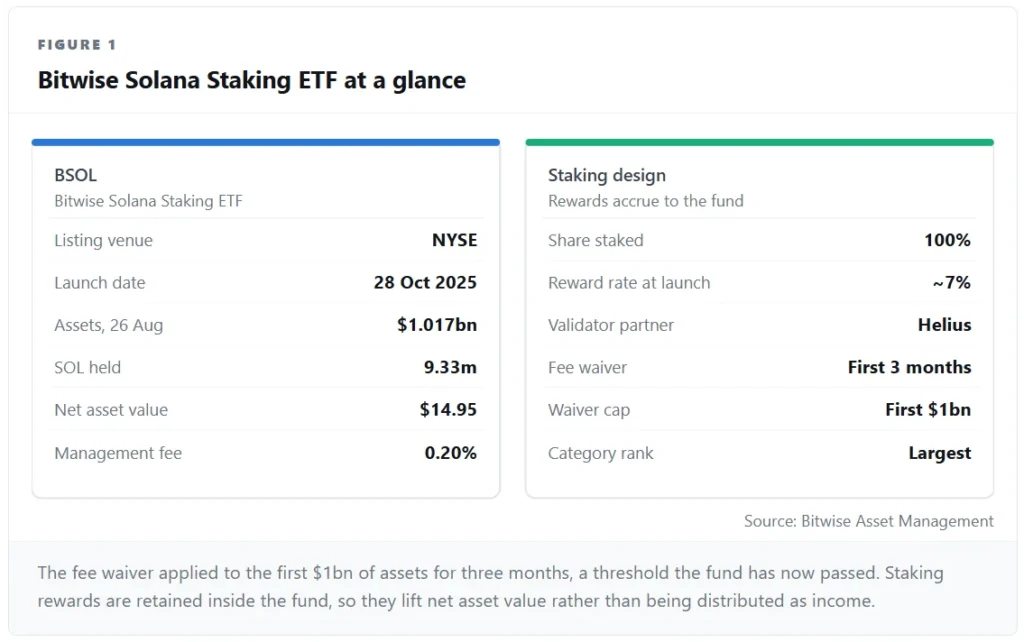
Bitwise also waived that fee for three months on the first $1 billion. Cheap launches have become normal in new fund classes. Issuers want scale first and margin later. Because assets are sticky, early leads tend to hold. Rivals must then compete on fee or on service.
The asset ramp
Growth has been steady rather than wild. The fund now holds 9.33 million SOL. Net asset value was $14.95 a share on 26 August.
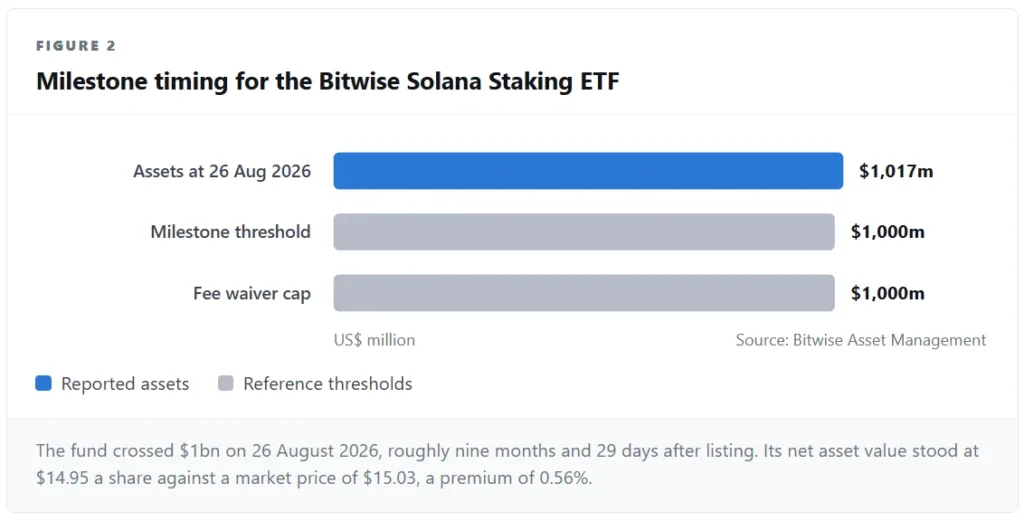
The market price was $15.03. That is a premium of 0.56%. Small gaps like this suggest the creation and redemption process is working well. Wide gaps would point to friction instead.
Bitcoin funds gathered far more in their first weeks back in 2024, though. So Solana looks like a smaller and slower class. Still, it is proving durable. Flows have continued through weak price stretches. That pattern suggests buyers are holding rather than trading.
A big share of a small market
Scale against peers is where BSOL stands out. US Solana funds hold about $1.7 billion between them. More than half of that sits in this one product.
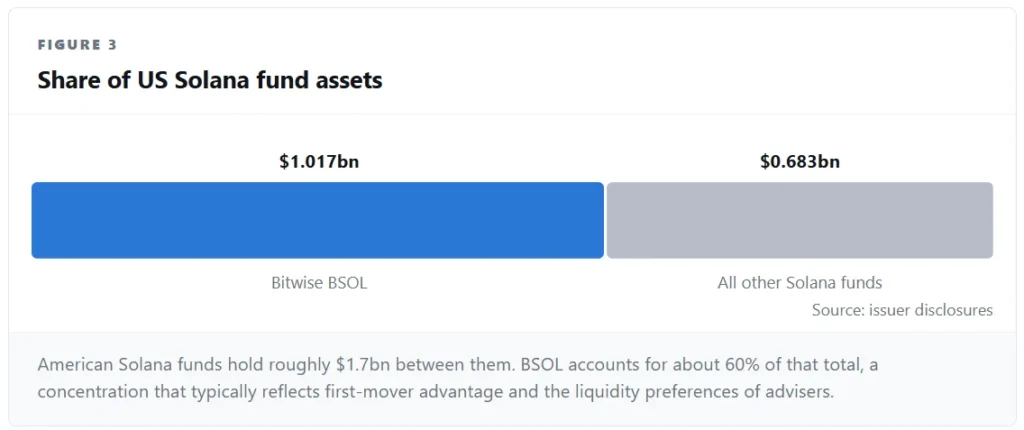
Such concentration usually reflects first-mover advantage. Advisers tend to pick the most liquid vehicle. That choice then feeds on itself, because tighter spreads draw more flow.
The rule change that made it possible
Plumbing explains the timing. Until 2025, each crypto fund needed its own rule filing. Approval took months, and outcomes were uncertain. So issuers filed and waited.
That changed when the SEC approved generic listing standards for commodity-based trust shares. Exchanges can now list a qualifying product without a bespoke order.
So a wave of single-asset funds followed. Solana was among the first to benefit. Other tokens have since followed the same path. Yet few have matched Solana’s early traction.
What staking adds, and what it risks
Staking is what makes these funds different. Bitcoin pays no native yield. Solana validators, by contrast, earn rewards for securing the chain.
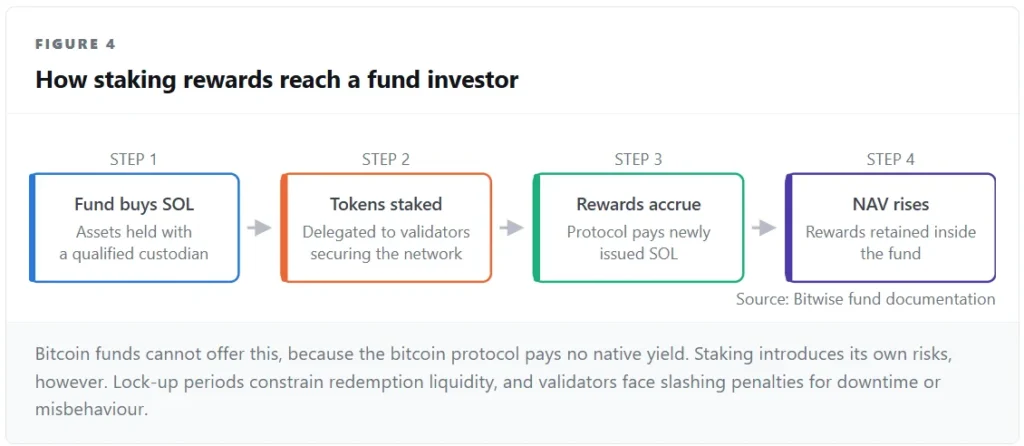
The design carries real risks, though. Staked tokens face lock-up periods. So the manager must plan for redemptions carefully.
Validators can also be slashed. Penalties apply for downtime or bad behaviour. Although the sums are usually small, the risk is not zero.
Reward rates move as well. Yields track network issuance and the share of tokens staked. If more holders stake, each one earns less. Therefore, the 7% figure should be read as a snapshot.
Why the milestone matters
A billion dollars is still modest next to Bitcoin and Ether funds. But it clears a practical bar. Many advisers cannot buy a fund below that size.
SOL traded near $103 in late August. Fund flows and token price now interact more tightly. Regulated vehicles have become a visible source of demand.
Two things will show whether the trend holds. First, whether rivals close the gap. Second, whether flows continue when prices fall. A fund that keeps growing in a downturn has found real demand.
The wider picture
Solana funds remain a small corner of the market. Bitcoin products still dwarf them. Yet the gap has a practical meaning for issuers.
Each new listed token widens the menu for advisers. Therefore, the next test is breadth, not size. If several tokens sustain funds of this scale, crypto becomes a normal allocation line rather than a single bet.




