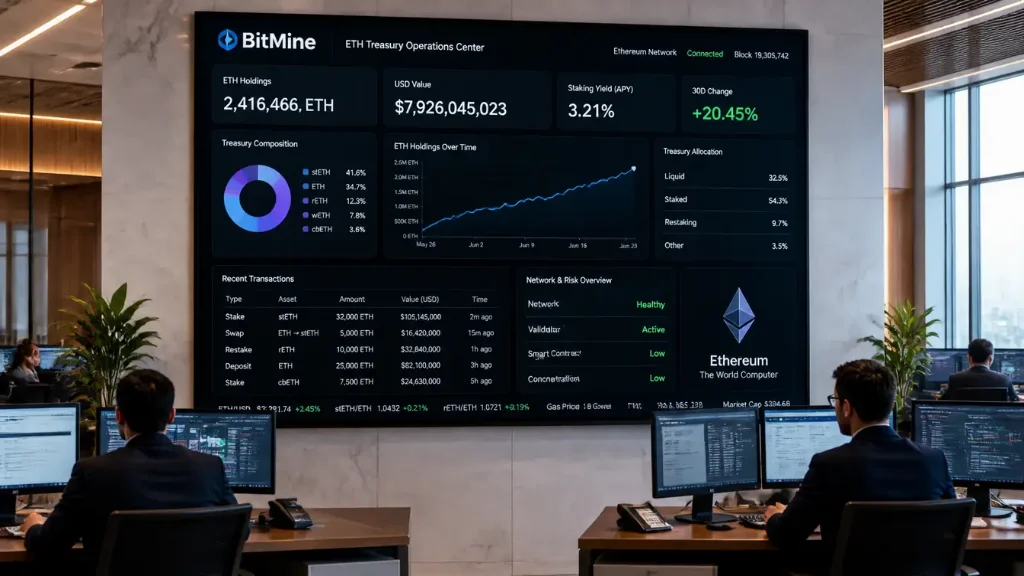


Catenaa, Wednesday, July 29, 2026- BitMine Immersion Technologies continued expanding its Ethereum treasury last week, purchasing another 9,946 ETH while increasing the pace of its common share repurchases, signaling that crypto treasury companies are evolving into active capital allocators rather than passive holders of digital assets.
The latest acquisition lifts BitMine’s Ethereum holdings to approximately 5.79 million ETH, representing about 4.8 percent of the cryptocurrency’s circulating supply.
At the same time, the company repurchased 6.1 million common shares under its previously announced $4 billion buyback program, up from 5.5 million shares purchased the previous week.
Taken together, the moves highlight a growing trend among digital asset treasury companies: managing shareholder value through a combination of cryptocurrency accumulation, staking income and capital allocation strategies.
The first generation of crypto treasury companies focused largely on accumulating digital assets.
Today’s treasury firms are becoming more sophisticated financial managers.
BitMine is not only adding Ethereum to its balance sheet but also actively deploying capital through share repurchases while generating recurring income from staking.
That approach increasingly resembles the capital management strategies employed by large public corporations, where treasury decisions extend beyond asset accumulation to include shareholder returns, liquidity planning and balance-sheet optimization.
The shift suggests crypto treasury companies are beginning to define a new corporate finance model built around blockchain-native assets.
BitMine has purchased Ethereum every week since launching its Ethereum Treasury Strategy, according to Chairman Tom Lee.
The company’s latest purchase exceeded the previous week’s acquisition, indicating continued confidence despite ongoing regulatory uncertainty surrounding digital assets.
Ethereum offers treasury companies a characteristic that distinguishes it from many other digital assets.
Unlike passive holdings, Ethereum can generate income through staking.
BitMine reported that approximately 4.92 million ETH from its treasury is currently staked, with projected annualized staking revenue of roughly $254 million.
That recurring yield transforms Ethereum from a speculative reserve asset into one capable of producing operating cash flow.
For treasury companies, staking income can help offset financing costs while strengthening long-term capital management.
The increase in share repurchases is equally significant.
Companies generally expand buyback programs when management believes shares are undervalued or when excess capital is available for shareholder returns.
Tom Lee said the company viewed the improving ETH-to-Bitcoin ratio as evidence that broader crypto market conditions were strengthening, despite reduced expectations that the US CLARITY Act would be enacted this year.
That statement suggests BitMine is linking capital allocation decisions not only to internal financial performance but also to broader digital asset market trends.
Such an approach reflects the increasingly integrated relationship between public equity markets and cryptocurrency valuations.
BitMine’s strategy illustrates how crypto treasury companies are becoming hybrid financial institutions.
Their balance sheets now combine digital asset accumulation, staking income, equity issuance, share repurchases and active treasury management.
This differs markedly from earlier corporate crypto strategies, which often involved simply purchasing Bitcoin or Ethereum as reserve assets.
Instead, treasury companies are beginning to manage digital assets much like conventional financial institutions manage investment portfolios.
That includes balancing liquidity, shareholder returns, recurring revenue and long-term asset appreciation.
Institutional investors are paying increasing attention to treasury companies because they provide indirect exposure to digital assets through publicly listed equities.
As these firms mature, investors are placing greater emphasis on financial discipline rather than cryptocurrency accumulation alone.
Metrics such as staking yield, capital efficiency, share buybacks, leverage and treasury performance are becoming as important as the size of digital asset holdings.
This evolution may encourage broader institutional participation, particularly among investors seeking regulated exposure to digital assets through public markets.
BitMine’s latest purchases reinforce a wider transformation occurring across the digital asset treasury sector.
Success is no longer measured solely by the amount of cryptocurrency held.
Increasingly, investors are evaluating how effectively companies manage those assets to generate returns, strengthen shareholder value and improve financial resilience.
Ethereum’s staking capability gives treasury companies an additional financial tool unavailable to firms holding non-yielding reserve assets.
If more public companies adopt similar strategies, digital asset treasuries could evolve into a distinct corporate finance model combining blockchain-based income generation with traditional capital allocation practices.
BitMine’s latest acquisition is more than another weekly Ethereum purchase.
It demonstrates how crypto treasury companies are increasingly operating as active capital managers.
By combining digital asset accumulation with staking revenue and aggressive share repurchases, the company is helping define what a blockchain-native treasury strategy may look like for publicly traded firms.
As institutional adoption grows, the effectiveness of these capital allocation decisions could become as important as the size of the underlying cryptocurrency holdings.
BitMine Immersion Technologies is a publicly traded company that has adopted Ethereum as the primary asset in its corporate treasury strategy. Unlike Bitcoin, Ethereum supports staking, allowing holders to earn rewards by helping secure the blockchain network. Corporate digital asset treasury strategies have expanded rapidly as listed companies seek alternative reserve assets and new sources of long-term value creation. Investors are increasingly assessing these firms using both traditional financial metrics, such as capital allocation and shareholder returns, and blockchain-specific indicators including staking income and digital asset holdings.