

September 02, 2026 – A record single-day short liquidation cleared the path for bitcoin in August. Institutional flows then took the baton, and dense supply now waits overhead.
In Summary
19 August 2026 produced the heaviest single-day short flush since 2019, according to Glassnode.
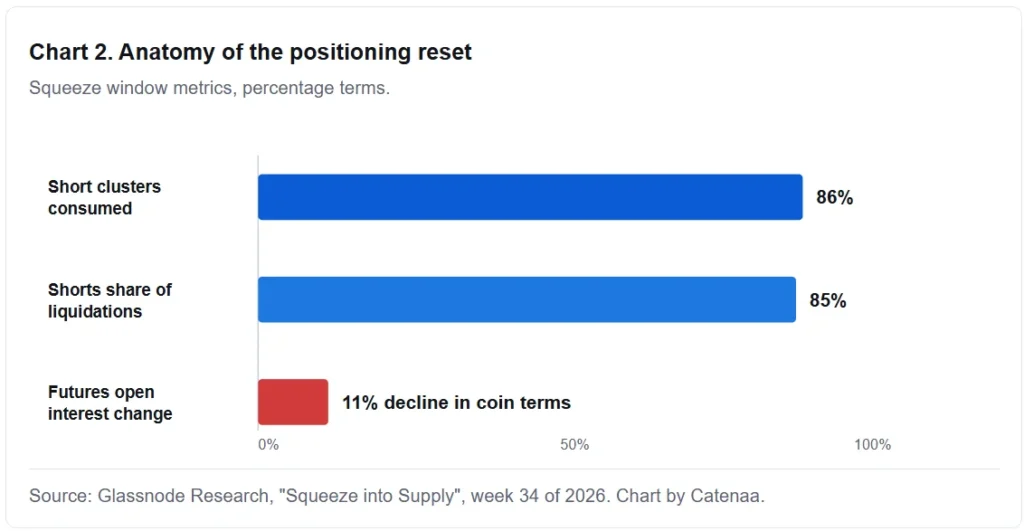
Shorts made up 85 percent of liquidations during the squeeze window.
Futures open interest contracted about 11 percent in coin terms, so leverage genuinely left the system.
Spot exchange-traded funds absorbed $2.23 billion over seven days, the strongest run of 2026.
Bitcoin now trades below a supply band that stretches from roughly $81,000 to $86,000.
Crypto markets added close to $500 billion in value in barely a week. Forced buying started the move. Discretionary institutional buying then sustained it. Consequently, the ownership of this rally shifted from leveraged traders to allocators.
The sequence matters more than the headline number. Squeezes fade quickly when nothing replaces the forced bid. This one did not fade. Instead, exchange-traded funds and treasury allocators stepped in behind the liquidation wave.
What happened on 19 August
Bitcoin bottomed near $62,700 in mid-August. A violent reversal followed. Glassnode recorded the largest single-day short flush since 2019 on 19 August 2026. Shorts accounted for 85 percent of liquidations across the squeeze window. Moreover, the rally consumed about 86 percent of the modelled short clusters sitting in its path.
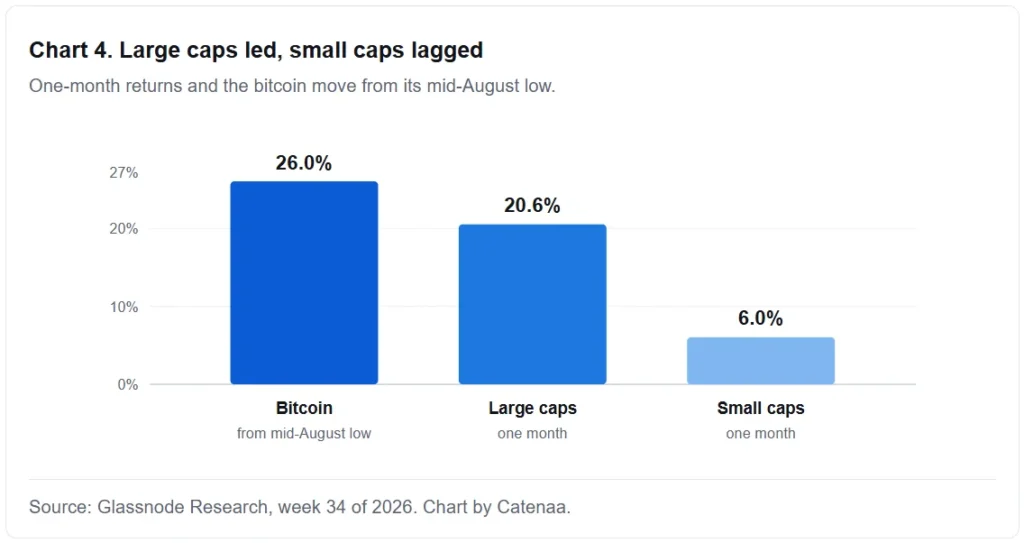
Price advanced roughly 26 percent from the low. Bitcoin later traded near $78,300, having briefly cleared $80,000.
Leverage genuinely left the market
Open interest tells the cleanest story. Futures positioning shrank about 11 percent in coin terms across the squeeze window. Funding rates stayed close to neutral throughout. Traders, therefore, did not simply flip from crowded shorts into crowded longs.
Such a reset improves the quality of a rally. Fewer stop-loss clusters sit beneath price. In addition, spot buyers absorbed roughly 31,500 bitcoin into custody balances during the same week.
Why the handover matters
Short squeezes are mechanical events. Exchanges close losing positions automatically, and that forced buying lifts price. Such demand disappears the moment the positions clear. History shows most squeeze rallies then retrace quickly.
August broke that pattern. Spot vehicles kept buying after the liquidation cascade ended. Accumulation scores across all six tracked wallet cohorts held at or above the neutral threshold for more than 20 days. Ownership therefore rotated from fast money to patient money.
Institutions replaced the shorts
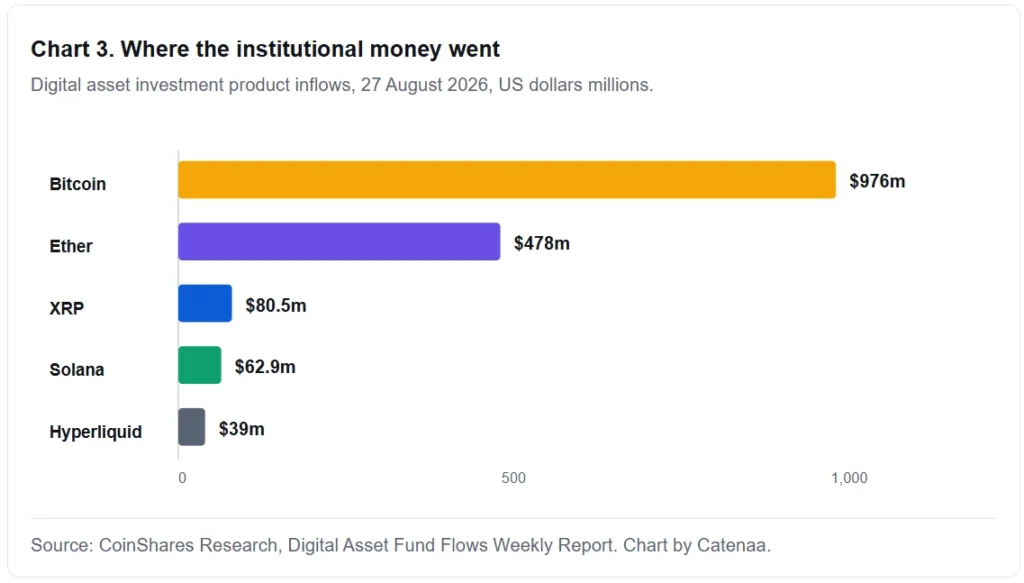
Fund flow data confirms the handover. Global digital asset investment products drew about $2.9 billion in the week to 20 August. A further $1.65 billion arrived across the first three sessions of the following week. Bitcoin products led with roughly $976 million on 27 August alone.
Ether products took about $478 million on the same day. XRP, Solana and Hyperliquid vehicles collected smaller sums. Meanwhile, spot exchange-traded funds recorded a seven-day intake of $2.23 billion, the strongest of 2026.
Breadth stayed narrow
Not every corner of the market benefited equally. Large capitalisation tokens returned about 20.6 percent over one month. Small capitalisation tokens managed roughly 6.0 percent. That gap signals allocator money rather than retail speculation.
Retail participation actually softened during the advance. Glassnode also flagged modest declines in active addresses and total fee volume. Investors should read the rally as institutional in character.
The macro tape turned hostile
Rate expectations shifted sharply against risk assets in late August. Federal Reserve Chairman Kevin Warsh used his Jackson Hole keynote to stress price stability. He noted 12-month headline inflation of 3.7 percent on the personal consumption expenditures measure. Traders responded, and futures-implied odds of a September hike climbed above 60 percent.
Energy added a second shock. Brent crude pushed past $90 a barrel on 31 August after renewed conflict involving Iran. Higher energy costs complicate the disinflation path. Crypto therefore faces tighter financial conditions just as it approaches heavy supply.
Levels that decide the next move
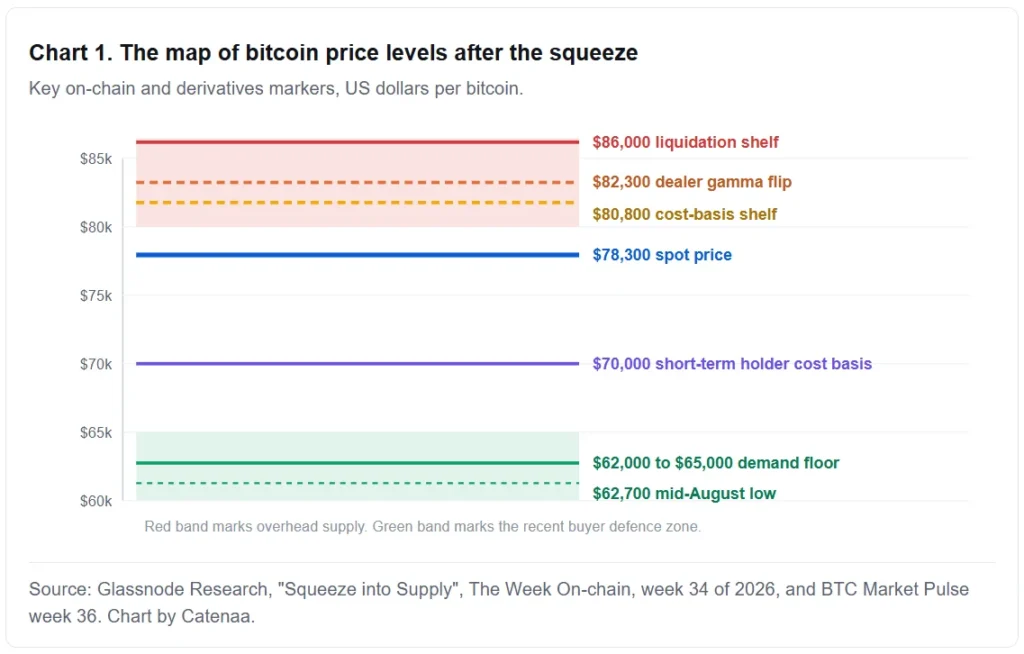
Overhead resistance is unusually well defined. A cost-basis shelf begins at $80,800. Dealer gamma flips near $82,300, and liquidation clusters extend to $86,000. Bulls need daily closes above that band to confirm continuation.
Downside markers look equally clear. The short-term holder’s cost basis sits at $70,000. A sustained break below that level would put recent buyers underwater. Support then rests in the $62,000 to $65,000 zone defended in mid-August. Traders often treat that band as the line between correction and trend reversal.
Risks that sit under the surface
Concentration remains a live concern. Exchange-traded funds now supply the dominant marginal bid. A single week of redemptions would remove that support quickly. Furthermore, options positioning clusters around a $69,000 to $70,000 pain zone.
Volatility spreads have also narrowed sharply. Narrow spreads usually mean the market underprices near-term risk. Investors should size positions with that asymmetry in mind.
What to watch next
Three catalysts dominate the near term. Payroll data lands on 4 September. Inflation figures follow on 11 September. The Federal Open Market Committee then decides on 16 September. Persistent fund inflows through those events would confirm that allocators, not leverage, now drive this market. A reversal in flows would send the opposite signal, and price would likely retest the demand floor.




