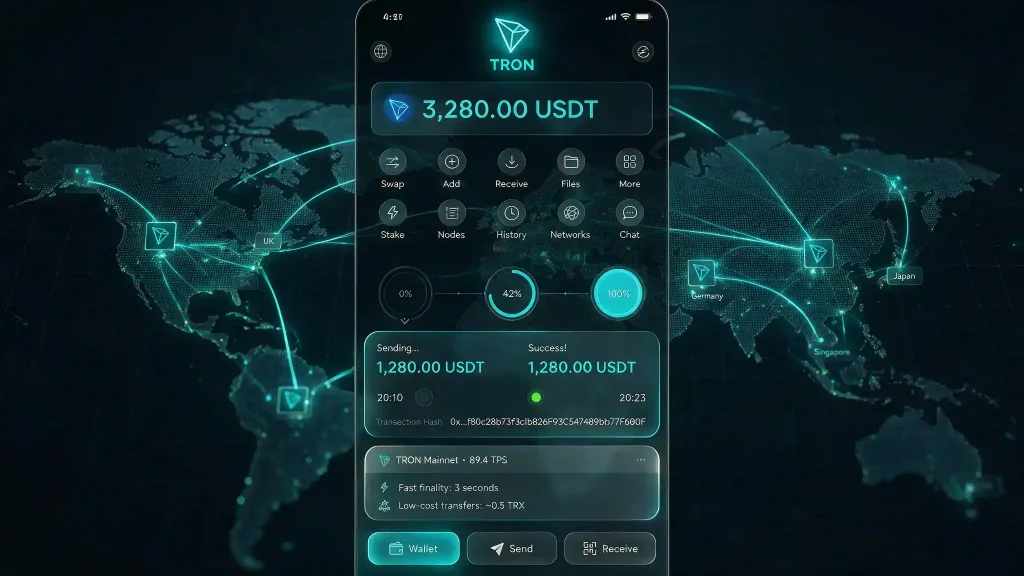


Catenaa, Sunday, August 30, 2026- Bitcoin.com Wallet has added native support for the TRON blockchain, allowing users to hold, send, receive, swap and purchase TRX and USDT-TRC20 directly through its self-custody wallet.
The integration became available across Bitcoin.com Wallet’s iOS, Android and web applications, according to an announcement commissioned by TRON.
Users no longer need a separate TRON wallet or a bridging service to interact with TRC20 assets.
The addition is particularly focused on Tether’s USDT stablecoin.
TRON has become one of the most widely used blockchain networks for USDT transfers, especially for exchange withdrawals, cross-border transfers and dollar-denominated payments.
Before the integration, Bitcoin.com Wallet users seeking to transfer USDT over TRON needed to use another wallet or network.
The new support allows TRON addresses to operate directly inside Bitcoin.com’s existing multichain interface.
Users can store TRX and supported TRC20 tokens alongside assets already held in the wallet.
They can also send assets to any compatible TRON address.
The wallet additionally supports swaps between TRX, supported TRC20 assets and other cryptocurrencies available through the platform.
Users can purchase TRX and USDT-TRC20 using supported card or bank-transfer services.
The change reduces the number of steps required for users receiving payment requests that specify USDT on TRON.
USDT has developed into one of the most widely used digital dollar instruments in cryptocurrency markets.
TRON has captured a large share of those transfers.
The announcement said more than $90 billion in USDT was circulating on TRON and that the network was processing about $23 billion in daily transfer volume.
Those figures were supplied by the companies involved in the announcement.
TRON’s appeal for stablecoin transfers has been linked to its relatively low transaction costs, fast settlement and broad support across cryptocurrency exchanges.
Those characteristics have made USDT-TRC20 particularly common in markets where users rely on stablecoins for international payments or access to U.S. dollar-denominated value.
The network is also used for exchange-to-exchange transfers.
Bitcoin.com Wallet operates as a self-custody wallet.
That means users control the private keys required to access their digital assets rather than leaving those keys with a centralized exchange.
Self-custody gives users direct control over assets.
It also places responsibility for key security and recovery with the individual user.
Adding TRON support brings another large stablecoin network into that model.
Users can now receive USDT-TRC20 directly into a wallet where they retain control over the keys.
That differs from holding USDT on a centralized exchange, where the exchange manages custody and withdrawal infrastructure.
The integration reflects a broader shift in stablecoin use.
Stablecoins were initially used heavily as trading instruments that allowed crypto investors to move between volatile assets without returning to traditional currencies.
Their role has expanded.
Businesses and individuals increasingly use dollar-backed stablecoins for cross-border transfers, payments, treasury management and settlement.
TRON has benefited from that shift because of the amount of USDT already circulating on the network.
A wider range of wallet integrations could make those payment flows easier to access outside centralized exchanges.
Bitcoin.com said its users often think about the asset and network requested by a payment recipient rather than the technical differences between blockchains.
The TRON integration is designed to remove that technical barrier.
Crypto wallets are increasingly competing on how many networks and financial services users can access from one interface.
Early cryptocurrency wallets were often built around a single asset.
Modern wallets increasingly support multiple blockchain networks, swaps, stablecoins and fiat purchase services.
That trend is partly driven by fragmentation across blockchain ecosystems.
A user may hold bitcoin on Bitcoin, stablecoins on TRON, tokens on Ethereum and other assets across additional networks.
Supporting those networks through one interface can reduce the need to maintain several wallet applications.
It can also create additional security considerations because broader functionality increases the number of systems and external services a wallet must support.
TRON launched its mainnet in 2018 and has developed into one of the largest blockchain networks by transaction count.
The TRON organization said the network had recorded more than 399 million user accounts and 15 billion transactions as of August.
It also reported more than $28 billion in total value locked.
Those figures were supplied by TRON and are not necessarily equivalent to unique individual users or economic transactions.
Blockchain account totals can include multiple addresses controlled by the same user.
The stablecoin supply on the network offers a separate measure of its role in digital payments.
USDT remains the dominant stablecoin on TRON.
The Bitcoin.com integration fits a wider move toward making blockchain networks less visible to end users.
Wallet providers increasingly try to handle network selection, swapping and payment routing inside the application.
That reduces the need for users to understand infrastructure before making a transfer.
The approach could become more important as stablecoins move further into conventional payment activity.
For many users, the practical question is whether a recipient can receive the requested digital dollars quickly and cheaply.
Which blockchain processes the transaction may become secondary.
The Bitcoin.com Wallet integration moves closer to that model by adding one of the largest USDT settlement networks directly into an existing multichain wallet.
For TRON, the addition expands access through another established consumer wallet.
For Bitcoin.com, it closes a gap in stablecoin support that had required users to leave its platform when counterparties requested a TRC20 address.