

August 26, 2026 – A bond market decision, not a crypto catalyst, powered the fastest bitcoin rally since 2023. Flow and yield data show exactly who moved first.

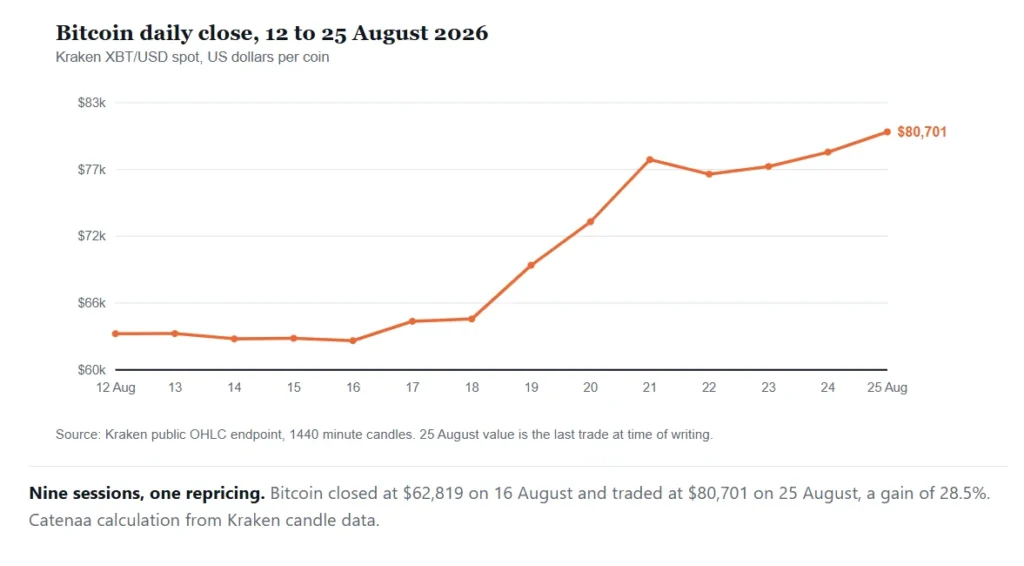
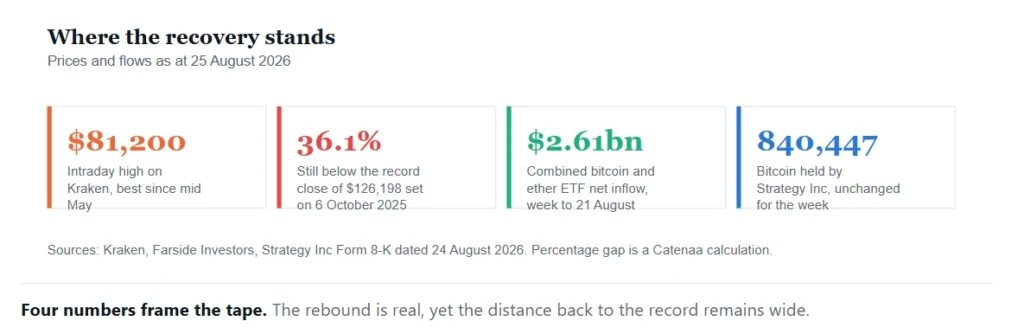
Bitcoin punched through $80,000 on Tuesday. The bitcoin rally reached an intraday high of $81,200 on Kraken, its strongest print since mid-May. Moreover, the token still traded near $80,700 during Asian hours.
Momentum has swung hard in both directions this year. Bitcoin closed at $62,819 on 16 August, according to Kraken daily candle data. Nine sessions later the price sat 28.5% higher. In fact, that stretch delivered the sharpest run of buying since 2023.
In Summary
The bitcoin rally reached $81,200 on 25 August, up 28.5% from the 16 August close.
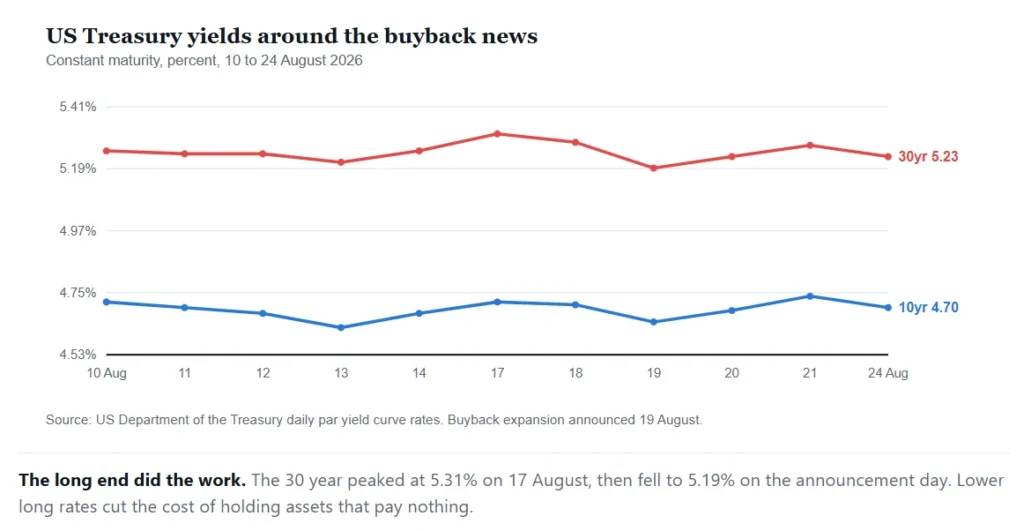
A US Treasury decision to double long-end buybacks pulled the 30-year yield down from 5.31%.
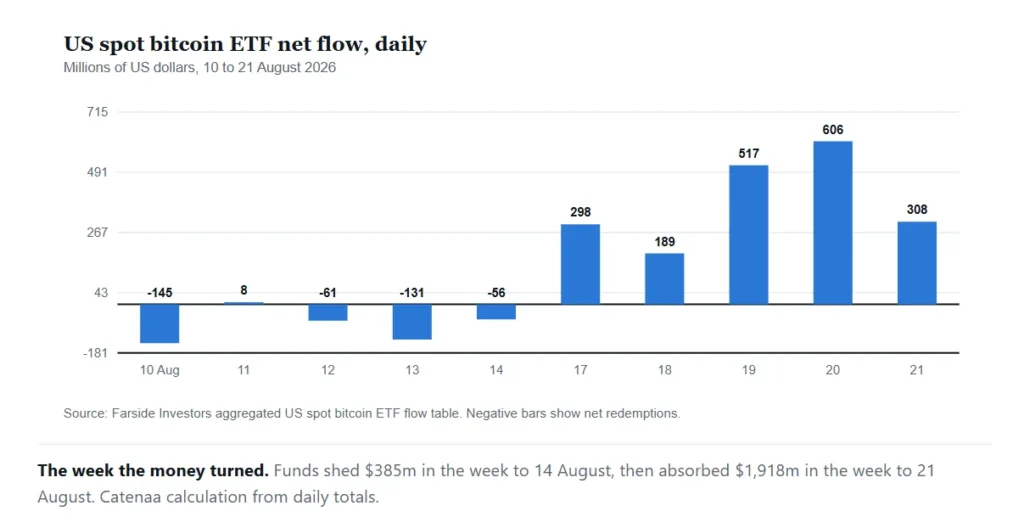
US spot bitcoin funds absorbed $1.92bn in the week to 21 August, after $385m of redemptions the week before.
Ether funds added $693m, lifting the combined weekly intake to roughly $2.61bn.
Bitcoin still trades 36.1% below its record close of $126,198 set on 6 October 2025.
What lit the Bitcoin rally
The spark came from the bond market rather than from crypto itself. On 19 August, the Treasury said it would at least double the size of its long-end liquidity support buybacks. Operations in the 10-year to 20-year and 20-year to 30-year sectors rise from $2bn to at least $4bn each.
Timing matters here. Notably, the change takes effect on 9 September and runs through 4 November. Therefore, the market has priced a policy shift that has not yet bought a single bond. In short, expectation is doing the heavy lifting.
Long yields still moved within minutes. Treasury constant maturity data put the 30-year at 5.31% on 17 August. By 24 August, the same tenor sat at 5.23%. Meanwhile, the 10-year eased from 4.72% to 4.70%.
Lower long rates reduce the opportunity cost of holding a zero-coupon asset. At the same time, the dollar softened. Consequently, traders revived the debasement trade that drove crypto through late 2025. That trade rewards scarce assets over paper claims.
Fund buyers returned in force
Flow data explains the Bitcoin rally most cleanly. US spot Bitcoin funds took in $1.92bn across the five sessions to 21 August, according to Farside Investors flow tables. That marks their strongest week since October 2025.
The reversal looks abrupt. Over the previous week, the same products shed $385m. Ether funds meanwhile added $693m, so the two complexes together pulled in about $2.61bn. Crucially, both series turned on the same day.
Two sessions carried most of the load. Net inflows reached $517m on 19 August and $606m on 20 August. Above all, both days sat directly on top of the Treasury announcement. Clearly, macro news sets the pace.
Concentration cuts both ways, though. Weekly flow swung by $2.3bn between mid-August and late August. Similarly, that swing can reverse within days. For example, February and June both produced flow reversals of comparable size.
Leverage washed out before the move
Short sellers took the other side and lost badly. Kraken traded 6,536 bitcoin on 21 August, the heaviest single session of the month. Similarly, 19 and 20 August each cleared more than 5,000 coins.
Yet this looks less like a pure squeeze than earlier rebounds. Coin-denominated open interest fell during the advance while dollar open interest rose. In fact, that divergence points to spot demand rather than fresh futures leverage.
Corporate treasuries stayed on the sidelines. For instance, Strategy Inc bought no bitcoin between 17 and 23 August, as its Form 8-K filing confirms. Instead, the company parked $1.59bn in a newly created dollar liquidity pool.
How far the repair still has to run
Context tempers the excitement. Bitcoin set its record close at $126,198 on 6 October 2025. Tuesday’s level, therefore, sits 36.1% below that peak. In other words, buyers still face a long climb.
History offers a rough yardstick. Earlier bear markets cut 84% in 2018 and 77% in 2022. By that measure, the current drawdown remains shallow. Equally, the repair so far looks partial rather than complete.
Three dates now steer the tape
Chip earnings land first. Nvidia reports on Wednesday, and semiconductor sentiment has whipsawed Asian equities all month. Meanwhile, a US inflation reading follows later in the week. Crypto now tracks both closely.
Central bank signalling comes next. The Jackson Hole symposium runs from 27 to 29 August. Above all, traders want clarity on the policy path before they add risk.
Then the mechanics arrive. Indeed, the first enlarged buyback operation settles only from 9 September. Until then, the bond market trades on a promise.
Risks stay concrete. Long yields could climb again on a hot inflation print. Additionally, fund flows have flipped inside a single week twice this year. Liquidity over holiday periods also thins out. Even so, the current bid looks broader than the one that failed in July.




