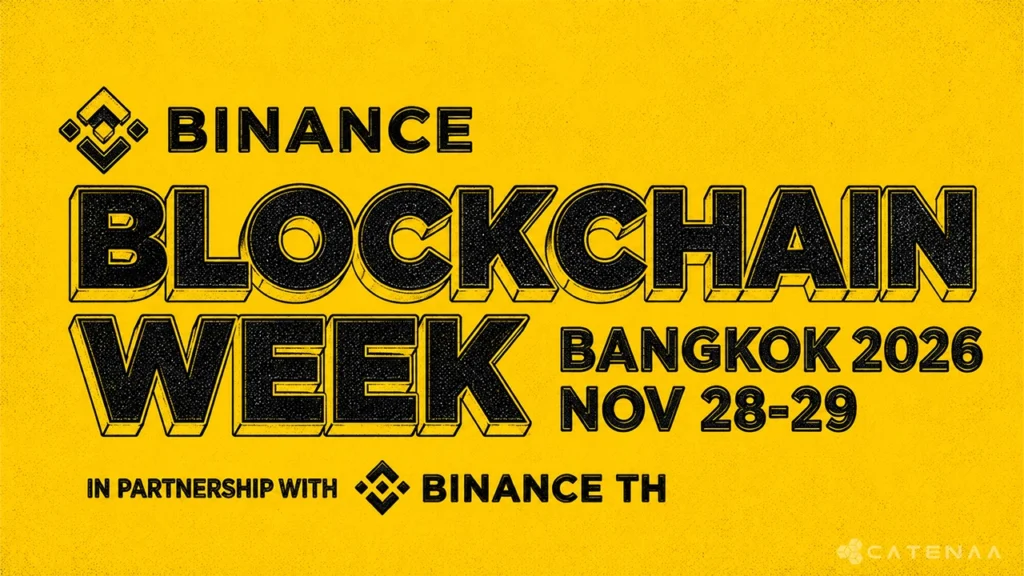


Catenaa, Wednesday, August 26, 2026-Binance will bring its flagship Blockchain Week back to Asia in November, choosing Bangkok as the venue for discussions centered on institutional crypto adoption and the convergence of traditional finance with digital assets.
Binance Blockchain Week Bangkok 2026 will run Nov. 28-29 at the Queen Sirikit National Convention Center in the Thai capital.
The event marks the first Asian edition since Singapore and follows previous gatherings in Istanbul, Paris and Dubai.
This year’s theme, “EVOLVE,” reflects an industry that is moving beyond cryptocurrency trading into payments, tokenized securities, asset management and institutional financial infrastructure.
Binance expects developers, institutional investors, fintech executives and policymakers to attend the two-day event.
Binance’s choice of Bangkok reflects the growing importance of Asia in global digital asset markets.
The region combines large retail crypto markets with rapidly expanding institutional participation and a patchwork of regulatory systems.
Several Asian jurisdictions are experimenting with formal licensing, tokenization and regulated digital asset services.
Thailand has also been developing a more structured framework for crypto businesses while allowing regulated exchanges and brokers to operate domestically.
BINANCE TH, operated by Gulf Binance and regulated in Thailand, will serve as a local supporting partner for the event.
Binance co-CEO Richard Teng said Asia is where the next phase of integration between traditional finance and digital assets could be built and adopted at scale.
The company plans to use the Bangkok gathering to examine how that growth can occur alongside stronger consumer safeguards and clearer operating standards.
The agenda illustrates how much the industry’s focus has changed.
Institutional Bitcoin investment will remain one topic, but discussions will extend well beyond cryptocurrency prices.
Stablecoins will be examined as payment and cross-border settlement infrastructure.
Real-world asset tokenization and tokenized equities will address efforts to place traditional securities and other financial assets onto blockchain networks.
Institutional DeFi will explore how decentralized financial infrastructure can interact with regulated financial firms.
The event will also examine artificial intelligence and digital assets, an area attracting growing attention as AI agents become capable of interacting directly with wallets and financial applications.
Cross-border payments and digital portfolio management complete another part of the agenda.
Together, those themes represent an industry increasingly competing with parts of traditional financial infrastructure rather than merely creating alternative digital currencies.
Large financial institutions have steadily increased their participation in digital assets.
Spot Bitcoin and Ether exchange-traded products have expanded regulated investment access, while banks are developing tokenized deposits, digital custody and blockchain settlement systems.
Asset managers are also experimenting with tokenized funds and Treasury products.
Stablecoins have developed from crypto trading instruments into tools for international settlement and business payments.
Binance’s Bangkok agenda places those developments under the broader question of how traditional financial institutions and blockchain markets increasingly connect.
For crypto companies, institutional participation can bring capital and legitimacy.
It also brings greater expectations around custody, compliance, market integrity and investor protection.
Regulation will therefore occupy a prominent part of the event.
Asia does not have a single digital asset rulebook.
Singapore, Hong Kong, Japan, South Korea, Thailand and other jurisdictions have developed different approaches to exchanges, stablecoins and tokenized assets.
SB Seker, Binance’s head of Asia-Pacific, said the region is increasingly producing practical models showing how digital assets can operate under formal regulation.
Those differences make Asia an important testing ground.
Rules strict enough to prevent abuse but flexible enough to allow new financial products could influence where companies choose to build and where institutions deploy capital.
Binance itself has increasingly emphasized regulatory engagement as it expands across global markets.
Co-CEO Yi He is expected to focus on another issue: whether crypto products can become simple enough for widespread daily use.
The next wave of adoption may depend less on consumers understanding blockchain mechanics and more on digital assets disappearing into familiar financial services.
A user making a cross-border payment does not necessarily need to know which blockchain settles it.
An investor accessing tokenized securities may care more about cost, liquidity and legal protection than how the token was created.
That is the direction Binance increasingly describes as the industry’s next stage.
The company has framed its longer-term ambition around reaching billions of users by making crypto infrastructure easier to use.
Bangkok’s selection says as much about the changing geography of digital finance as it does about Binance.
For years, much of the industry’s regulatory attention centered on the United States and Europe.
Asia is increasingly developing its own models.
The region contains large digital economies, high mobile adoption, active retail markets and governments willing to experiment with regulated digital assets.
That makes it fertile ground for the convergence Binance wants to discuss.
The more important change, however, is what a major crypto conference now considers central.
Bitcoin trading remains part of the story.
But stablecoin payments, tokenized stocks, institutional DeFi, AI and cross-border settlement increasingly define where competition is heading.
Crypto exchanges are also evolving.
They are moving from platforms that primarily match buyers and sellers of digital coins toward financial ecosystems spanning payments, custody, investment products and tokenized assets.
Binance Blockchain Week Bangkok will therefore serve as a useful measure of how far that transition has progressed.
The industry’s next battle may not be over which exchange lists the most cryptocurrencies.
It may be over who builds the financial infrastructure connecting traditional and blockchain markets.
Binance Blockchain Week is the company’s flagship global industry gathering. Previous editions have been held in Singapore, Istanbul, Paris and Dubai. The Bangkok event will feature Binance co-CEOs Richard Teng and Yi He alongside senior executives from the company’s Asia-Pacific, institutional, marketing and payments businesses. Binance says thousands of developers, investors, policymakers and financial-industry representatives are expected to participate.




