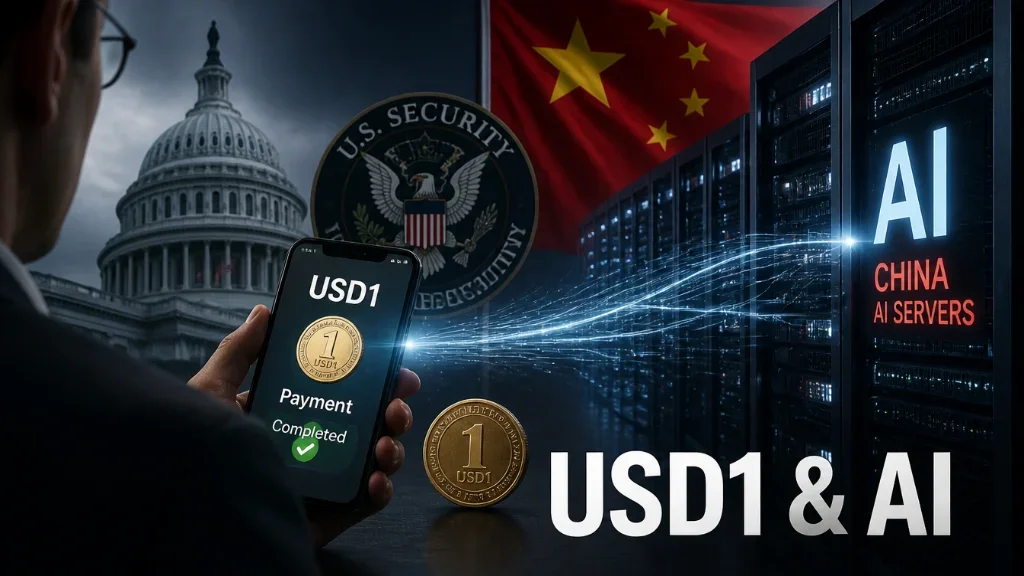


Catenaa, Tuesday, August 25, 2026- Trump family-backed World Liberty Financial is collaborating with an AI platform that distributes models from Chinese technology companies facing US national security restrictions, creating fresh scrutiny over the intersection of the family’s crypto business and administration policy. https://www.reuters.com/world/china/trump-crypto-firm-backs-venture-offering-ai-restricted-chinese-companies-2026-08-17/
Hong Kong-based WorldClaw allows customers to access artificial intelligence models from US and Chinese developers and accepts World Liberty’s USD1 stablecoin as payment.
A Reuters review found that 43 of 90 models available through WorldClaw at the time were developed by Chinese companies, including Alibaba, Baidu, Z.ai, DeepSeek and Moonshot AI.
Several of those companies have faced action or criticism from US government agencies.
However, the collaboration itself is legal, and access to most Chinese AI models is not prohibited for US users.
WorldClaw uses World Liberty’s USD1 as one of its payment options for AI services.
The platform also allows customers to lock WLFI tokens to obtain service packages.
World Liberty Head of Growth Ryan Fang has advised WorldClaw, particularly on USD1 adoption and partnerships.
Donald Trump Jr. and Eric Trump, co-founders of World Liberty, have also publicly promoted WorldClaw.
WorldClaw maintains that it is independently owned and operated and is not managed or controlled by World Liberty.
Its terms explicitly separate the two companies.
The commercial connection nevertheless gives USD1 another use case as World Liberty attempts to expand the stablecoin beyond crypto trading into payments and other digital services.
The controversy centers on some of the AI developers available through WorldClaw.
Z.ai, formerly known as Zhipu AI, was added to the US Commerce Department’s Entity List in January 2025.
The designation restricts the company’s access to certain US technology and requires licenses for covered exports.
The Commerce Department said Zhipu AI supported China’s military modernization through advanced artificial intelligence work.
Alibaba and Baidu were separately included this year on a Pentagon list identifying Chinese military companies operating in the United States.
Alibaba has rejected that classification and said it intends to challenge the designation.
DeepSeek and Moonshot have also faced accusations from US technology companies concerning the use of American AI model outputs to train rival systems.
Those allegations remain separate from WorldClaw’s relationship with World Liberty.
WorldClaw is not exclusively a Chinese AI marketplace.
It also offers access to models developed by US companies, including OpenAI and Anthropic.
World Liberty spokesperson David Wachsman said using a platform that combines models from multiple countries is common across the technology industry.
WorldClaw has similarly argued that making an AI model available does not amount to endorsing its developer.
Its current service describes itself as a unified gateway connecting users with hundreds of AI models.
That model-aggregation approach allows customers to choose among providers based on cost, capability and performance.
The national security issue becomes more complicated when AI aggregators sit between users and model developers.
WorldClaw’s privacy policy says prompts submitted through its services may be transmitted to third-party AI providers for processing.
It also states that WorldClaw does not control how those providers subsequently process information under their own policies.
That does not mean customer information is automatically exposed to Chinese authorities.
But it illustrates why model origin and data handling have become security questions for governments and businesses using AI.
Experts cited by Reuters raised concerns ranging from censorship and surveillance risks to malicious code generated through AI systems.
WorldClaw says it maintains privacy and security safeguards.
The political dimension comes from the Trump family’s financial interest in World Liberty.
Reuters reported that the family owns a 38% interest in the crypto business and benefits from revenue generated through its tokens.
The exact commercial terms between World Liberty and WorldClaw have not been publicly disclosed.
Reuters said it could not establish how much the Trump family had earned specifically from WorldClaw activity.
The White House denied that the relationship creates a conflict of interest and said President Donald Trump acts in the public interest.
The case nevertheless adds to continuing debate over the overlap between the president’s policymaking role and his family’s expanding digital asset businesses.
Catenaa View
The WorldClaw relationship highlights a broader problem emerging as stablecoins become infrastructure rather than simply trading assets.
USD1 is not itself supplying Chinese AI.
It is providing a payment rail to a platform that offers those models alongside American ones.
That distinction matters.
Yet payment infrastructure can help an ecosystem grow, and World Liberty benefits when USD1 gains additional circulation and use.
The result creates an unusual policy tension.
The US government is restricting access to American technology for some Chinese AI developers while a crypto business connected to the president’s family benefits from a platform distributing their finished models.
There is no allegation that either World Liberty or WorldClaw is violating those restrictions.
But the arrangement shows how difficult technological decoupling becomes once AI models, stablecoins and internet services operate globally.
A company can be restricted from obtaining advanced US technology while its AI products remain available through international platforms.
And a US-linked stablecoin can become part of the payment infrastructure supporting that access.
That makes the WorldClaw case less about one crypto partnership and more about the increasingly complicated intersection of AI policy, national security and digital finance.
World Liberty Financial is a crypto business co-founded by members of the Trump family and is behind the dollar-backed USD1 stablecoin. WorldClaw is a Hong Kong-based AI aggregation platform offering access to models from multiple international developers. The companies say WorldClaw is independent, while World Liberty executive Ryan Fang has advised the platform on areas including USD1 adoption. US agencies have separately imposed restrictions or designations on several Chinese AI companies whose models are available through WorldClaw.




