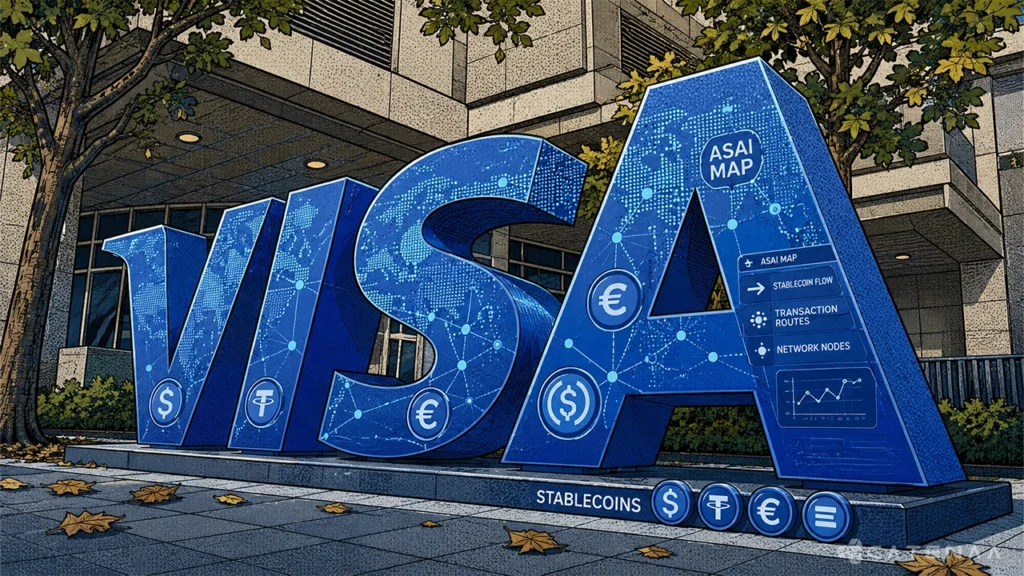


August 26, 2026 – A card network, a payments firm, and a central bank want money to move on Sundays. The stablecoin settlement pilot is narrow, yet the cash flow prize is not.

Visa has joined a Singapore central bank project on digital money. The card network will pilot stablecoin settlement with the payments firm Nium. Moreover, the trial aims to move funds on weekends and public holidays. Nium is the first partner named.
The project carries the name BLOOM. It stands for borderless, liquid, open, online, and multi-currency. Besides Visa, the Monetary Authority of Singapore runs the scheme.
In Summary
Visa joined the MAS BLOOM initiative and named Nium as its first pilot partner in Singapore.
The trial tests whether regulated dollar and euro stablecoins can settle obligations seven days a week.
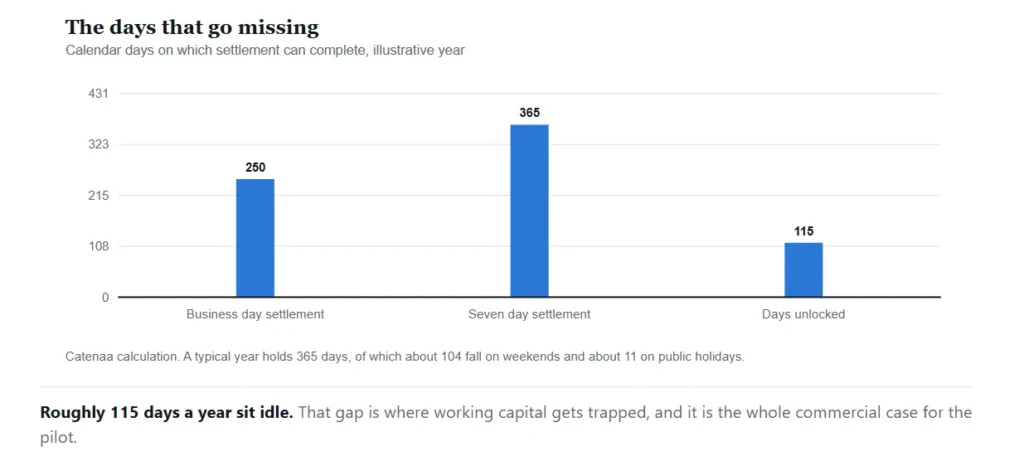
Business day cycles leave roughly 115 calendar days a year when funds cannot land.
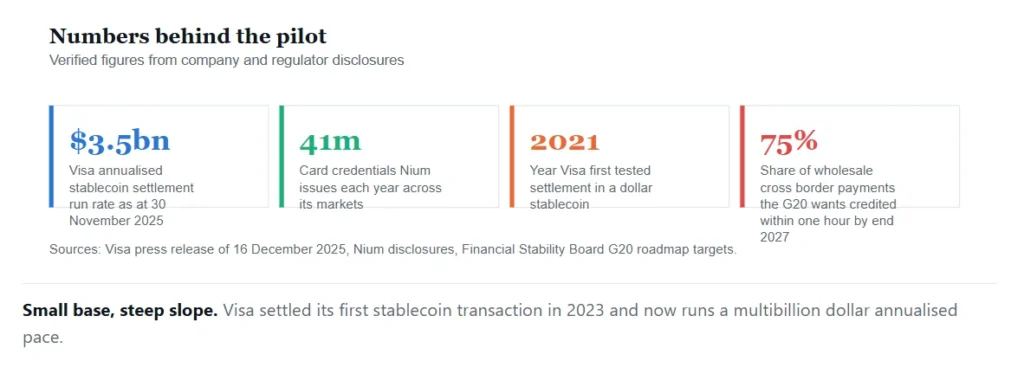
Visa reported a $3.5bn annualised stablecoin settlement run rate as at 30 November 2025.
BLOOM already counts banks, issuers, and payment platforms among its named participants.
Why stablecoin settlement matters here
Card money moves fast. Settlement money does not. Today, most bank legs clear only on working days. As a result, a Friday sale may not fund until Monday.
The gap creates a real cost. Firms hold spare cash to cover the wait. So treasury teams tie up money that could earn a yield elsewhere.
Weekends make up the bulk of the problem. About 104 days a year fall on a Saturday or Sunday. Then add public holidays, and roughly 115 days drop out of the calendar.
What Visa and Nium will test
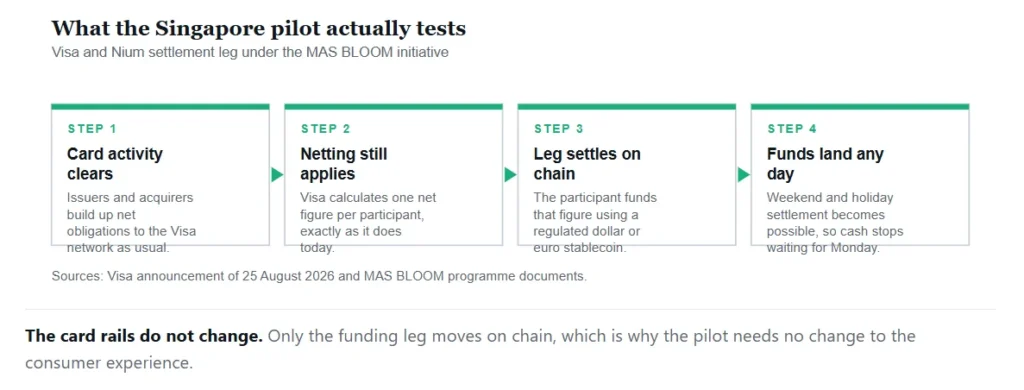
The pilot keeps the card rails untouched. Visa still nets the sums owed between issuers and acquirers in the usual way. Instead, only the funding leg shifts onto a chain.
Currency choice stays cautious. The trial backs only regulated tokens tied to major currencies, chiefly the dollar and the euro. Therefore, members avoid odd collateral and the risks it brings.
Adeline Kim runs Southeast Asia for Visa. She framed the goal as adding to the rails rather than swapping them. Safety, uptime, and rule-keeping must all hold, she stressed. Meanwhile, Amaresh Mohan, chief risk officer at Nium, called the work a step toward joined-up systems.

Nium brings scale, not novelty
Nium is no newcomer to this pairing. Indeed, the firm already settles with Visa using a major dollar token. That deal began under a wider pilot last November.
Above all, volume gives the test weight. Nium issues more than 41m card credentials a year across Singapore, Hong Kong, Australia, Britain and Europe. Also, it began issuing cards inside the United States this year.
BLOOM keeps adding names
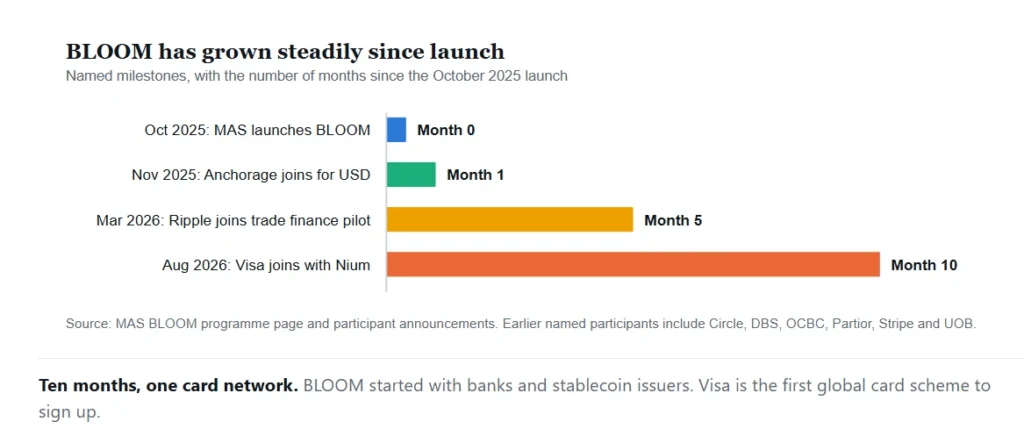
Singapore launched the programme in October 2025. The founding release named two kinds of settlement assets: tokenised bank money and well-regulated stablecoins.
Scope reaches well beyond retail cards. BLOOM targets big-ticket uses such as company treasury, trade finance and machine-driven payments. Besides that, it covers both G10 and Asian currencies.
Membership has widened month by month. Banks, token issuers and payment platforms joined through late 2025 and early 2026. Visa, however, is the first global card scheme to sign on.
The commercial history behind the move
The network has run this test for years. Visa first tried a dollar token leg in 2021. Then it settled its first live deal in 2023.
Scale arrived only recently. For example, in December 2025, the company launched stablecoin settlement for United States banks. At that point, monthly volume passed a $3.5bn yearly run rate.
That launch used the same seven-day logic. Card issuers gained weekend access with no change for the card user. So the Singapore pilot extends a proven model into a new region.
The policy clock is ticking
Regulators set the deadline that frames all of this. The G20 roadmap targets set a deadline for the end of 2027. By then, three-quarters of large cross-border payments should land within one hour.
Retail goals bite harder still. The same roadmap caps the global average cost at 1%, with no route above 3%. Clearly, a five-day cycle makes those numbers hard to hit.
Risks remain, of course. Token legs bring chain outages, redemption queues, and issuer credit questions. Even so, a netted card sum is a fairly small and well-defined risk.
What to watch next
Three questions will decide whether the pilot grows. First, which routes go live and at what volume? Second, whether rival card networks follow into BLOOM.
Third, the currency mix matters. A euro leg would push stablecoin settlement past the dollar for the first time at this scale. In short, Singapore now hosts the test that decides the answer. Watch the next corridor announcement closely.




