

September 03, 2026 – The microgrid deal moves Vertiv upstream to the grid connection. Earnouts could lift the total to $2.6bn.
In Summary
Vertiv will buy UtilityInnovation Group for about $1.45bn in cash, with earnouts of up to $1.15bn.
The upfront price values UIG at roughly 13 times expected 2027 EBITDA.
Closing is targeted for the fourth quarter of 2026, subject to regulatory approvals.
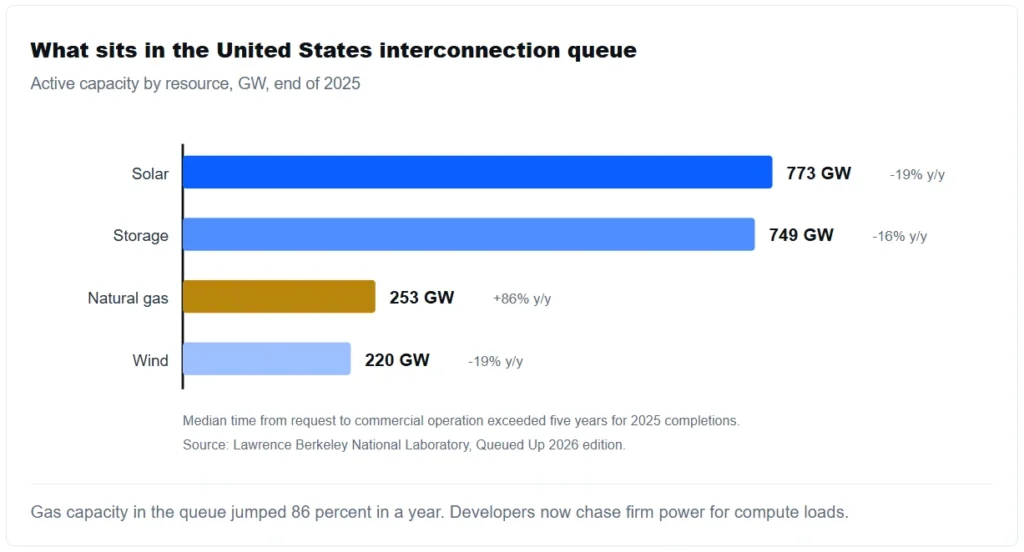
United States interconnection queues held 1,312 GW of generation at the end of 2025.
Vertiv lifted full-year 2026 guidance to $13.8bn to $14.2bn in net sales.
A power bottleneck, priced at $1.45bn
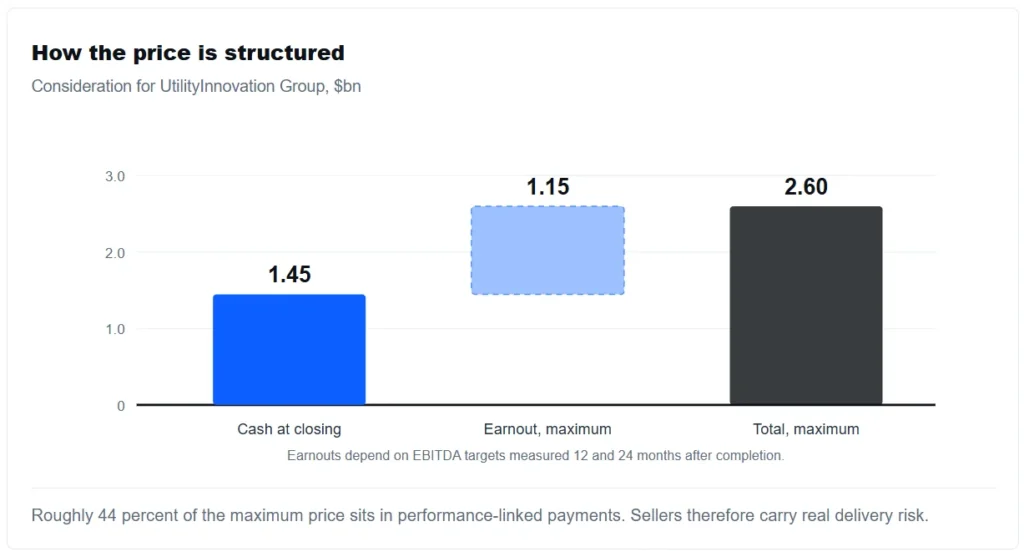
Vertiv has agreed to acquire UtilityInnovation Group. The company disclosed the transaction on 2 September 2026. It will pay about $1.45bn in cash at closing. Earnouts of up to $1.15bn may follow, linked to EBITDA targets over the 12 and 24 months after completion. Total consideration could therefore reach roughly $2.6bn.
The upfront figure implies about 13 times UIG’s expected 2027 EBITDA. Vertiv expects the deal to add to adjusted earnings per share in the first year after closing. Completion is targeted for the fourth quarter of 2026. Regulatory approvals and customary conditions still apply.
UIG was founded in 2020. Its head office sits in Raleigh, North Carolina, with European operations in Dublin. The firm designs microgrid systems and writes the proprietary controls software that runs them. Its customers operate AI data centres across North America and Europe.
Why the grid connection became the prize
Compute capacity no longer waits on chips alone. Electricity has become the binding constraint. American interconnection queues illustrate the squeeze plainly. Roughly 8,200 projects sat in those queues at the end of 2025, according to Lawrence Berkeley National Laboratory research. They represented 1,312 GW of generation and 749 GW of storage.
Waiting times explain the frustration. Median duration from request to commercial operation exceeded five years for projects completed in 2025. History looks harsher still. Only 13 percent of requests filed between 2000 and 2020 had reached operation by the end of 2025. Three quarters were withdrawn.
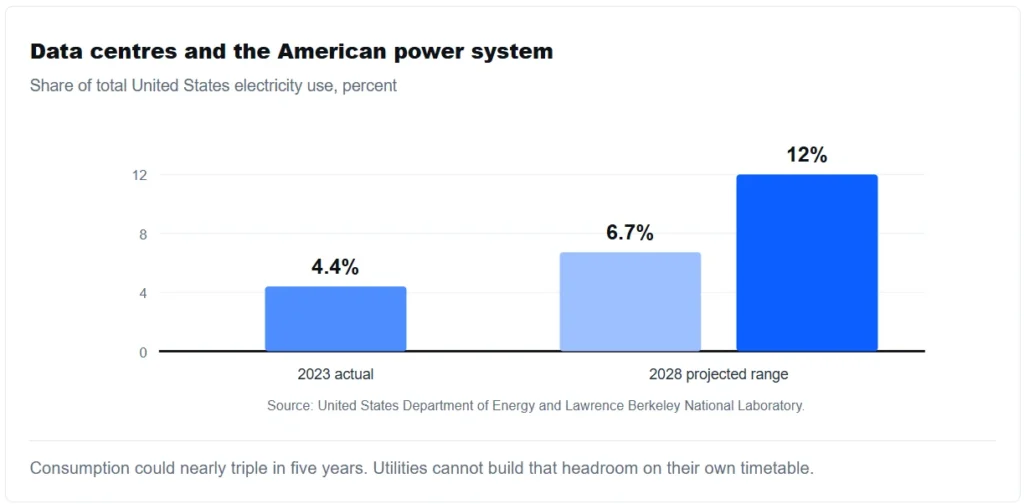
Demand keeps climbing regardless. Data centres consumed about 4.4 percent of United States electricity in 2023, according to the Department of Energy. That share could reach 6.7 percent to 12 percent by 2028. Operators consequently look for power they can build behind the meter.
The strategic logic
Vertiv already sells power distribution and thermal management inside the building. UIG extends that reach to the point where the campus meets the utility. Microgrid controls, onsite generation orchestration and behind-the-meter architecture all come with the deal.
Chief executive Gio Albertazzi framed the rationale in blunt terms. “For AI data center operators, competitive advantage increasingly depends on how quickly they can move from site selection to first token,” he said. Speed to energised capacity, in other words, now beats unit cost.
Compute capacity no longer waits on chips alone. Electricity has become the binding constraint.
Regulators are working on the same problem from another direction. The Federal Energy Regulatory Commission ordered queue reforms through Order No. 2023. Cluster studies and firmer deadlines should shorten waits over time. Private microgrids, however, bypass the queue rather than shorten it.
Vertiv can afford the cheque
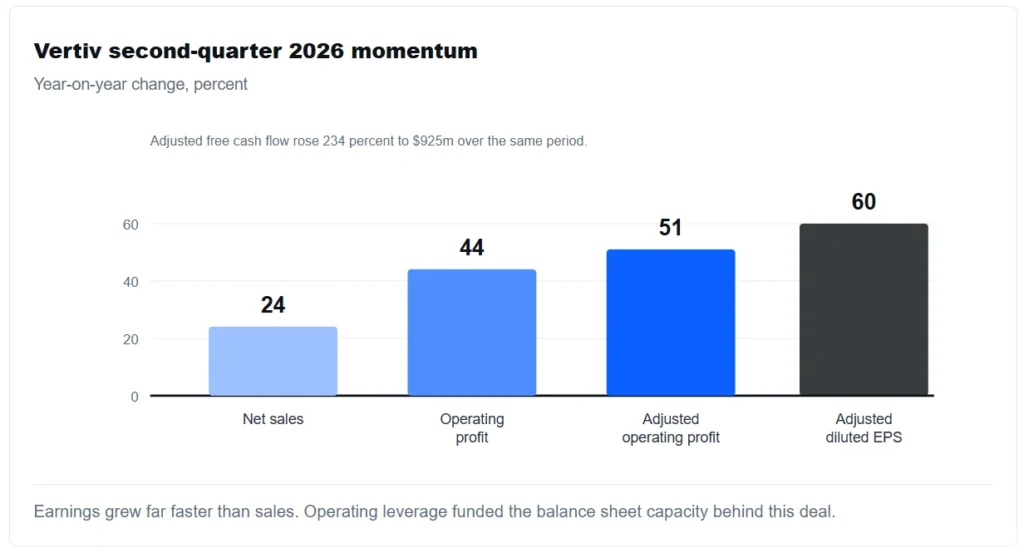
Second-quarter results gave the company room to move. Net sales reached $3.274bn, up 24 percent year on year, Vertiv reported in July. Organic growth supplied 18 points of that gain. Acquisitions added five points and currency added one.
Profitability improved faster than revenue. Adjusted operating margin rose 410 basis points to 22.6 percent. Earnings per share on an adjusted basis climbed 60 percent to $1.52. Free cash flow, also adjusted, reached $925m. That figure was more than triple the prior-year result.
Balance sheet strength followed. Vertiv ended the quarter in a net cash position with $5.6bn of total liquidity. Management also raised full-year guidance to net sales of $13.8bn to $14.2bn. Adjusted diluted earnings per share guidance moved to $6.65 to $6.75.
How the market values this deal
The multiple looks full but defensible. Roughly 13 times expected 2027 EBITDA sits above Vertiv’s own historical bolt-on range. However, UIG grows faster than the parent and carries software margins. Buyers of scarce grid expertise rarely find bargains today.
Structure softens the risk. Nearly half the maximum price depends on results after closing. Vertiv therefore pays the top price only if UIG delivers. Additionally, management expects the deal to lift adjusted earnings per share within a year.
Where the sector goes next
Consolidation is spreading across the power chain. Switchgear makers, turbine suppliers and controls vendors all trade at rich multiples. Buyers want assets that shorten project timelines. Vertiv has now bought one of the clearest examples.
What investors should watch
Integration risk deserves attention first. UIG is a young company with software at its core. Vertiv must protect that engineering culture while folding in procurement and sales. Talent retention through the earnout period will matter greatly.
Backlog conversion comes second. Orders mean little until sites energise. Investors should track whether UIG’s pipeline turns into installed megawatts on schedule. Any slippage would delay the earnout and dilute the strategic argument.
Competition forms the third watch item. Turbine makers, switchgear specialists and independent power developers all court the same customers. Vertiv nevertheless enters with an installed base inside thousands of data halls. That incumbency, combined with grid-edge control, is the bet being made here.