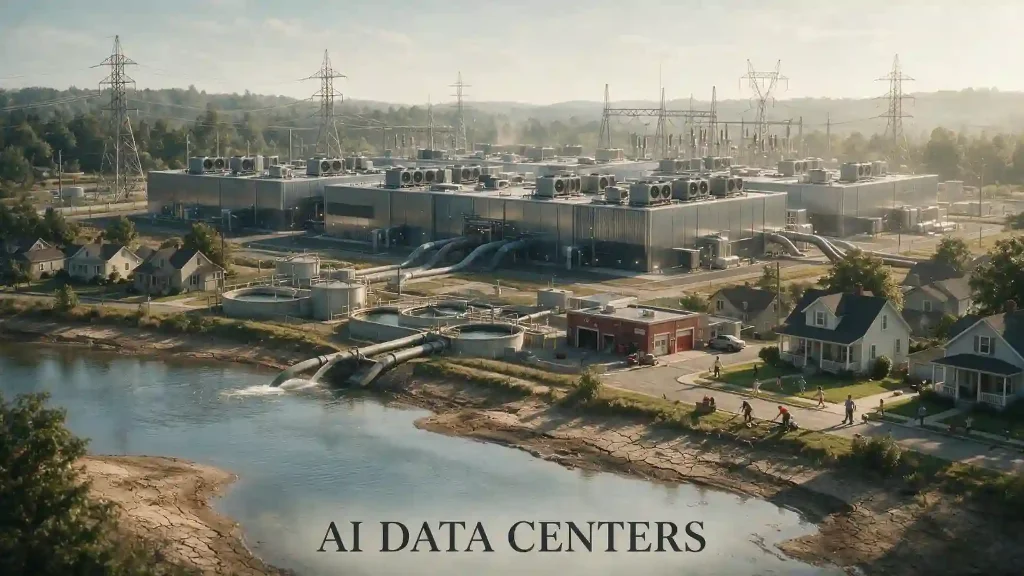


Catenaa, Friday, September 04, 2026- US cities are moving to restrict new AI data centers as communities challenge the rapid expansion of facilities consuming large amounts of electricity, water and land.
Austin, Texas, became the latest city to act Thursday when its City Council voted unanimously to begin drafting regulations that could restrict or exclude new data centers from some areas.
The move follows bans or moratoriums in other parts of Texas, North Carolina, Kentucky and New Jersey as local governments respond to growing public pressure.
Austin officials will now prepare changes to the city’s Land Development Code that define data centers and establish safeguards governing where they can operate.
Council members are expected to consider the first stage of the ordinance in December.
The vote followed growing concern over the resources required by large computing facilities, particularly those being developed to support artificial intelligence workloads.
AI data centers can contain thousands of high-performance processors that require extensive electricity and cooling.
That infrastructure has turned water and power availability into increasingly important factors when communities evaluate new projects.
The Austin vote came as nonprofit sustainability organization Ceres released research examining freshwater withdrawals by power plants serving data centers.
The study covered Virginia, Texas, California, Illinois, Georgia, Ohio and Arizona.
Those seven states account for roughly half of US data center capacity, according to the report.
Power plants serving those facilities withdraw approximately 3.4 trillion gallons of freshwater annually, equivalent to about 10.4 million acre-feet.
Ceres said that figure exceeds California’s average annual urban water demand of approximately 8 million acre-feet.
It is also about 12 times the combined annual water use of Los Angeles, Phoenix and Washington, D.C., according to the study.
The figures require an important distinction.
The Ceres study measures water withdrawn by power plants from rivers, reservoirs and other sources while generating electricity associated with data center demand.
Not all of that water is permanently consumed.
Some is returned to the environment after use, while water lost through evaporation or other processes is not immediately available for reuse.
Even so, large withdrawals can place pressure on supplies during droughts or in regions already facing water stress.
Ceres said 66% of water-using power plants examined in the seven states were exposed to medium or high water stress.
That raises questions about how rapidly data center capacity can expand in regions where water resources are already under pressure.
Austin is not alone.
San Marcos, Texas, amended its zoning rules in June to prevent data center development.
Durham County in North Carolina and Cave City, Kentucky, have imposed moratoriums, while Jersey City, New Jersey, recently barred data centers from becoming the primary use of industrial property.
Local resistance has increasingly moved beyond planning meetings.
At least 37 people have been arrested during protests against AI data center projects in the United States during 2026, according to figures cited by Decrypt.
Opponents have raised concerns ranging from water consumption and electricity prices to noise, industrial development and the effect of large facilities on nearby communities.
The opposition is becoming financially important for the technology industry.
At least 75 proposed US data center projects worth around $130 billion encountered organized local resistance during the early part of 2026, according to figures cited in the report.
That suggests the industry may increasingly face constraints outside federal regulation.
Local zoning boards, city councils and county authorities can influence whether facilities are approved, delayed or blocked entirely.
For companies spending tens of billions of dollars on AI infrastructure, those decisions can affect where new computing capacity is built.
The dispute has also reached state legislatures.
Maine lawmakers approved a proposal in April that would have created the first statewide moratorium on large data centers.
Gov. Janet Mills vetoed the measure because it did not exempt a proposed development in Jay.
She later established an advisory council to examine data center policy.
Pennsylvania has taken a different approach.
The state recently introduced requirements for large data centers to report their water and energy consumption annually.
Such reporting rules could give regulators and communities more information when evaluating future projects.
Water is only one part of the debate.
Large AI facilities can require electricity on the scale of industrial plants, placing additional demand on regional grids.
Communities increasingly want to know who will pay for new generation, transmission lines and substations required to support those facilities.
Critics worry that households and small businesses could eventually bear some infrastructure costs through higher electricity rates.
Developers argue that data centers can attract investment, expand local tax bases and support construction and technical employment.
The economic benefits and resource costs vary considerably by project and location.
The dispute comes during one of the largest infrastructure expansion cycles in the technology industry.
Meta, Microsoft, Google, Amazon and other companies are investing heavily in facilities designed to train and operate advanced AI systems.
Those projects require not only processors but also electricity generation, cooling systems, fiber networks and large parcels of land.
The scale has made AI increasingly dependent on physical infrastructure rather than software development alone.
That dependency is drawing local governments into decisions that were once largely handled by technology companies and utility providers.
Austin’s decision illustrates how the balance of power may be shifting.
Federal and state governments can encourage AI infrastructure investment, but cities often retain authority over zoning and land use.
That gives communities the ability to slow or block projects even when national policy favors rapid AI development.
Local restrictions could also redirect investment toward regions with greater power capacity, water availability or political support.
Companies may therefore need to consider community acceptance alongside electricity prices and network connectivity when choosing future data center locations.
The central question is increasingly whether the infrastructure required for AI can expand without creating unacceptable pressure on local resources.
Supporters see data centers as part of a new industrial cycle capable of creating investment and strengthening US leadership in artificial intelligence.
Opponents want stronger guarantees that communities will not absorb higher utility costs, water shortages or land-use impacts while technology companies receive the economic benefits.
Austin has not yet imposed a ban.
Its council vote begins a rulemaking process that could eventually restrict where future facilities are built and what safeguards they must meet.
But taken alongside actions in several other cities and states, the vote shows that AI’s infrastructure boom is beginning to encounter a new constraint.
The next competition for computing power may depend not only on chips and electricity, but also on whether local communities are willing to host the data centers themselves.