

August 28, 2028 – Dallas Fed research finds instant settlement could shorten deposit life and shrink the lending banks can safely fund.
In Summary
A Dallas Fed study models how tokenized deposits could reshape bank balance sheets.
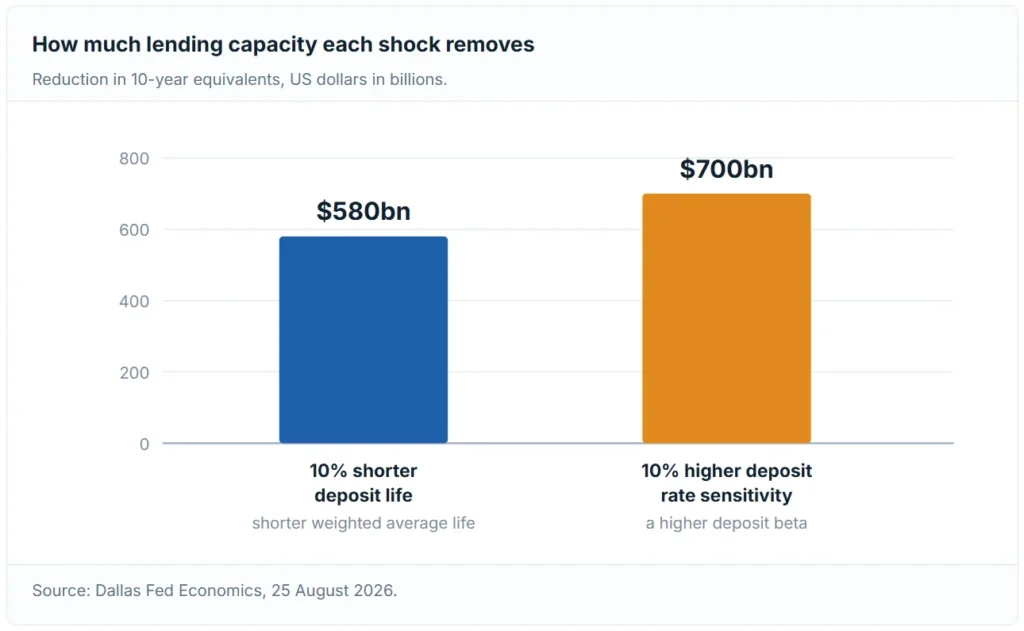
Cutting deposit life by 10% would remove about $580 billion of lending capacity.
A 10% rise in deposit rate sensitivity would strip out $700 billion more.
Roughly 80% of bank duration risk rests on how depositors behave.
Brazil’s Pix rail already shows lower bank lending after its launch.
Instant money carries a hidden cost for banks. New Dallas Fed work asks what happens when deposits move on rails that never close. Rosie Levy and Srini Ramaswamy published the study on 25 August 2026. Their answer is blunt. Tokenized deposits could cut how long money stays put. At the same time, they could make it react faster to rates.
What a tokenized deposit actually is
A tokenized deposit is a bank deposit held on a shared ledger. The claim still sits on the bank. Ownership can move in seconds, at any hour. That speed is the whole point. It is also the source of the risk this study flags.
Why deposit habits fund long lending
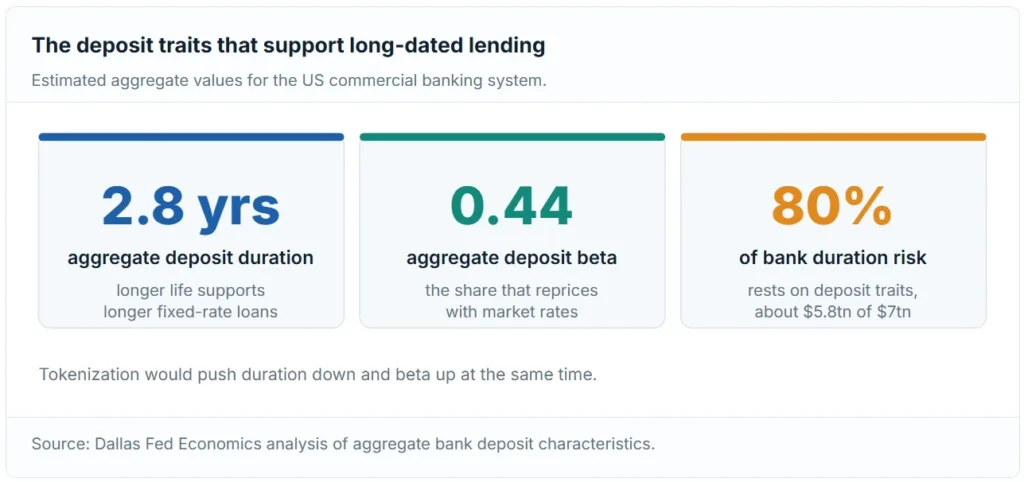
Banks borrow short and lend long. The trick works because deposits behave in steady ways. Levy and Ramaswamy treat a deposit as part floating-rate and part fixed-rate. In practice, beta sets the split. A long life and a low beta let banks write long fixed-rate loans.
Today’s numbers show the point. Across the system, deposit duration sits near 2.8 years. Beta runs close to 0.44. So about 80% of bank duration risk leans on those traits. That share is roughly $5.8 trillion of a $7 trillion total.
Two shocks, one balance sheet
The study runs two simple tests. A 10% cut in deposit life takes about $580 billion out of lending capacity. Next, a 10% rise in rate sensitivity removes $700 billion more. Both figures use 10-year equivalents, a standard way to size duration risk. Neither shock looks wild on its own.
Together, though, they change the funding map. Banks that lose that room must find cash elsewhere. Wholesale debt is the obvious swap. Yet wholesale money costs more than retail deposits. Firms and households would pay that gap in time.
Liquid buffers would need to grow
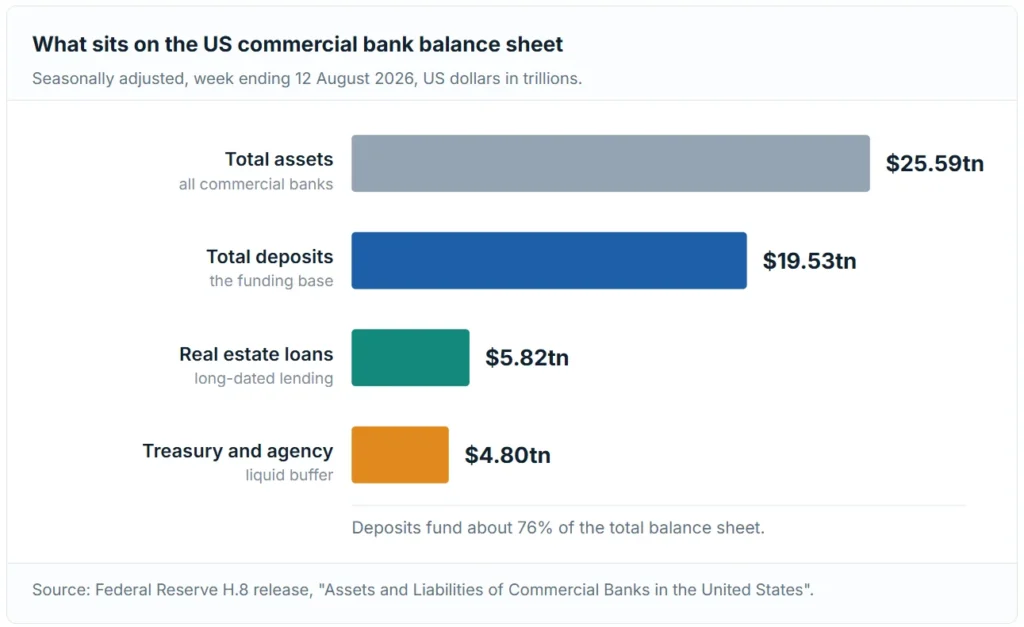
Speed changes habits as well as prices. Instant transfers make daily balances jumpy. Banks would then hold bigger buffers of safe, liquid assets. Indeed, reserves and Treasuries fit that job best. US banks already hold $4.80 trillion of Treasury and agency debt.

Brazil offers a live test
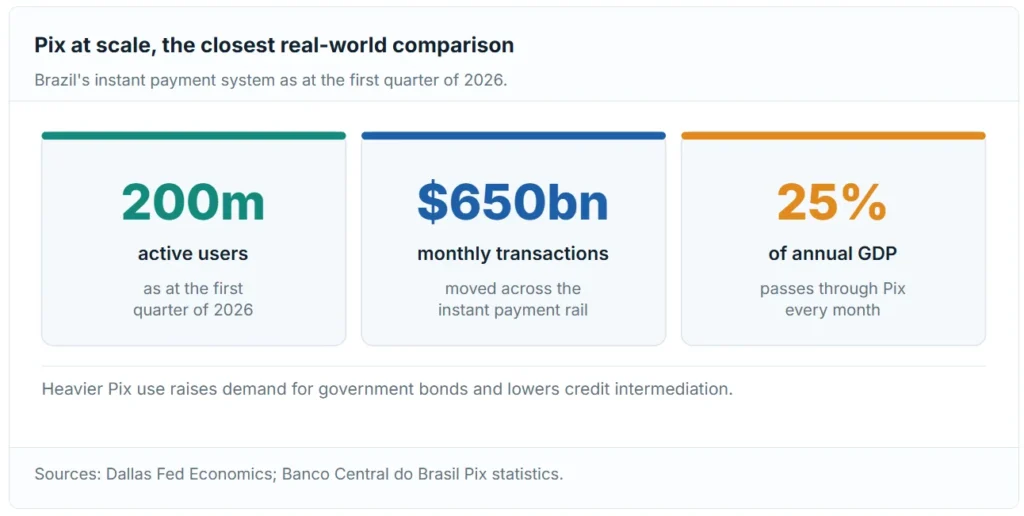
Theory needs proof, and Brazil supplies some. Pix launched in 2020 as an instant payment rail. By early 2026, it had about 200 million active users. Monthly flows reached roughly $650 billion. That sum equals about a quarter of the yearly Brazilian output.
The lending effects are already clear. Heavy Pix use lifts bank demand for government bonds. Meanwhile, lending falls. Within the loan book that remains, banks take on more subprime risk. In short, speed reshapes credit as well as payments.
Brazil is not the United States, of course. Still, the direction of the effect is hard to wave away.
How tokenized deposits differ from stablecoins
The split matters for rule makers. Tokenized deposits sit inside bank rules. By contrast, stablecoins largely do not. Also, a tokenized deposit can pay interest. Wide take-up still needs a way for tokens to move between issuers.
That plumbing gap is doing useful work now. It slows take-up, which buys watchdogs time. Even so, the path looks set. Deposits are turning programmable, and $19.5 trillion of them sit in US banks.
What policy makers should watch
The authors avoid firm advice. Instead, they list the questions worth asking. Payment design comes first. How policy moves through the system comes next. Uneven effects across bank sizes round out the list.
Small banks look most exposed there. After all, their funding leans harder on sticky retail cash. Big banks hold deeper wholesale access and larger liquid books. As a result, the shift could widen a gap that already exists.
The read for markets
Three signals will show whether the model bites. First, watch deposit betas at the next rate move. Second, track bank Treasury holdings against loan growth. Third, look for the first cross-bank token settlement standard. Above all, watch smaller lenders for funding strain.
None of this makes tokenized money a bad idea. It does make the plumbing choices matter. Banks fund homes and firms with deposits that stay put. Speed up the money, and that job gets harder.