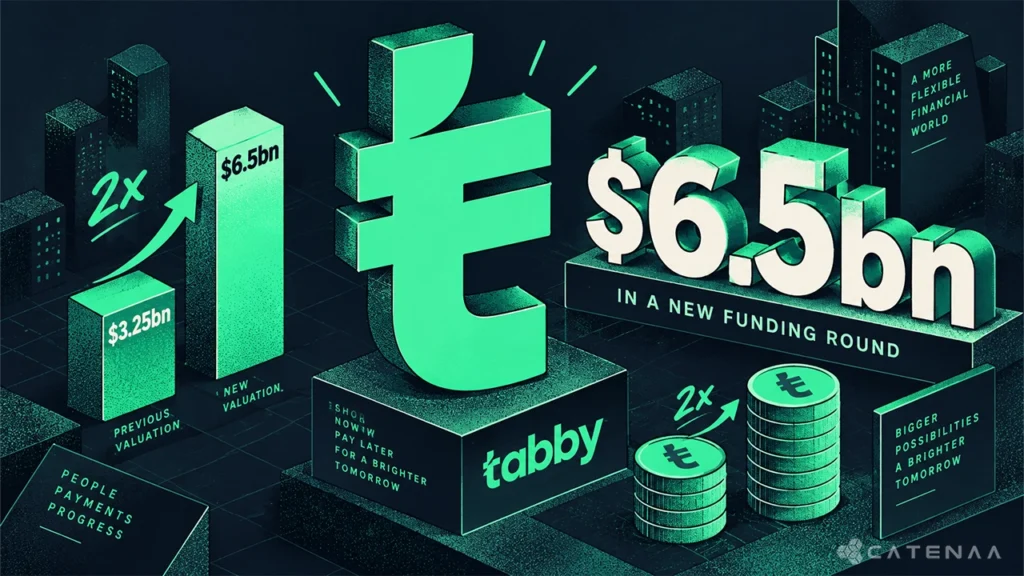


September 17, 2026 – The Saudi buy-now, pay-later leader raised $233 million from Blue Pool Capital and existing backers as it pushes into loans, wallets, and accounts.

In Summary
Tabby raised $233 million at a $6.5 billion valuation, led by Blue Pool Capital.
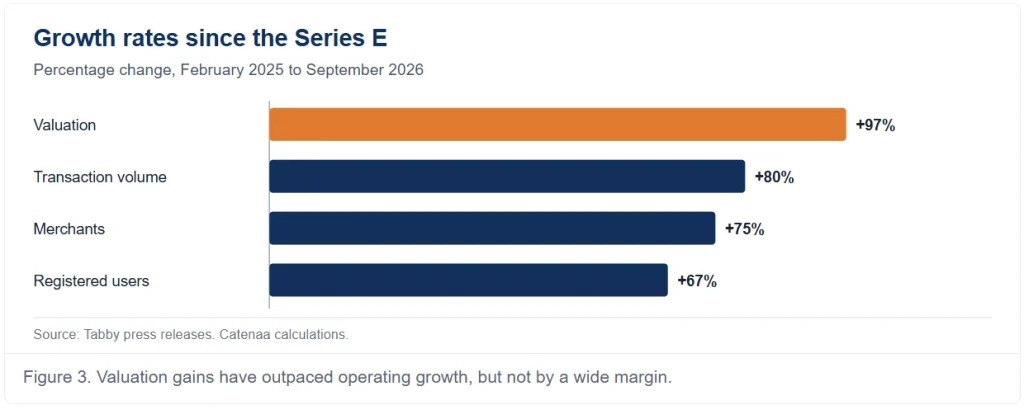
The valuation is up 97% from $3.3 billion at the February 2025 Series E.
Volume topped $18 billion, with 25 million users and 70,000 business partners.
New Saudi finance licences allow plans of up to SAR 50,000 over 12 months.
The round still needs regulatory approval, including from the Saudi Central Bank.
The Tabby valuation has almost doubled in 19 months. On 14 September, the Riyadh based fintech raised $233 million at a $6.5 billion valuation. That deal cements its status as one of the region’s most valuable fintech firms.
This round arrives as the buy now, pay later model faces tough scrutiny in public markets. Yet Tabby says it has stayed profitable since 2023, and investors keep paying up. Today, its business spans Saudi Arabia and the United Arab Emirates.
Inside the latest Tabby valuation
According to the company announcement, Hong Kong-based Blue Pool Capital led the equity round. Existing shareholders HSG, Wellington Management and Arbor Ventures also took part. Regulators, including the Saudi Central Bank, must still approve the deal.
Staff also gain liquidity from the round. Tabby has run share tenders since 2023 and has facilitated more than $100 million in employee share sales. That matters because private firms often struggle to reward early employees before a listing.
Blue Pool manages the assets of investor Joe Tsai and a group of influential families. Its chief investment officer, Christopher Wu, praised the company’s shift beyond payments.
From $3.3 billion to $6.5 billion
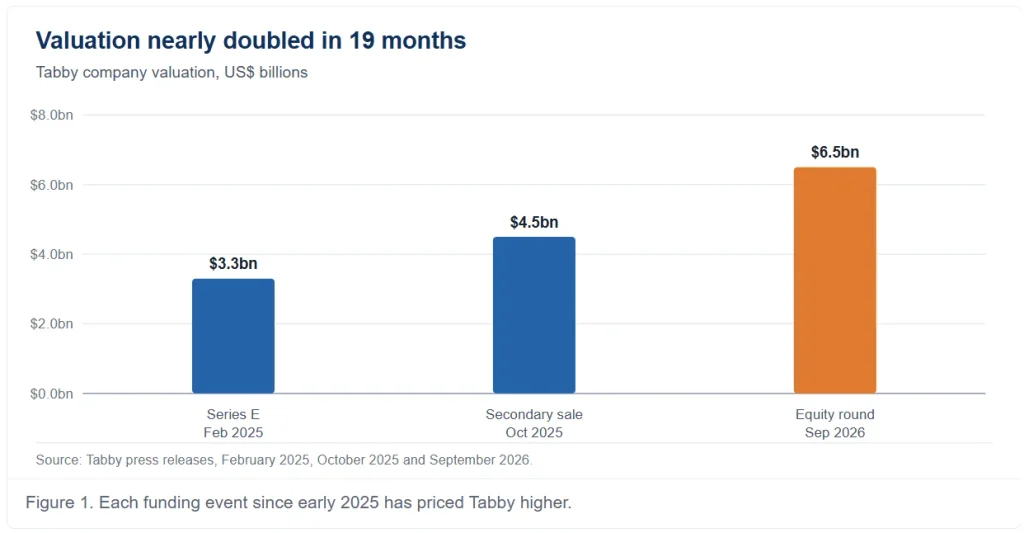
The climb has been steep. In February 2025, Tabby raised $160 million in a Series E round at a $3.3 billion valuation. Then, in October 2025, a secondary share sale implied a $4.5 billion valuation.
No new shares changed hands in that secondary deal, and the company received no proceeds. Even so, it set a fresh marker. The new round lifts the valuation by 97% from the Series E level, based on a Catenaa calculation.
Growth that supports the price
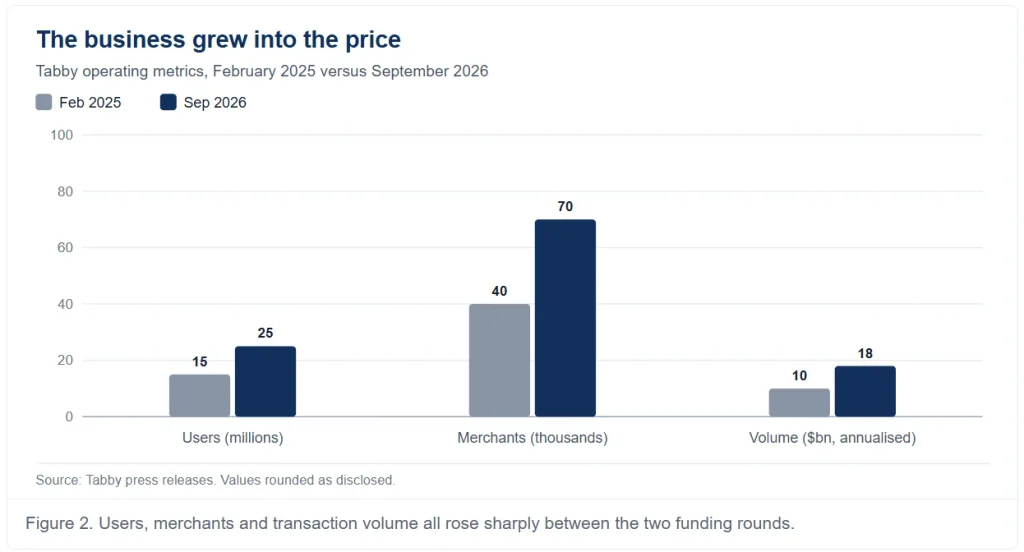
Operating numbers have kept pace. Tabby now processes more than $18 billion in annualised transaction volume, up from over $10 billion in early 2025. Registered users rose to 25 million from 15 million.
Merchant reach grew as well. The company now works with 70,000 business partners, compared with 40,000 sellers in early 2025. Brands include SHEIN, Amazon, Apple, IKEA, and Samsung.
Taken together, the figures show valuation growth running only slightly ahead of the business. Volume rose 80%, while the valuation climbed 97%. In short, investors pay a modest premium for momentum.
Licences unlock new products
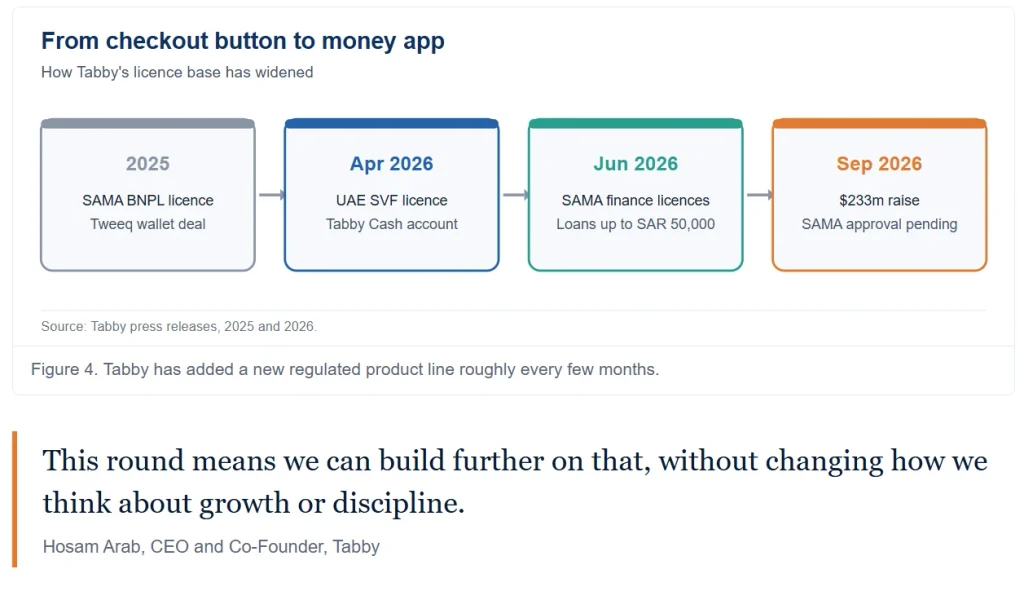
Tabby now wants to become a full money app rather than a checkout button. In June, it won consumer and SME finance licences from the Saudi Central Bank. As a result, Saudi shoppers can now spread purchases of up to SAR 50,000 over as many as 12 months.
Tabby had already graduated from the regulator’s sandbox and won a buy now, pay later licence in 2025. The longer plans use a Shariah-compliant Murabaha structure with a fixed cost and no late fees. In addition, the SME licence lets Tabby lend working capital to retailers on its platform.
The UAE forms the second pillar. There, Tabby holds a stored value facilities licence from the central bank. It uses that licence to run Tabby Cash, a fee-free alternative to a debit account with cashback.
Bigger loans bring bigger risks
Larger plans change the risk profile. A SAR 50,000 purchase over 12 months carries far more exposure than a small four part split. Therefore, investors will watch repayment and default trends as the lending book expands.
Funding costs matter too. With global interest rates rising, lenders pay more for the money they advance. So Tabby’s ability to stay profitable while it scales credit will face a real test.
A contrast with listed rivals
Public investors have treated the sector far more harshly. Klarna listed in New York at $40 a share, according to its IPO prospectus. Its shares closed at $14.11 on 15 September, about 65% below that price.
That gap highlights a key question for Tabby. Private rounds can reward growth and profits, yet public markets often apply stricter tests. Back in 2025, Tabby said it was preparing for an IPO.
What it means for Gulf fintech
For the region, the deal signals strong investor demand for profitable, licensed fintech firms. Saudi Arabia’s Vision 2030 push for cashless payments adds a policy tailwind. Meanwhile, a steady stream of new licences gives Tabby more ways to earn revenue.
Next, watch for SAMA approval of the round and any update on listing plans. Those two steps will show whether private market optimism can survive a public test.