


September 07, 2026 – BNP Paribas and HSBC moved a treasury payment from euro into sterling using tokenised deposits. The pilot tests demand, not just design.
In Summary
BNP Paribas and HSBC ran the first corporate treasury payment on Swift’s shared ledger.
The transfer moved euro at BNP Paribas into sterling at HSBC using tokenised deposits.
Neither bank disclosed the amount or the corporate client involved.
Seventeen banks across six continents are piloting the ledger, which went live in July.
The G20 wants 75 percent of wholesale cross border payments credited within one hour by 2027.

A corporate treasury payment has crossed Swift’s blockchain ledger for the first time. BNP Paribas and HSBC ran it together.
The transfer moved value from a euro account in France into a sterling account in the United Kingdom. Both legs used tokenised deposits.
Neither bank named the amount or the client. Even so, the step matters far more than the size.
Why this test is different
Banks have run bank to bank pilots for years, of course. Corporate flows are another matter entirely.
Yet treasury payments carry real timing, tax and book keeping needs. They also involve a third party with no interest in the plumbing.
So this run tests demand rather than design. In short, it asks whether a treasurer actually gains something. That question has dogged bank blockchain work for a decade.
How the payment worked
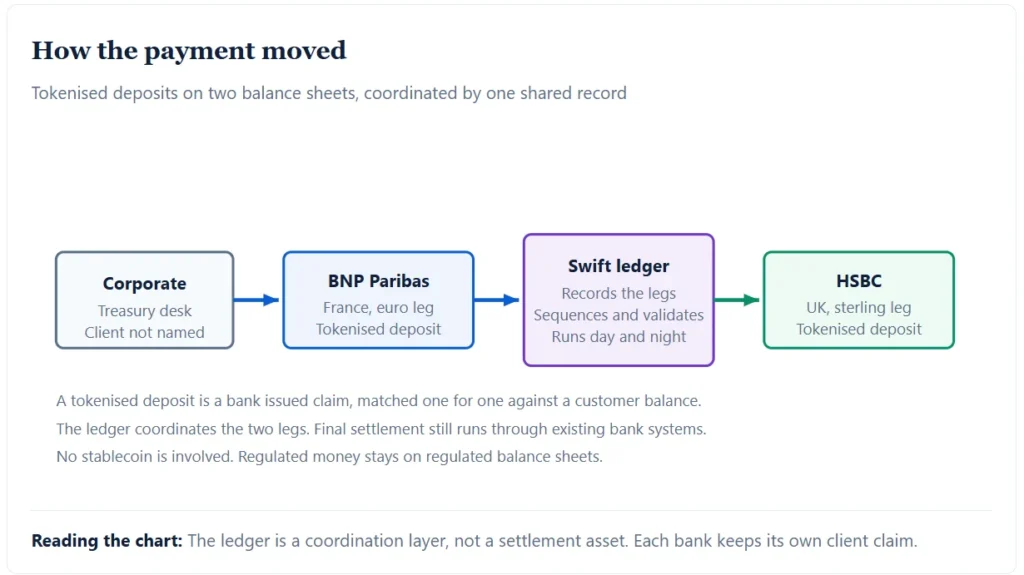
Tokenised deposits sit at the centre. Each one is a bank issued claim, matched against a customer balance.
First, BNP Paribas booked the euro leg. Then HSBC booked the sterling leg. Swift’s shared ledger then matched and sequenced the two.
Its role is to record and to coordinate. Final settlement still runs through existing bank systems.
Such a design keeps regulated money inside regulated hands. Nothing here resembles a stablecoin.
Pierre Fersztand leads cash management and payments at BNP Paribas. Lewis Sun runs digital currencies at HSBC. Both executives have driven their banks’ tokenised deposit work.
Deposits, not stablecoins
The choice of instrument matters a great deal. A tokenised deposit stays a bank liability. So it carries the usual capital, supervision and protection rules.
Stablecoins, by contrast, sit outside that frame. Issuers hold reserves and face different rules by country.
Banks prefer the deposit route for good reason. It keeps both the client relationship and the balance sheet intact.
Critics say it also limits reach. After all, deposits move only where banks agree to connect.
The programme timeline
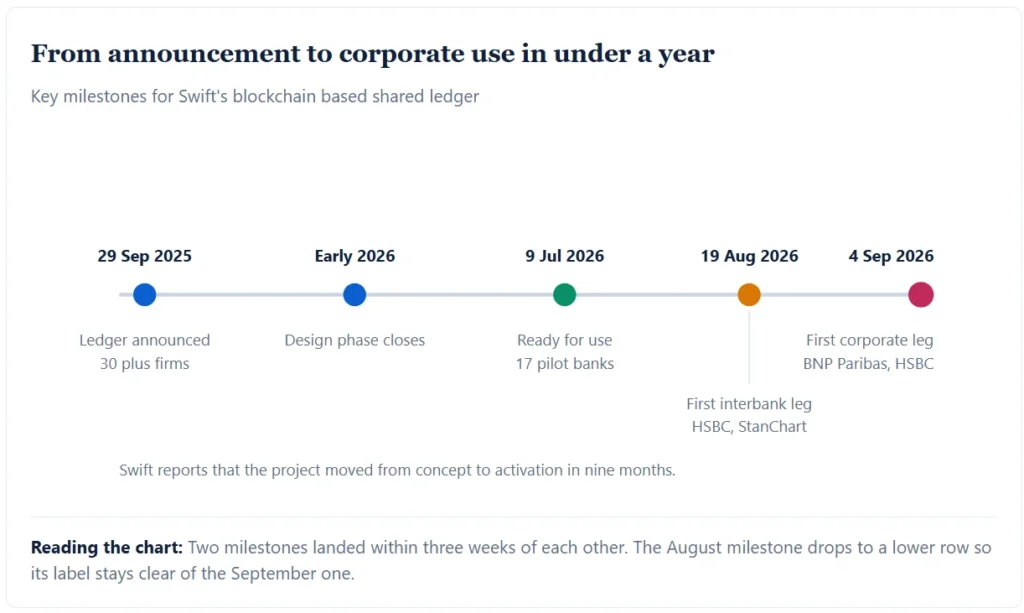
Swift announced the ledger on 29 September 2025. More than 30 firms from 16 countries joined the work. Consensys built the first test version.
The design phase closed in early 2026. Swift then declared the ledger ready for use on 9 July. Seventeen banks across six continents signed up to pilot it.
HSBC and Standard Chartered completed the first live interbank transfer on 19 August. This corporate payment followed weeks later.
Concept to live corporate use therefore took under a year. That pace is unusual for market infrastructure.
Who is in the pilot
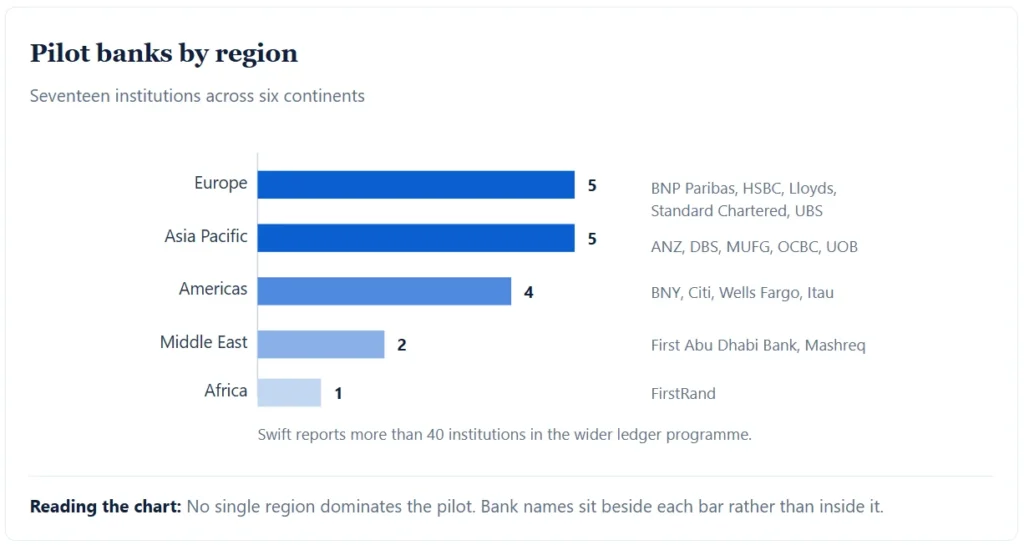
The bank list spans every major region. Europe supplies five members, namely BNP Paribas, HSBC, Lloyds, Standard Chartered and UBS.
Asia Pacific also supplies five: ANZ, DBS, MUFG, OCBC and UOB. Meanwhile the Americas bring BNY, Citi, Wells Fargo and Itaú Unibanco.
First Abu Dhabi Bank and Mashreq cover the Middle East. FirstRand stands for Africa. In short, the group looks global by design.
Swift says more than 40 firms now take part in the wider programme. So the pilot group should widen from here.
The problem it aims to fix
Cross border payments still stumble on time zones. Local systems close at night. Cut off times bite as well.
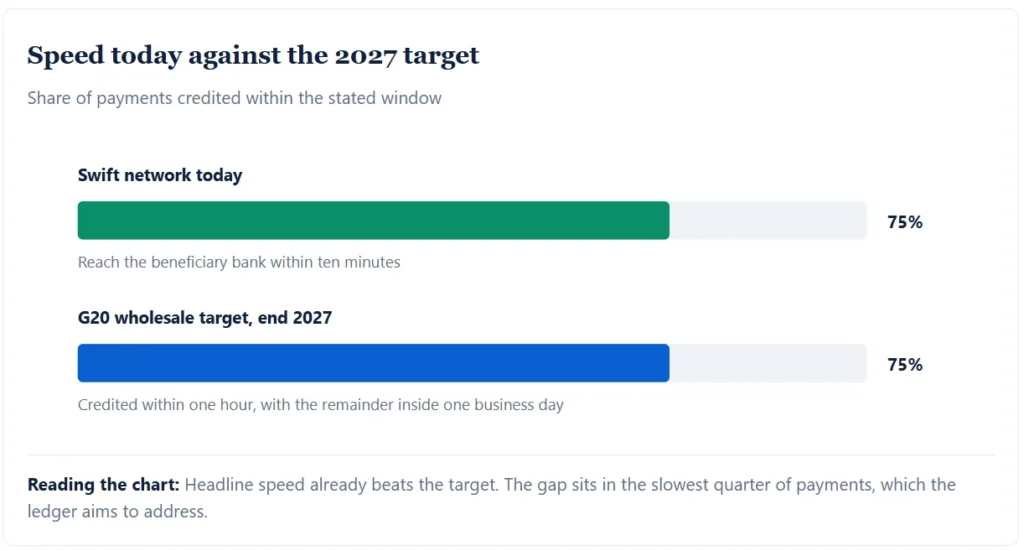
Swift already moves money fast on its main rails. About 75 percent of payments reach the receiving bank within ten minutes. More than 11,500 firms sit on that network.
Yet the last mile drags. Compliance checks, funding gaps and local hours cause most delays.
A shared ledger targets exactly that gap. It offers one common record that runs around the clock.
Regulators set the bar
The Financial Stability Board has a clear target for wholesale flows. By the end of 2027, 75 percent should be credited within one hour.
Furthermore, any remainder should clear within one business day. Those goals sit behind much of this work.
Europe is moving in step. Its central bank is building a link between market platforms and central bank money. Both projects aim at the same weak point.
What treasurers gain, and what they risk
The upside is control. Cash can move outside local bank hours. Buffers can shrink as a result, which frees up working capital.
Matching the books should get easier too. One shared record replaces several private ones. Fewer breaks mean less manual work at month end.
Risks are real, though. Legal finality still differs from one country to the next. Netting can also hide exposures if a member fails.
Book keeping raises another question. Auditors will want to know what a tokenised deposit is. They will also ask where it sits on the balance sheet.
Credit teams should ask similar questions. Intraday exposure to a ledger member is still bank exposure. Limits and haircuts must reflect that fact.
What to watch next
Three markers will show real progress. First, disclosed volumes and corridors rather than single pilots. Second, currencies beyond euro and sterling. Third, corporates willing to name themselves in the flow.
Until then, this remains a proof of concept. It is a promising one, and the pace has been quick. Above all, a live client has now used the rail.




