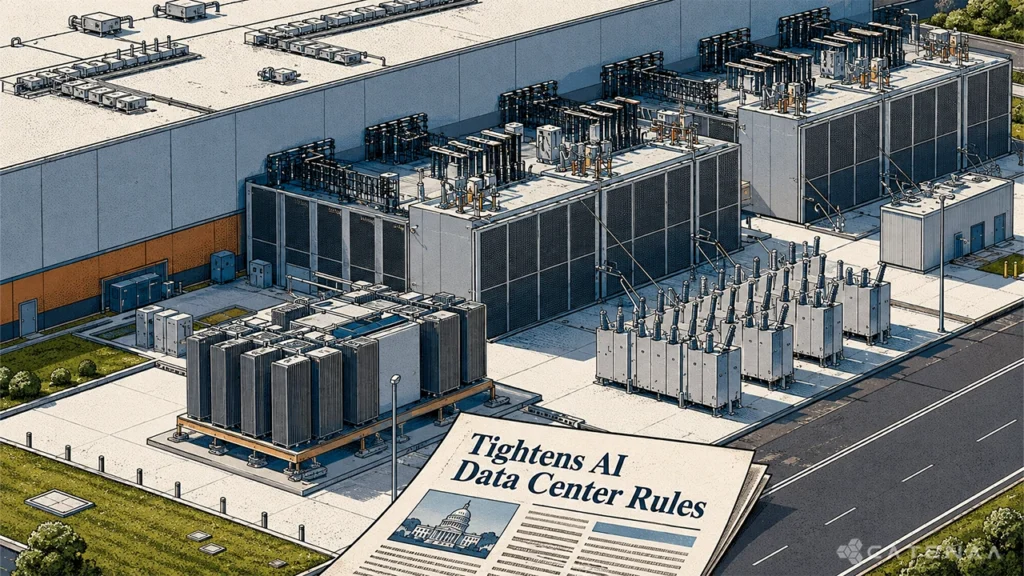


Catenaa, Tuesday, August 25, 2026- Pennsylvania has imposed new restrictions on large data centers, requiring developers to shoulder more of their electricity-grid costs as public resistance grows over the impact of artificial intelligence infrastructure.
Gov. Josh Shapiro signed Executive Order 2026-05 on Tuesday, establishing new requirements for data centers with peak electricity demand above 25 megawatts.
The order removes those projects from Pennsylvania’s Permit Fast Track Program and requires developers seeking streamlined state review to meet environmental, energy, workforce and community conditions.
Developers must also secure required local approvals.
The measures mark an escalation in the debate over who should pay for the enormous amounts of electricity and infrastructure required by AI data centers.
A central part of the order addresses electricity prices.
Shapiro directed Pennsylvania’s Special Counsel for Energy Affordability to pursue utility rules requiring large data centers to cover grid costs created by their projects instead of passing those expenses to other electricity customers.
Large facilities could also face curtailment ahead of other customers during certain grid emergencies unless they secure enough power to meet their own demand.
The policy reflects growing concern that rapid construction of AI infrastructure could force utilities to build new power plants, transmission systems and substations.
Those investments can eventually affect electricity bills if costs are spread across the wider customer base.
Pennsylvania wants large data center operators to bear a greater share of those expenses.
Data centers will also lose access to the state’s expedited permitting system.
The change means developers cannot automatically benefit from the Permit Fast Track Program used to coordinate and accelerate reviews of major projects.
Shapiro said large data centers should not receive special treatment without meeting additional conditions.
The order also bars Pennsylvania state agencies from entering nondisclosure agreements related to data center projects.
That addresses another source of public criticism, as communities have sometimes learned about planned facilities only after negotiations between developers, landowners and government bodies were well advanced.
Pennsylvania plans to establish a public map showing proposed data center developments.
Operating facilities will also have to disclose their electricity and water consumption annually beginning in July 2027.
Water use has become an increasing concern around AI infrastructure because some large data centers rely heavily on cooling systems.
The reporting requirements are intended to give communities more visibility into the environmental and infrastructure demands of projects operating nearby.
Shapiro said his administration had heard concerns from communities across the state about rising utility bills, pollution and the effect of large facilities on local resources.
More than 100 data center projects have reportedly been proposed in Pennsylvania, although only about 20 have submitted applications to the state Department of Environmental Protection.
The dispute reflects the extraordinary energy requirements of modern AI systems.
Training and operating large artificial intelligence models depends on enormous clusters of specialized computing hardware.
Those facilities can consume electricity on the scale of industrial plants.
Technology companies are therefore competing for locations with reliable power, transmission capacity, water and available land.
Pennsylvania is attractive because of its large energy sector and proximity to major East Coast technology and financial markets.
But those advantages have also placed the state near the center of the debate over whether residents should bear infrastructure costs created by AI expansion.
Opposition to data centers has been growing across the United States.
Community groups have challenged projects over electricity demand, noise, water consumption, land use and potential increases in utility bills.
Some technology companies have responded by promising to finance new electricity generation and infrastructure associated with their facilities.
But state and local governments are increasingly considering their own conditions rather than relying on voluntary commitments.
Pennsylvania’s action is notable because it combines permitting, energy pricing, transparency and local approval within a single state policy.
Catenaa View
The Pennsylvania order shows that the next constraint on AI growth may not come from semiconductor shortages or computing technology.
It may come from electricity politics.
AI companies can buy processors and construct data centers, but the power systems supporting those facilities are shared with millions of homes and businesses.
That creates a political problem when investment needed for one industry threatens to increase electricity costs for everyone else.
Pennsylvania’s answer is to make data center developers internalize more of those costs.
The approach could influence other states facing similar disputes.
It also changes the economics of AI infrastructure.
Cheap land and favorable taxes may no longer be enough to attract a project if developers must also finance grid upgrades, meet tougher environmental conditions and negotiate with local communities.
For technology companies, access to power could increasingly depend on proving that their expansion does not make electricity less affordable for surrounding residents.
That represents a new stage in the AI infrastructure race.
The first question was whether companies could build enough computing capacity.
The next is whether communities will accept the cost of hosting it.
Pennsylvania has attracted growing interest from data center developers as AI companies search for large sources of electricity and suitable industrial sites. Executive Order 2026-05 applies additional conditions to facilities demanding more than 25 megawatts of power. The order removes data centers from accelerated permitting, increases disclosure requirements and directs officials to pursue utility rules that protect other electricity customers from project-related grid costs. Similar disputes over power, water and community impacts are developing in other parts of the United States.




