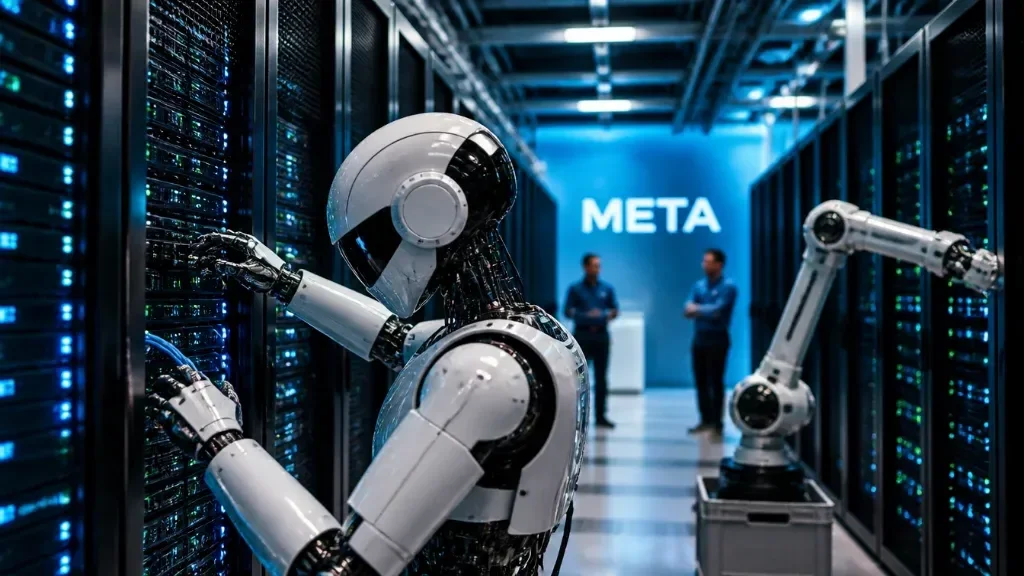


Catenaa, Thursday, September 03, 2026-Meta is testing robots capable of replacing network cables, restarting servers and inspecting equipment inside the data centers supporting its expanding artificial intelligence infrastructure.
The company is experimenting with systems from robotics companies including Watney Robotics, Kinova and ABB, according to a WIRED report cited by Decrypt. The machines could eventually perform repetitive maintenance that currently requires technicians to enter server rooms.
Meta’s experiments come as technology companies spend heavily on computing infrastructure needed to train and operate increasingly powerful AI models.
The systems being tested can perform several physical tasks, including moving server racks, examining equipment, reconnecting cables and restarting servers.
Those jobs may appear simple compared with advanced industrial manufacturing, but data centers create difficult environments for robots. Cables are densely packed, equipment layouts vary and machines must operate around expensive hardware without causing damage.
Current robots remain slower than human technicians and still require supervision. They can also struggle with navigation, visual inspection and limited battery life.
Handling flexible cables presents another problem because their position and shape can change each time they are touched.
These limitations mean Meta’s experiments remain far from fully autonomous data center maintenance.
The tests are nevertheless raising concerns among some employees about what could happen if the technology improves.
One unnamed worker cited by WIRED estimated that a successful cable-replacement robot could eventually perform as much as 80% of the work involved in certain roles.
The estimate came from the employee, not Meta, and should not be interpreted as a company staffing forecast.
Another concern is that automation could change the type of people required inside data centers.
Some experienced technicians fear sophisticated work could be broken into simpler tasks, with lower-paid workers following instructions generated by AI systems while robots perform much of the physical maintenance.
Meta has disputed the broader suggestion that its automation work means fewer workers will be needed.
The company told Decrypt that it continues hiring and training staff because demand for skilled infrastructure workers remains high.
The robotics experiments come during a rapid expansion of global AI computing capacity.
Meta, Microsoft, Google, Amazon and other technology companies are spending heavily on data centers containing advanced graphics processors, networking equipment and cooling infrastructure.
Larger AI systems require more servers and more complex networks, increasing the amount of physical equipment that must be installed, inspected and repaired.
Automating repetitive maintenance could help companies operate those facilities while reducing the time technicians spend on routine tasks.
It could also allow human workers to concentrate on failures and repairs that remain difficult for robots.
The economic question is whether machines primarily supplement those workers or eventually reduce the number needed.
Meta’s project is part of a wider push toward what the technology industry often calls embodied AI.
Instead of operating only through software, embodied AI systems use cameras, sensors and robotic hardware to understand and manipulate their physical surroundings.
Nvidia and Alibaba are developing technologies designed to improve how robots learn such tasks.
Alibaba introduced its Qwen-Robot Suite in June with models covering navigation, physical simulation and object manipulation.
Nvidia researchers have also developed AI agents that can assist with training groups of robots.
A shortage of high-quality real-world training data remains one of the biggest obstacles.
Software models can train on enormous quantities of text or images collected online. Robots need data showing how physical objects move, how environments change and what happens when machines interact with them.
Companies are testing similar technology in factories and construction sites.
Mercedes-Benz has experimented with humanoid robots for repetitive manufacturing work, while Bedrock Robotics has developed autonomous construction equipment.
Developers often present automation as a response to worker shortages and dangerous or repetitive jobs.
Labor groups and workers see another possibility: companies could use automation to reduce headcounts once machines become reliable enough.
Data centers could become an important test of those competing views because the AI boom is simultaneously creating infrastructure jobs and producing technologies capable of automating some of them.
Current robotics systems are not ready to eliminate data center technicians.
Unexpected equipment failures, complicated cable arrangements and delicate repairs can still require human judgment and dexterity.
Robots also need people to supervise their operation and intervene when they encounter unfamiliar situations.
That could change as computer vision, robotic manipulation and AI planning improve.
More autonomous AI agents may eventually allow robots to identify equipment problems, plan repairs and carry them out with less human assistance.
Such systems would combine digital AI reasoning with physical automation.
The financial incentive for technology companies is considerable.
AI data centers contain enormous numbers of servers and networking components, and maintaining them requires staff operating around the clock.
Even partial automation of repetitive jobs could reduce operating costs across large fleets of facilities.
The issue has attracted attention beyond the technology industry.
Microsoft co-founder Bill Gates recently raised the idea of taxing robots and AI-related automation where machines replace human labor, arguing that tax systems can favor automation over employment.
That debate remains largely theoretical, but rapidly improving robotics could make it more immediate.
Meta has not announced plans to replace its data center workforce with robots, and the systems under evaluation remain dependent on people.
The experiments instead show how AI infrastructure may increasingly be maintained by the same technologies it supports.
A data center of the future could contain human technicians, autonomous software agents and physical robots working together.
Whether that creates new technical roles or removes existing ones will depend on how quickly the machines improve and how companies deploy them.
For now, Meta’s robots are still learning how to handle cables and navigate server rooms.
But as AI companies build ever larger computing facilities, even those basic maintenance tasks have become another frontier for automation.




