

August 27, 2026 – Regulators want instant settlement for equities and government bonds. A design plan should arrive in early 2027.
In Summary
Japan plans a blockchain network for stock and government bond settlement.
The Financial Services Agency, the Ministry of Finance, and the Bank of Japan lead the work.
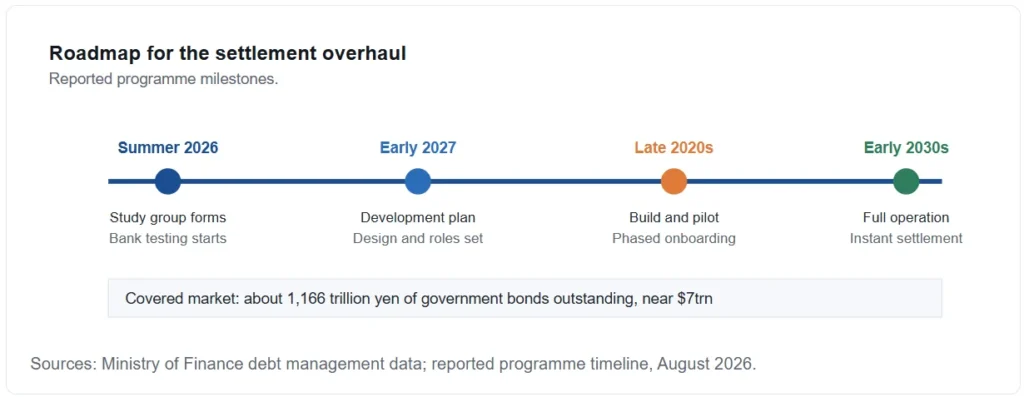
A development plan is expected in early 2027, with full operation in the early 2030s.
Part of the commercial bank reserves held at the central bank would be tokenised.
Japanese government bonds outstanding total about 1,166 trillion yen.
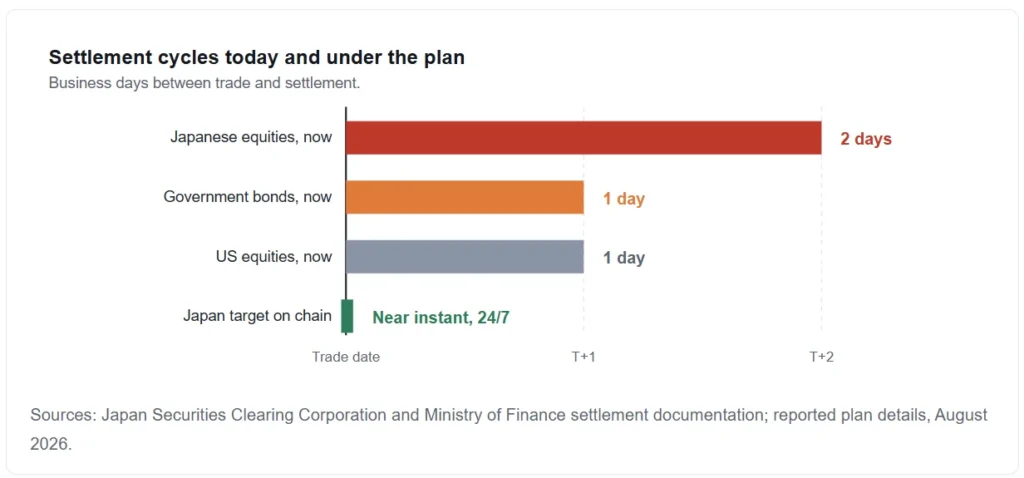
From two days to seconds
Japan wants to rebuild the plumbing under its stock market. Domestic shares currently settle two business days after a trade. Government bonds settle one day after. Under the new design, both would settle almost at once.
Officials plan one shared network for shares and cash. A joint study group begins work during the summer of 2026. It brings together the Financial Services Agency, the Ministry of Finance, and the Bank of Japan. Banks will also join the early tests.
Central bank money moves on chain
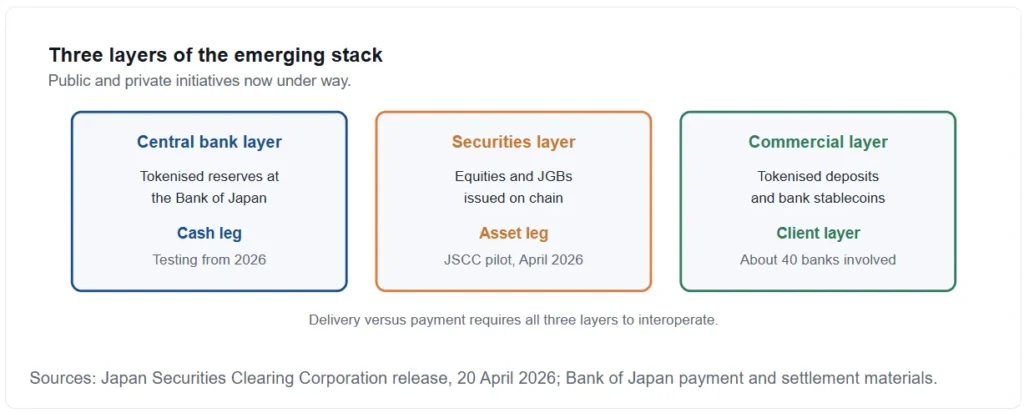
One detail matters most here. A portion of the current accounts that banks hold at the Bank of Japan would be tokenised. Cash would then move as central bank money, not bank credit.
That structure removes credit risk from the cash leg. It also allows true delivery versus payment on one ledger. Interbank testing may begin as early as summer 2026.
Scale explains the caution
The stakes are high. Japanese government bonds outstanding stand near 1,166 trillion yen, or roughly seven trillion US dollars. Officials therefore refuse to rush. They target a full launch in the early 2030s.
Pilots already point the way
Japan is not starting from a blank page. On 20 April 2026, the Japan Securities Clearing Corporation launched a proof-of-concept trial for digital collateral. The JSCC trial uses Japanese government bonds as tokenised collateral. Mizuho, Nomura, and technology provider Digital Asset joined the exercise.
The aim is round-the-clock movement of cross-border collateral. According to the Nomura announcement, the trial tests how the system works, not a live product.
Banks are building in parallel
Roughly 40 regional and online banks have announced a tokenised deposit proof-of-concept exercise. Separately, Mizuho, MUFG, and SMBC are working on a joint stablecoin project. Work, therefore, runs on public and private layers at once.
Why the timing matters
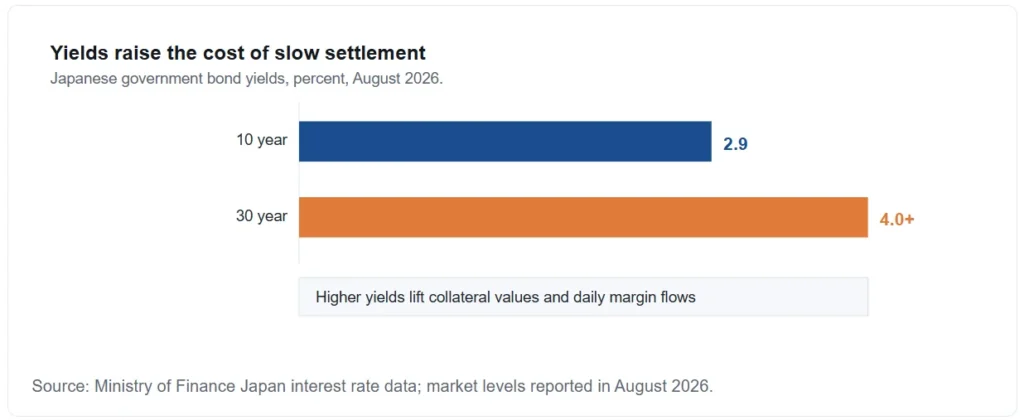
Bond market conditions add urgency. Ten-year government bond yields sit near 2.9%, close to multi-decade highs. Thirty-year yields have traded above 4%. Higher yields lift collateral values and margin calls alike.
Faster settlement frees cash trapped in the pipeline. It also cuts risk between trade and delivery. Consequently, both dealers and regulators gain.
Costs and benefits for market users
Shorter cycles cut margin needs at clearing houses. Dealers can therefore recycle collateral more often each day. Custodians, however, lose fee income from settlement float. Tech budgets will also rise during the build.
Foreign investors stand to gain the most. Japanese assets sit outside the trading day of many global funds. A 24/7 ledger would remove that friction. As a result, cross-border demand for yen assets could deepen.
Asia sets the competitive backdrop
Regional rivals are moving in the same direction. Hong Kong and Singapore have both run tokenised bond programmes. Japan, by contrast, targets core market plumbing, not pilot deals. That aim raises both the payoff and the risk.
Who pays for the build
Funding remains an open point. The state may cover core ledger costs. Banks would then pay to connect. Smaller brokers worry about that bill. Clear rules on fees would ease their fears.
The open questions
Several hurdles remain. Governance of the shared ledger needs clear legal footing. Cross-border access rules must satisfy foreign investors. Moreover, the Bank of Japan still weighs a retail digital yen.
Japan holds one of the world’s largest bond markets, as Ministry of Finance data shows. A smooth switch would set a global template. Failure, however, would slow tokenisation across Asia for years.
Investors should therefore treat early 2027 as the real checkpoint. The development plan will reveal scope, cost, and governance. Until then, the pilots offer the clearest signal of intent. Meanwhile, banks continue to build the private layers around them.




