

September 04, 2026 – A Swift services giant will route payment instructions to blockchain settlement. Banks keep their existing message format.
In Summary
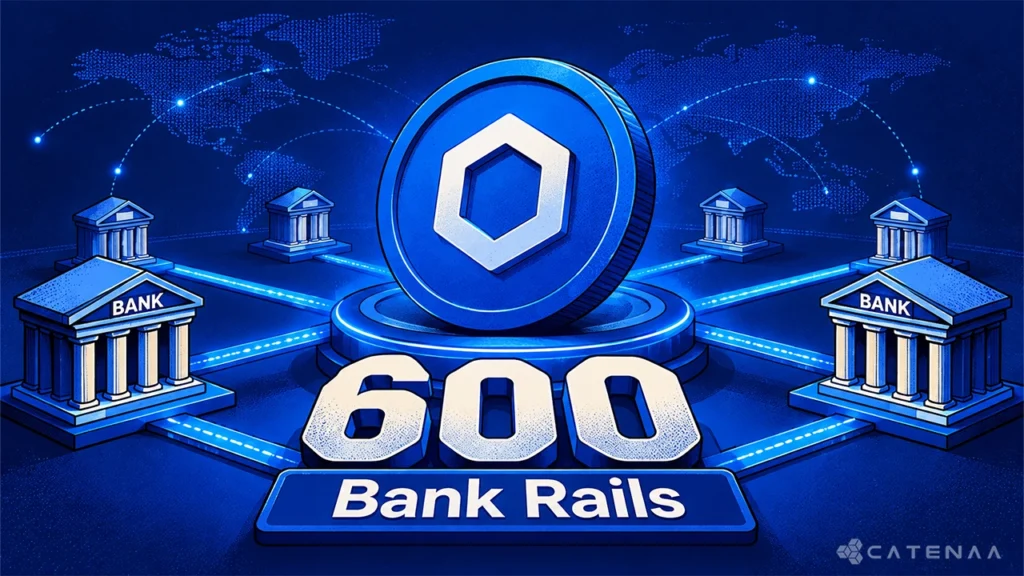
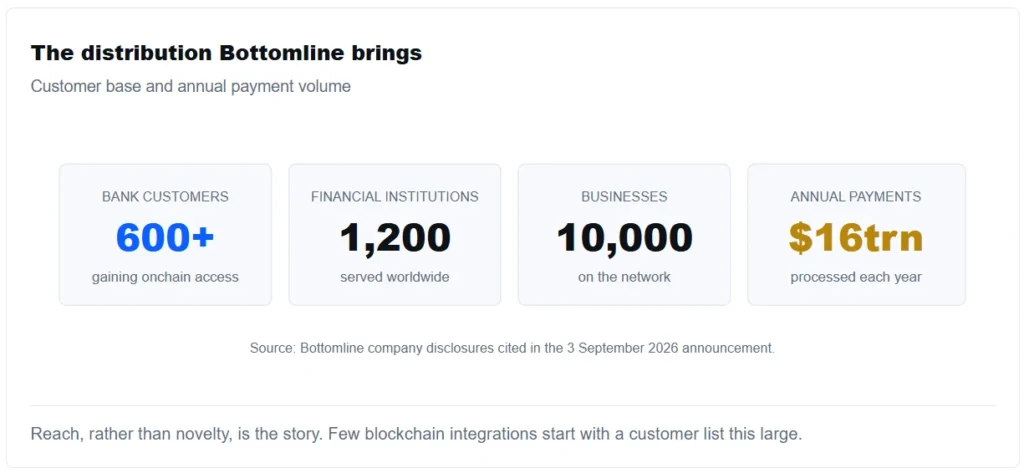
Bottomline will connect more than 600 bank customers to blockchain settlement through Chainlink.
The firm processes over $16trn of payments a year and ranks among the top three Swift service providers.
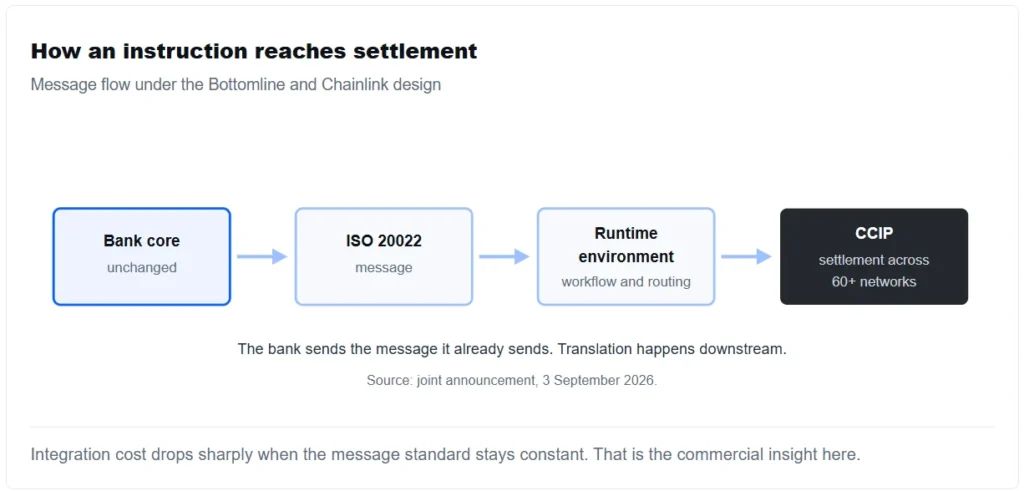
Banks keep ISO 20022 messaging, so core systems need no rebuild.
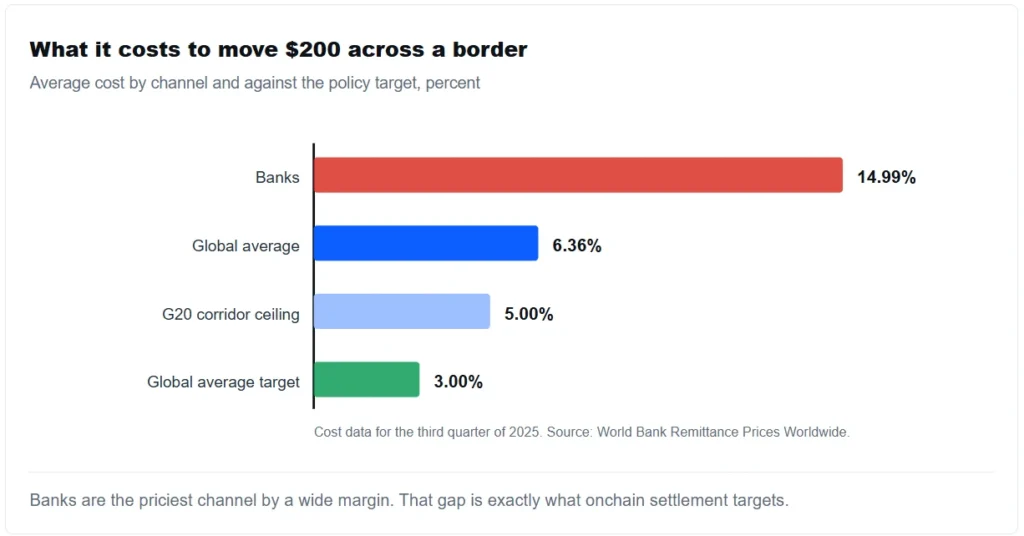
Sending $200 across borders still costs 6.36 percent on average worldwide.
Chainlink’s interoperability protocol already links more than 60 blockchain networks.
A distribution deal, not a pilot
Bottomline has agreed to work with Chainlink on cross-border settlement. The two firms announced the plan on 3 September 2026. More than 600 bank customers gain a route to blockchain rails as a result. Bottomline also serves about 1,200 financial institutions and 10,000 businesses.
Scale gives the deal weight. Bottomline handles over $16trn of payments each year. It ranks among the top three Swift service providers and carries a meaningful share of cross-border traffic. Distribution of that size rarely reaches digital-asset infrastructure.
The design avoids a rip-and-replace project. Banks continue sending instructions in the ISO 20022 format. Chainlink’s software translates those messages into onchain actions behind the scenes. Core banking platforms therefore stay untouched.
The problem is price and time
Cross-border payments remain slow and expensive. Settlement can take days when several correspondent banks sit in the chain. Each hop adds fees, reconciliation work and settlement risk. Transfers can consume 5 percent or more of their value.
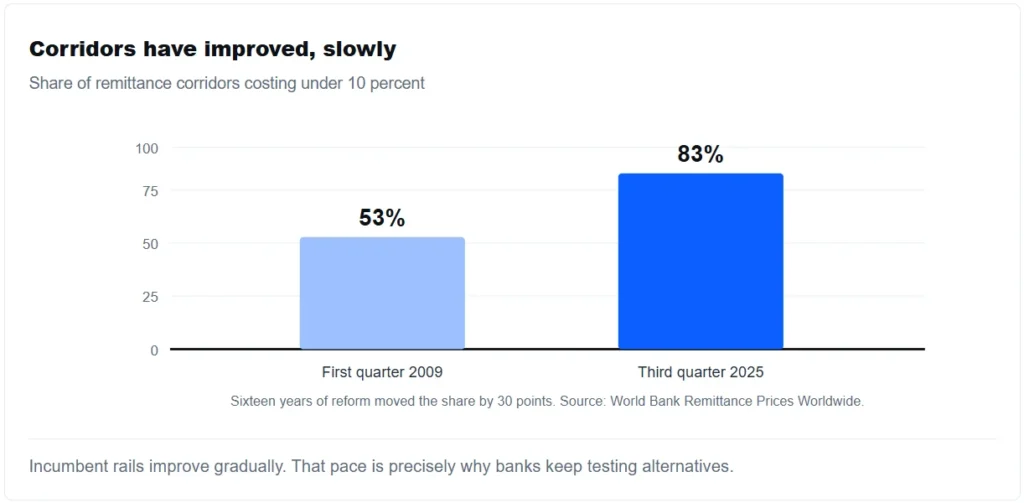
Official data confirms the scale of the friction. Sending $200 cost 6.36 percent on average worldwide in the third quarter of 2025, according to World Bank tracking. Banks charged the most of any channel at 14.99 percent. Progress has been slow rather than absent.
Policymakers set targets years ago. The G20 and the Sustainable Development Goals aim for costs of 5 percent or less in every corridor. A global average of 3 percent sits alongside that goal. The Financial Stability Board roadmap tracks the gap each year.
Chainlink already has bank references
The protocol is not arriving cold. Chainlink’s interoperability layer has run since July 2023 and now connects more than 60 networks. JPMorgan Chase, ANZ Bank and UBS Asset Management have used it. So has the Hong Kong Monetary Authority.
A larger consortium effort runs in parallel. Project Pangea brings together more than 50 banks across Europe and South Korea. Those institutions manage over $10trn of assets between them. Same-day foreign exchange settlement sits at the centre of the work.
Technical detail matters for risk teams. The cross-chain protocol handles message transport and token movement. A separate runtime layer coordinates the payment workflow and chooses the route. Both sit outside the bank’s own perimeter.
Access is not adoption
Capability and usage differ sharply in banking. Every one of those 600 banks must still decide to route value onchain. Risk committees, auditors and regulators each get a vote. Legal finality questions also remain live in several jurisdictions.
Liquidity poses a second hurdle. Onchain settlement needs a settlement asset at both ends. Tokenised deposits and regulated stablecoins are growing, yet corridor depth varies. Thin liquidity can erase the cost saving that motivated the switch.
History counsels patience. Distributed ledger pilots in trade finance and securities took years to reach production. Some never did. Bottomline’s own recent moves, including an American Express tie-up in July 2026, show a steady rather than sudden strategy.
Where the saving would come from
Correspondent chains create most of the cost. Each intermediary holds funds, checks sanctions and charges a fee. Nostro and vostro accounts also tie up liquidity along the route. Prefunding alone consumes working capital at every hop.
Onchain settlement attacks those three items together. Value can move atomically against a payment instruction. Prefunding requirements shrink when settlement is instant. Reconciliation, moreover, becomes a matter of reading one shared record.
Nothing here removes compliance duties. Sanctions screening, travel-rule data and reporting all remain. Banks simply run those checks before the message leaves. The settlement layer changes, while the control layer does not.
What the banks still need to see
Legal finality tops the list. A payment must be final in law, not merely on a ledger. Jurisdictions differ on when that point arrives. Counsel will therefore want written comfort before volume moves.
Operational resilience follows closely. Supervisors expect the same uptime standards they apply to existing rails. Chain outages, bridge failures and key management all enter the risk register. Consequently, most banks will start with small corridors.
Market reaction and what follows
Traders responded quickly to the news. Chainlink’s token rose 6.4 percent on the day. It ranks around thirteenth by market value among digital assets. Announcement-driven moves of that size often fade without follow-through.
Three signals will show real progress. Watch for a named launch corridor with live volume. Look next for a disclosed settlement asset, whether a tokenised deposit or a regulated stablecoin. Finally, track whether any of the 600 banks publicly confirms production use.
Broader context favours the attempt. Analysts project the tokenised asset market could reach $16trn by 2030. Even modest capture of cross-border flow would matter. Meanwhile, Bottomline’s own product cadence suggests further integrations ahead.