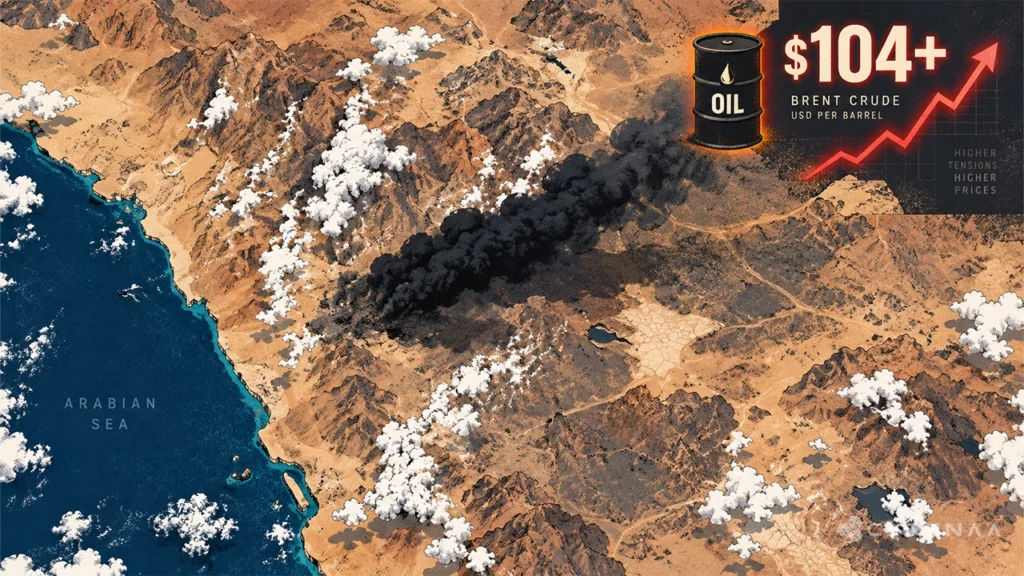


September 13, 2026 – Riyadh closed the East-West line after drone strikes. Houthi forces then seized an island at the mouth of the Red Sea.

In Summary
Saudi Arabia shut the East-West crude pipeline after drone strikes.
The line carries Gulf crude west, away from the Strait of Hormuz.
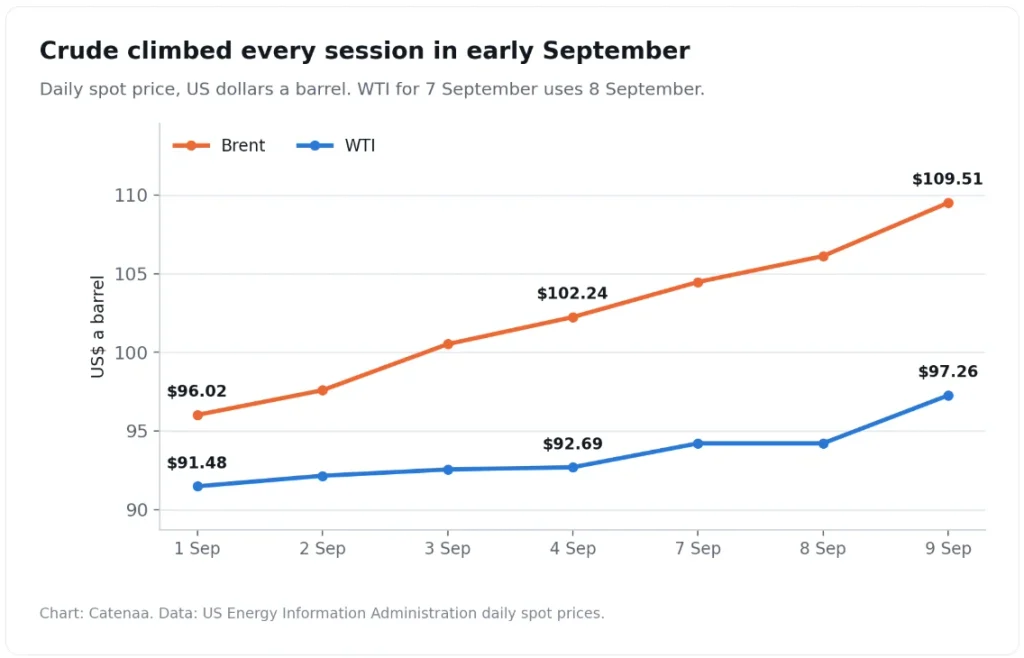
Brent’s spot reached $109.51 on 9 September, up from $96.02 on 1 September.
Houthi forces seized Perim Island at the mouth of the Red Sea.
Bab el-Mandeb traffic never recovered after attacks began in late 2023.
A Saudi pipeline shutdown has pushed crude sharply higher. Riyadh closed the East-West line after drone strikes hit pump stations. The route carries Gulf crude across the peninsula to the Red Sea. Moreover, it exists to avoid the Strait of Hormuz. Losing it removes the main workaround for a crowded chokepoint.
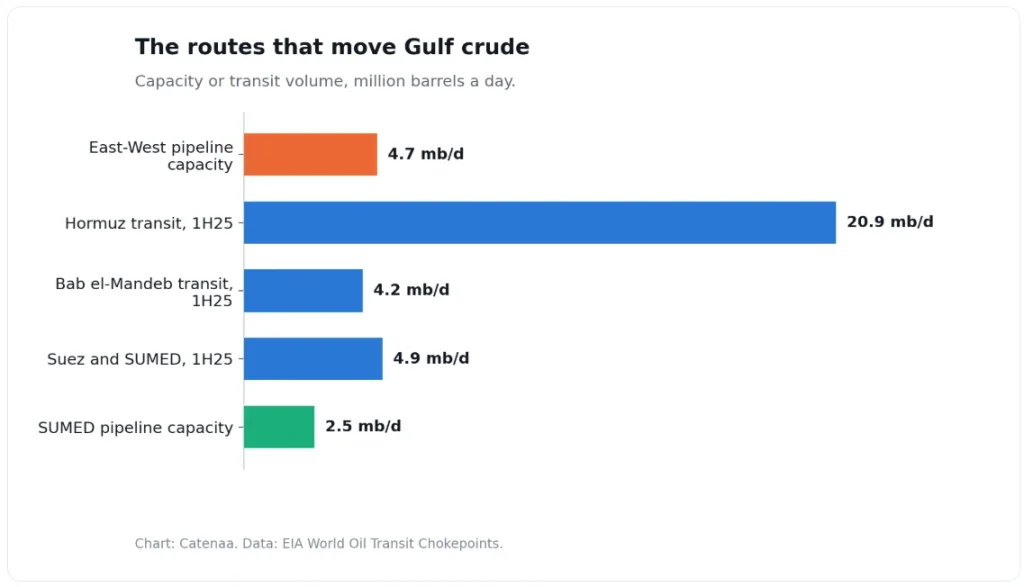
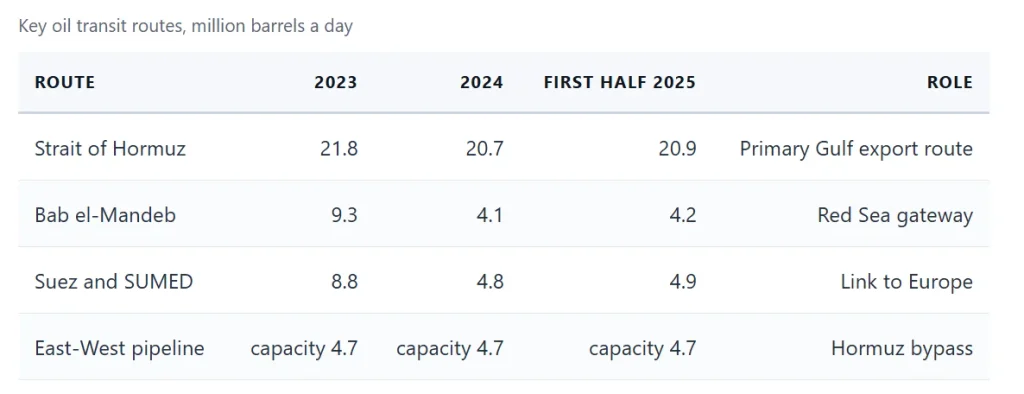
The line runs about 1,200km. Its capacity sits at about 4.7m barrels a day, according to the US Energy Information Administration. That is a large share of Saudi export capability. Therefore, even a short halt changes the supply picture.
Drones did the damage, and they came from the north. Strikes hit sites in the Riyadh and Medina regions. Saudi Arabia then closed the line while teams checked it. In addition, the kingdom kept its southern export options under review.
Pipelines rarely make headlines when they work. Yet this one does quite a bit of strategic work every day. It gives Gulf crude a second exit. Remove that exit, and buyers must trust a single narrow strait instead.
How the Saudi pipeline halt hit prices
Brent spot reached $109.51 on 9 September. It began the month at $96.02. West Texas Intermediate closed at $97.26 on the same day, up from $91.48 on 1 September. So both benchmarks rose in every session of the first week. Traders priced risk, not an actual barrel shortage.
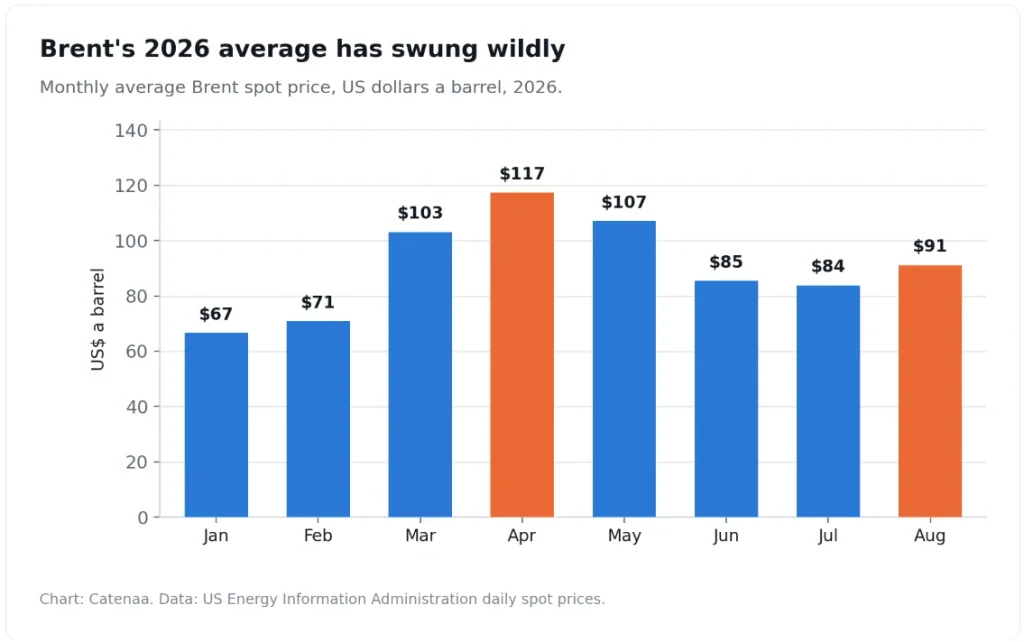
Context matters here. Brent averaged $66.60 in January. It then spiked above $117 in April before easing. August averaged $91.08. Consequently, this move builds on a year that was already volatile. Traders have learned to react fast.
Why the Red Sea matters more than the barrels
Houthi forces seized Perim Island at the mouth of the Red Sea. That island sits beside the Bab el-Mandeb Strait. Ships moving between Asia and Europe must use that gap. Hence, control of the island carries outsized weight.
A group holding both banks and the island can watch every hull. It does not need to sink ships to change behaviour. Instead, it needs only to make owners doubt the route. Doubt alone raises costs across the chain.
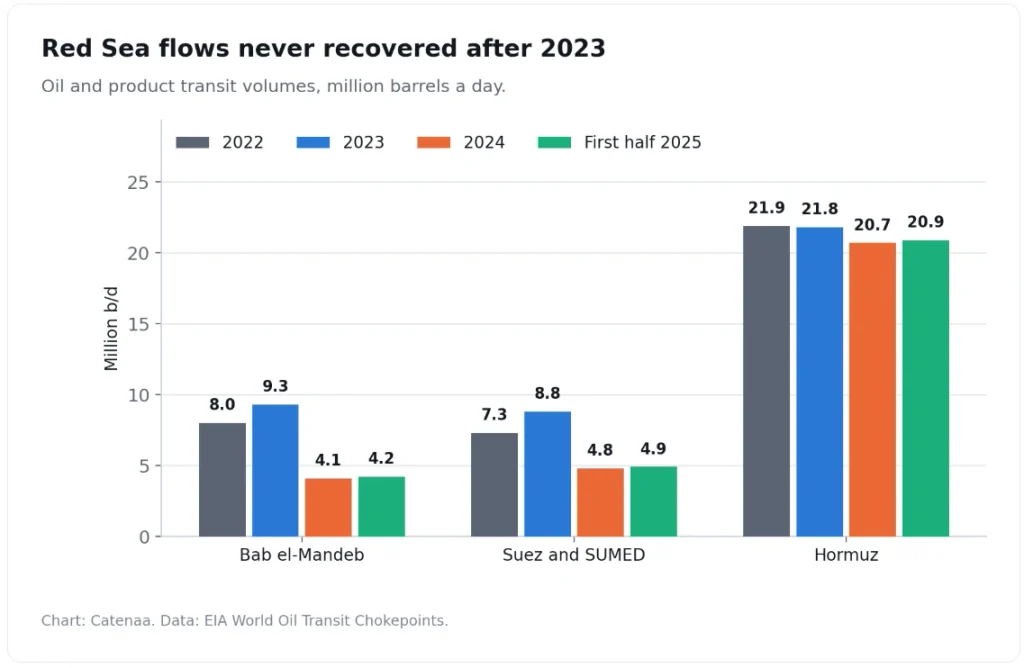
Traffic there already collapsed once. EIA data show 9.3m barrels a day crossing Bab el-Mandeb in 2023. The figure fell to 4.1m in 2024 after attacks on merchant ships. It recovered only to 4.2m in the first half of 2025. In short, the route never healed.
The detour is expensive. A voyage around southern Africa adds days and fuel. Charter rates rise, and cargo arrives later. Therefore, the same barrel costs more even when nobody loses a ship.
The Hormuz problem behind the headlines
Hormuz still carries about 20.9m barrels a day. That equals roughly a fifth of global petroleum use. The East-West line and the UAE pipeline exist to relieve it. Together, they move under 5m barrels a day. Therefore, the bypass can never replace the strait.
Hormuz volumes have also held up well. They sat at 20.7m in 2024 and 20.9m in early 2025. In contrast, Red Sea traffic halved over the same period. So the world leaned harder on the one route it cannot afford to lose.
What happens next for oil prices
The EIA forecast in September put Brent near $90 a barrel across 2026, with a fall toward $74 in 2027. That view assumes production rises and stocks rebuild. However, forecasts assume routes stay open. Two of the three main routes now carry active risk.
Repair speed will decide the size of the shock. Saudi Arabia fixed an earlier strike on the same line within days. Its energy ministry called this closure a precaution. Readers should watch the Saudi Press Agency for confirmation of any restart.
Three markers matter from here. First, follow daily spot prices rather than futures chatter. Second, track tanker bookings through Bab el-Mandeb. Third, watch freight and war risk insurance quotes. Those three tell the story before official data catches up.
Refiners feel this first. Diesel margins widen when routes lengthen. Asian buyers then bid harder for Atlantic barrels. As a result, the price effect spreads well beyond the Gulf.
Import-heavy economies carry the final cost. India, Japan, and much of Europe buy crude that crosses these waters. Higher freight and insurance land in fuel bills weeks later. Consequently, central banks watching inflation now watch shipping too.
One caution belongs here. Prices reflect fear as much as physical loss. Barrels still flow, and stocks still exist. So a credible restart could unwind much of this move quickly.