

September 06, 2026 – Refining margins on diesel have never been this wide. Moreover, the squeeze sits downstream of the oil well, where policy has almost no quick fix.
In Summary
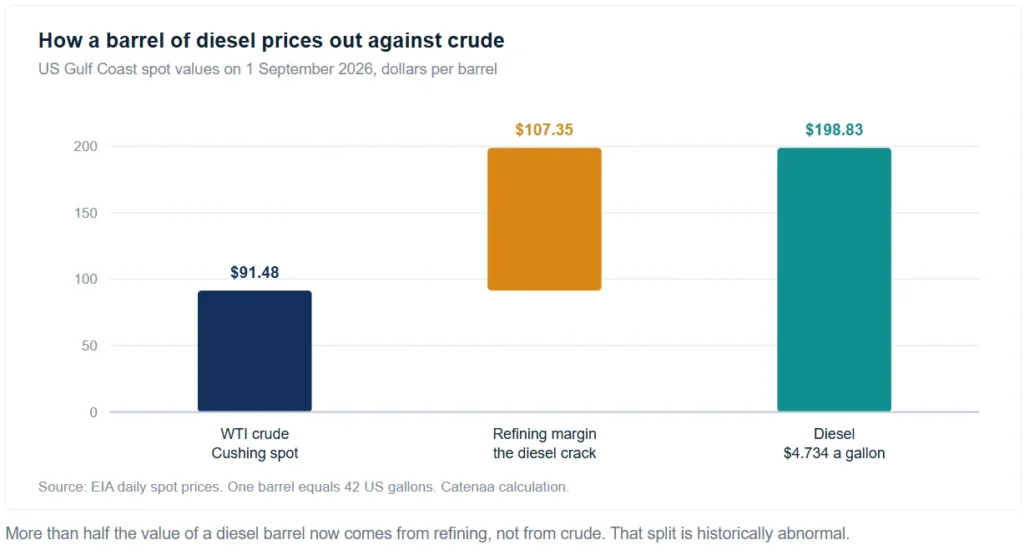
Gulf Coast diesel traded at $4.734 a gallon on 1 September, or $198.83 a barrel.
Against WTI at $91.48, that implies a crack of about $107 a barrel.
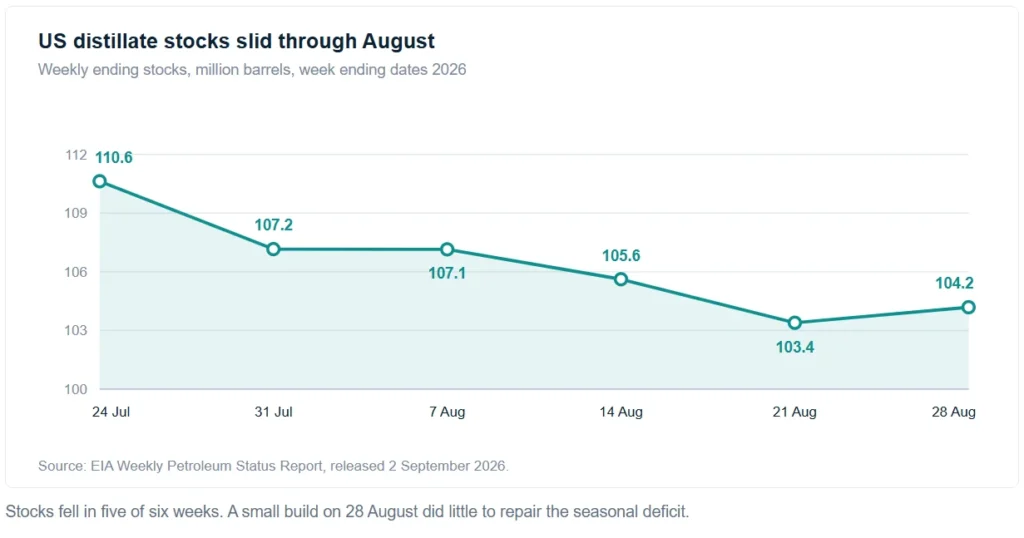
US distillate stocks stood at 104.2 million barrels on 28 August, a 30-year seasonal low.
Refineries ran at 98.0 percent of capacity, yet stocks still failed to rebuild.
The national pump average reached $5.85 per gallon, up $2.14 year over year.

The number that broke a record
Diesel margins have never looked like this. Gulf Coast ultra-low sulphur diesel settled at $4.734 a gallon on 1 September. That equals $198.83 a barrel. WTI crude fetched $91.48 on the same day. The gap works out to nearly $107 a barrel. Normal years produce a spread of $20 to $30.
The crack first cleared $100 in mid August. Records then fell in five of six sessions. By early September, the intraday peak passed $108. Traders now treat triple digits as routine. That shift matters far beyond the futures screen.
What a crack spread measures
The crack spread is a simple margin gauge. It compares a refined product price with the price of crude. Refiners buy the barrel and sell the fuel. The gap between them pays for everything else. Wages, energy, upkeep, and profit all come out of it. A wide crack, therefore, signals scarcity in the product, not the barrel. In other words, the market is paying for processing rather than for oil.
Stocks keep draining despite record runs
Inventories tell the clearest story. US distillate stocks fell to 103.4 million barrels on 21 August. They ticked up to 104.2 million a week later. Both readings sit at the lowest seasonal level since 1996. Six weeks earlier, the figure stood above 110 million.
Refiners are not idle. Gross inputs ran at 17.66 million barrels a day in late August. Utilisation reached 98.0 percent of operable capacity. Few plants can sustain that pace for long. Maintenance season, meanwhile, starts within weeks. Clearly, the output is still not matching demand.
Why refiners cannot simply make more
A refinery is not a tap. Each plant works to a fixed yield slate. Crude type, unit design, and catalyst limits all bind the output. Pushing more diesel costs petrol or jet fuel. Some sites can flex a few percentage points. Beyond that, the chemistry refuses.
New capacity offers no quick answer either. A greenfield plant takes years and heavy capital. Investors have avoided such projects for a decade. Closures, by contrast, have come thick and fast. The result is a thin cushion in every region. One unplanned outage can therefore move the whole curve.
The bottleneck moved downstream
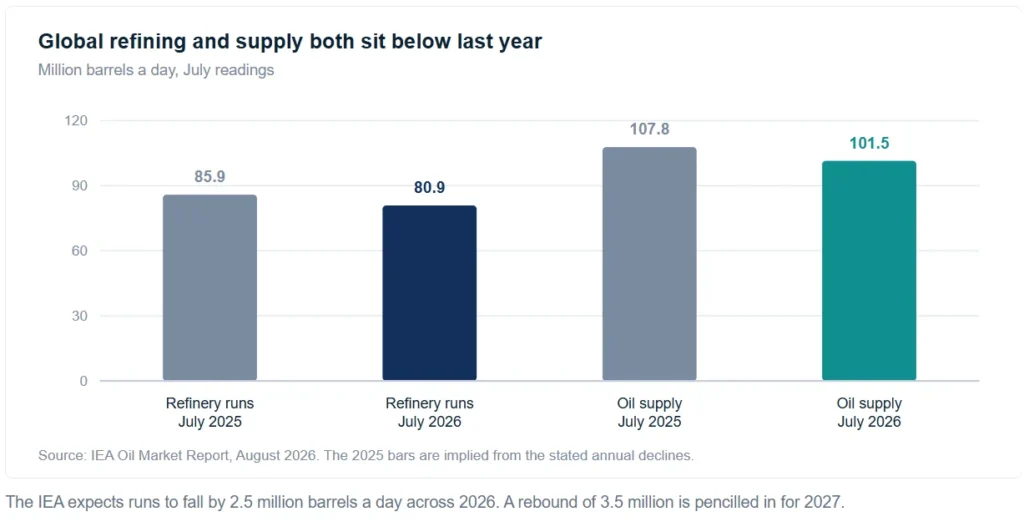
Crude supply is not the binding constraint here. Refining capacity is. Global crude runs averaged 80.9 million barrels a day in July. That level was almost 5 million below the prior year. World oil supply reached 101.5 million barrels a day. It still ran 6.3 million short of the year’s earlier volumes.
Two conflicts explain much of the loss. Missile and drone strikes have hit refineries and export terminals. Roughly 900,000 barrels a day of seaborne diesel moved through the affected Gulf routes. Moscow also banned diesel exports through 30 September. Replacement barrels are simply not available.
Drivers already feel it
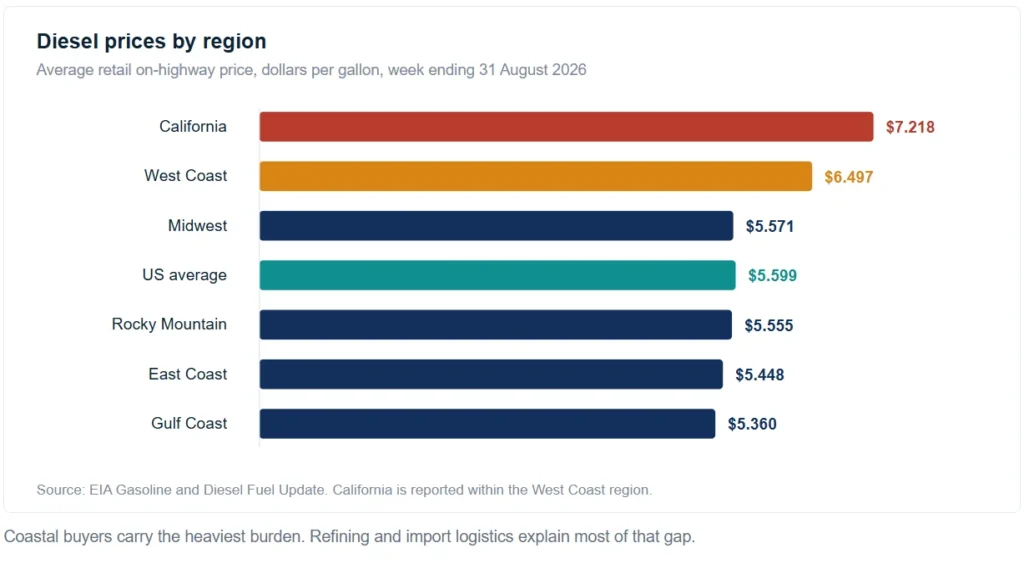
Retail prices have followed the wholesale squeeze. The EIA weekly average reached $5.599 a gallon on 31 August. That marks a rise of $1.865 over the year. Daily figures ran hotter still. AAA put the national average at $5.850 on 4 September. Usually, the two series track each other closely.
Regional gaps have widened sharply. California drivers paid $7.218 a gallon. West Coast buyers paid $6.497. Gulf Coast users paid $5.360, the cheapest in the country. A spread of almost $1.90 across regions is unusual.
Exports keep pulling barrels away
Strong exports explain part of the drain. Foreign buyers pay up for American diesel. Cargoes therefore leave the Gulf Coast rather than refill tanks. Domestic stocks stay thin as a result. Export limits would ease that pressure. Yet they would also raise costs for allies. As a result, Washington has left the trade alone so far.
Why this feeds inflation
Diesel moves the physical economy. Trucks, trains, ships, and tractors all burn it. Freight rates therefore respond within weeks. Food prices follow with a longer lag. Construction and mining costs climb in parallel. A crude spike, by contrast, hits consumers through petrol first. In practice, the pass-through takes about a quarter.
Autumn raises the stakes further. Harvest work lifts farm demand sharply. Heating oil draws on the same distillate pool. Cold weather could therefore tighten an already thin market. Policymakers hold few fast levers here. Strategic reserves hold crude, not finished diesel. Releasing crude would help refiners only at the margin. Consequently, the shortage would persist for months.
What would ease the squeeze
Only three things really help. More refining runs would help, yet capacity is nearly maxed. Fewer exports would help, though that shifts pain abroad. A ceasefire would help most of all. None of those looks likely before winter. To sum up, relief depends on events outside the market.
Investors should watch the weekly stock report closely. A second build would signal the peak. Another draw would point to a harder winter. Freight and food costs sit downstream of that single number.
Several other gauges deserve attention too. Track the front-month spread on diesel futures. Steep backwardation shows a scramble for prompt supply. Follow the weekly product supplied for demand strength. Monitor unplanned refinery outages as well. Together, those readings will confirm any turn. Until they do, assume the squeeze holds. Hauliers and farmers should budget for costly fuel this winter. Hedging that exposure now looks cheaper than waiting.