

September 03, 2026 – The producer wants 600,000 barrels a day from three joint ventures. Infrastructure remains the hard part.
In Summary
Chevron will invest more than $7bn in Venezuela across the next five years.
The company targets about 600,000 barrels a day from its three joint ventures.
Production across those ventures has already risen 15 percent so far this year.
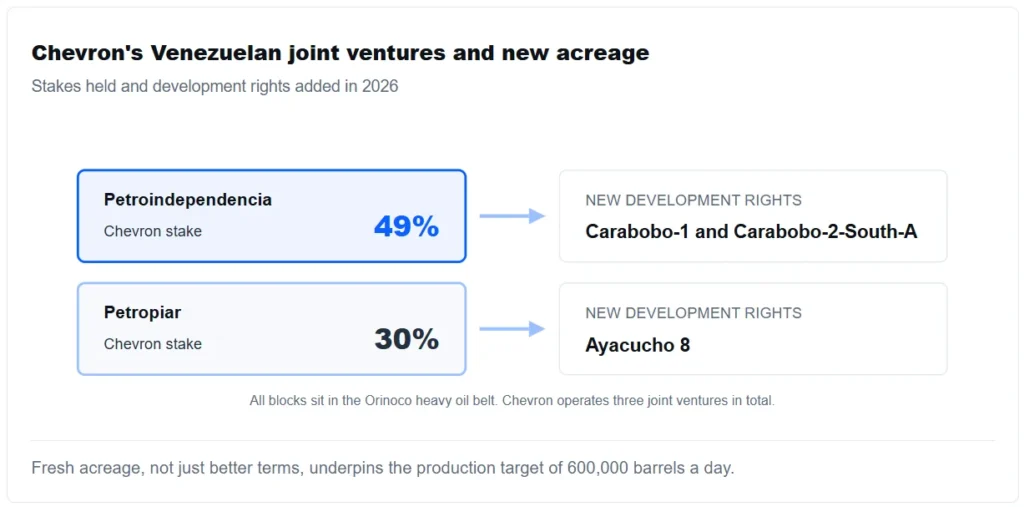
New acreage includes Carabobo-1, Carabobo-2-South-A and Ayacucho 8 in the Orinoco Belt.
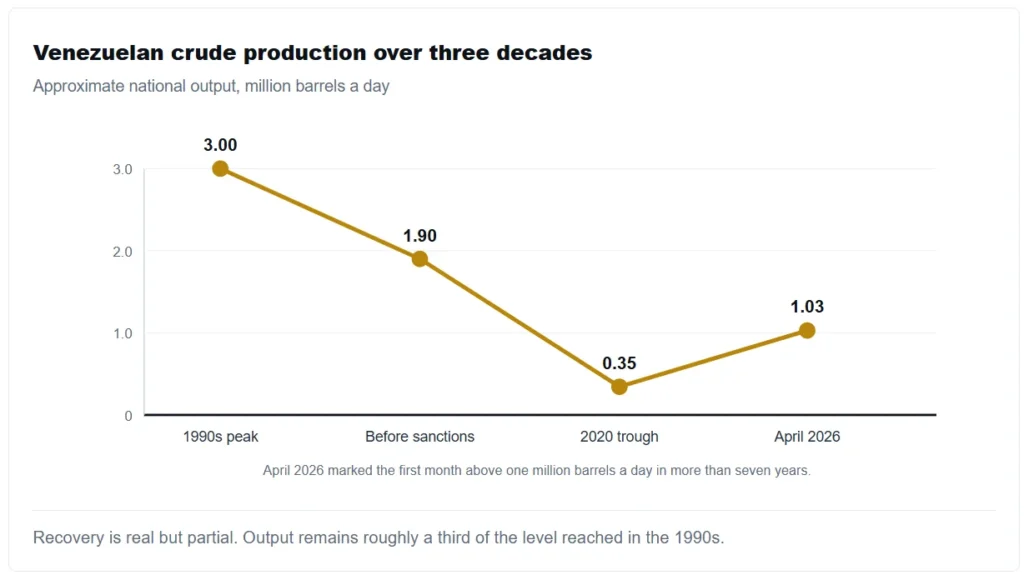
Venezuelan national output passed 1 million barrels a day in April 2026.
A five-year commitment in the Orinoco Belt
Chevron is expanding sharply in Venezuela. The producer announced the plan on 2 September 2026. It will invest more than $7bn through its joint ventures over five years. Management targets roughly 600,000 barrels a day of gross production from those ventures. Operating costs should stay below $20 a barrel.
Momentum already exists. Output across the ventures has climbed 15 percent since the start of the year. New commercial and fiscal terms underpin the fresh commitment.
Acreage came with the agreements. Petroindependencia, in which Chevron holds 49 percent after an April transaction, gained development rights over Carabobo-1 and Carabobo-2-South-A. Petropiar, where Chevron holds 30 percent, received rights to develop Ayacucho 8. Both areas sit inside the Orinoco heavy oil belt.
Chevron is the largest foreign operator in the country. Its presence there dates to the 1920s. Chief executive Mike Wirth pointed to the country’s deep resource potential. He added that Venezuela can now compete for investment again.
Washington set the stage
Policy changes preceded the corporate decision. A new United States and Venezuela oil agreement emerged days before the Chevron statement. That framework opens American access to sizeable proven reserves. Licensing conditions, however, still shape what operators may do.
Sanctions history explains the caution. The Office of Foreign Assets Control has restricted dealings with the Venezuelan oil sector since 2019. Specific licences have governed Chevron’s activity throughout. Any future tightening would therefore change the arithmetic quickly.
Chevron acknowledged the administration’s role in creating the opening. It also stressed that continued cooperation between government and industry remains essential.
The size of the prize, and the bill
Venezuela holds the largest proven crude reserves on record, according to the Energy Information Administration. Extracting that oil profitably is the difficulty. Decades of underinvestment left pipelines, upgraders and refineries in poor condition.
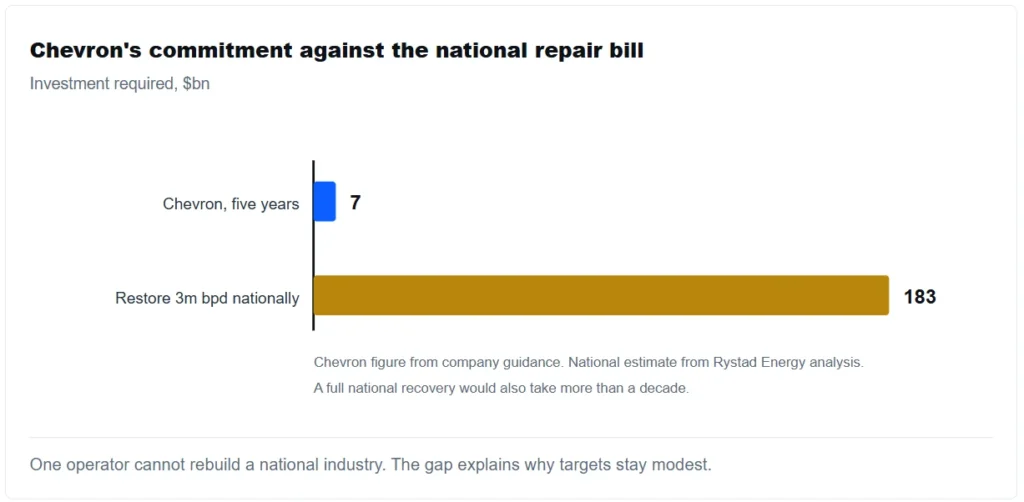
Analysts at Rystad Energy have quantified the repair job. Restoring national output to the 1990s level of about 3 million barrels a day would take more than a decade. It would also require roughly $183bn of investment. Chevron’s $7bn therefore buys a foothold rather than a transformation.
Heavy crude adds a technical wrinkle. Orinoco barrels need diluent and upgrading before export. Diluent supply and upgrader uptime therefore cap achievable volumes. Costs below $20 a barrel assume both work reliably.
Chevron can fund it comfortably
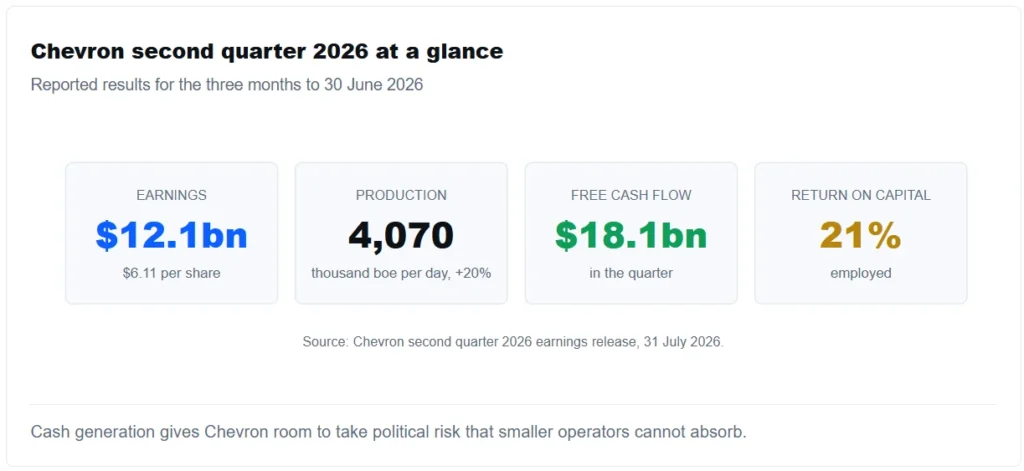
Second-quarter results left the balance sheet in strong shape. Earnings reached $12.1bn, or $6.11 a share, the company reported on 31 July 2026. Worldwide net oil-equivalent production hit 4,070 thousand barrels a day, a rise of 20 percent. Free cash flow reached $18.1bn in the quarter.
Capital discipline continued alongside that growth. Quarterly capital expenditure totalled $4.5bn. Debt fell by a record $8.4bn. Return on capital employed came in at 21 percent. Directors declared a quarterly dividend of $1.78 a share.
Seen against those numbers, $7bn over five years looks manageable. Annual spending of roughly $1.4bn equals about a third of one quarter’s capital budget. Risk, not affordability, is the constraint here.
How the target could be reached
Three levers drive the plan. Drilling more wells in existing blocks comes first. Restoring idle wells offers cheaper barrels next. Finally, new acreage adds volume from the middle of the decade.
Timing therefore skews toward the later years. Early gains should come from workovers and better uptime. Larger increments depend on upgraders and diluent supply. Investors should expect a gradual curve rather than a step change.
Market implications
Extra Venezuelan barrels arrive in a delicately balanced market. Heavy sour crude suits complex refineries on the United States Gulf Coast. Those plants have run short of comparable grades for years. As a result, incremental supply should find buyers quickly.
Price effects look modest for now. Chevron’s target adds a few hundred thousand barrels a day over five years. Global demand shifts of that size occur routinely. The Short-Term Energy Outlook tracks such balances month by month.
The risks worth pricing
Political risk sits at the top of the list. Licences can be revoked, and fiscal terms can change. Peers have learned that lesson before. ConocoPhillips and ExxonMobil both exited in 2007 after contract renegotiations.
Payment mechanics deserve attention too. Revenues flow through accounts that Washington oversees. Cash repatriation therefore depends on policy as much as on production.
Operational risk follows closely. Power outages, pipeline theft and equipment failures have plagued Venezuelan fields. Skilled labour has also emigrated in large numbers. Rebuilding that workforce will take patience.
Reputational questions persist too. Rivals have described the country as uninvestable in recent years. Chevron’s decision therefore reads as a calculated contrarian bet. Investors will judge it by barrels delivered, not by acreage announced.