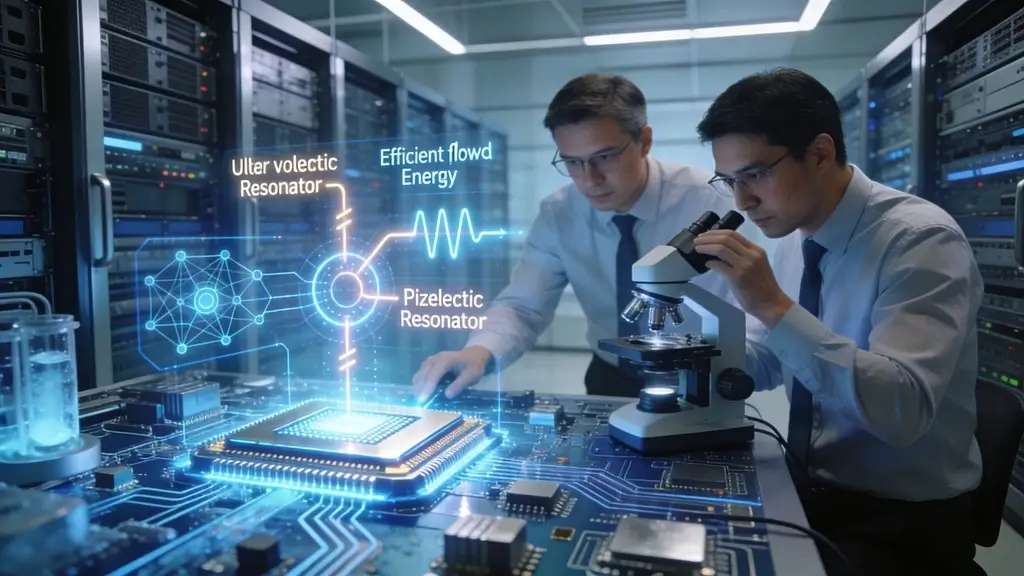


Catenaa, Sunday, May 17, 2026- Engineers at University of California San Diego developed a new power conversion chip that could sharply improve energy efficiency in GPUs and AI data centers by redesigning how electricity is delivered to computing hardware.
The prototype achieved more than 96% efficiency while converting high voltage power into the low voltage levels required by graphics processors, offering a possible path toward lower energy consumption and more compact computing infrastructure.
Modern data centers distribute electricity at roughly 48 volts to reduce transmission losses across servers and networking systems. GPUs powering artificial intelligence workloads, however, typically operate between 1 and 5 volts.
That large voltage reduction requires continuous DC to DC step down conversion, a process already used in nearly all electronic devices but becoming increasingly difficult as AI chips demand more power inside smaller spaces.
Traditional converters rely mainly on magnetic components called inductors. Researchers said those systems are approaching practical efficiency and scaling limits as power demands accelerate across AI infrastructure.
The UC San Diego team instead explored piezoelectric resonators, devices that transfer and store energy through mechanical vibrations rather than magnetic fields.
Researchers combined the resonator with specially arranged capacitors inside a hybrid circuit architecture. Laboratory tests showed the chip successfully converted 48 volts into 4.8 volts with peak efficiency reaching 96.2%.
The prototype also generated roughly four times more output current than earlier piezoelectric converter designs.
The breakthrough could become increasingly important as artificial intelligence systems consume rapidly growing amounts of electricity worldwide.
AI data centers require enormous power infrastructure because GPUs handling machine learning workloads operate continuously under high computational demand. Analysts said improving power conversion efficiency even slightly can reduce operating costs substantially at hyperscale facilities.
Researchers also noted the new design could help shrink the physical size of future power delivery systems, potentially improving chip density and cooling efficiency inside servers and edge computing devices.
Piezoelectric based converters may eventually support more energy efficient GPUs, mobile devices, robotics systems and advanced AI accelerators.
At the same time, researchers cautioned that the technology remains in early development and still faces manufacturing and packaging challenges before large scale commercial deployment becomes practical.
Professor Patrick Mercier said traditional inductive converters have matured to a point where further efficiency gains are becoming increasingly difficult.
Researchers involved in the project described piezoelectric resonators as offering greater long term scaling potential because they can achieve higher energy density in smaller spaces.
Industry analysts tracking AI infrastructure noted that energy delivery systems are becoming one of the most important engineering bottlenecks facing next generation data centers.
Semiconductor researchers also highlighted challenges involving integration because piezoelectric resonators physically vibrate during operation and cannot be attached using conventional soldering methods.
The team said future work will focus on improving materials, packaging systems and circuit integration to prepare the technology for real world data center applications.
The new chip design demonstrates how advances in power conversion may become increasingly important as artificial intelligence systems push computing infrastructure toward higher energy demands.
While piezoelectric converters are not yet ready to replace existing systems commercially, the research suggests alternative architectures could eventually outperform traditional power delivery technologies used in modern electronics.
As AI expansion accelerates globally, breakthroughs in energy efficiency may become as strategically valuable as improvements in processors and computing performance itself.
DC to DC converters are critical components inside nearly all electronic systems because processors and memory chips require lower voltages than incoming power supplies deliver. Modern GPUs and AI accelerators consume extremely large amounts of electricity, making efficient power conversion increasingly important for data center economics and thermal management. Traditional converters rely heavily on magnetic inductors that have steadily improved over decades but now face physical scaling and efficiency limitations. Piezoelectric materials generate mechanical movement when electrically charged and can also convert vibrations back into electrical energy. Researchers have explored piezoelectric power systems for years because they may offer smaller size, higher efficiency and greater energy density compared with conventional magnetic architectures. The rapid growth of artificial intelligence infrastructure has intensified interest in alternative power delivery systems capable of supporting future generations of high performance computing hardware.