

August 04, 2026 – World sponge output fell in 2025, and America stopped making the metal entirely. Yet the sector posted record profits. The reason is not what most investors assume.

In Summary
World titanium sponge output slipped to 370,000 tons in 2025, a fall of 2.6%.
The United States made no sponge at all and now relies on imports for 100% of supply.
Record imports of 44,000 tons arrived even as the landed price fell 9.8%.
Nickel alloys, rather than titanium, drove record margins at ATI and Carpenter Technology.
China holds 70.3% of world supply, yet Western aerospace cannot easily qualify that metal.
Titanium stocks have handed buyers strong gains over the past year. However, the metal behind them tells a stranger story. World sponge output actually fell during 2025. Also, American mills lost their last home source.
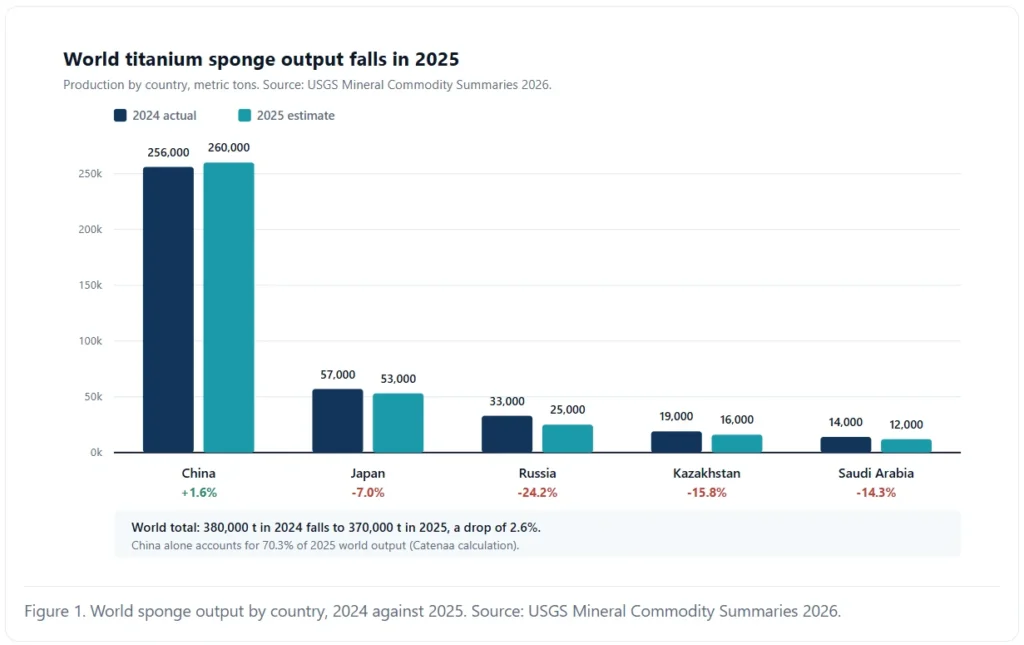
The U.S. Geological Survey put out its 2026 minerals report in February. It puts world titanium sponge output at 370,000 tons for 2025. That total sits below the 380,000 tons logged in 2024. Meanwhile, the United States made none at all.
America Now Buys Every Ton It Uses
The last American sponge plant closed during 2024. So net import reliance hit 100% last year. Two idle plants remain, one in Nevada and one in Utah. Together they hold about 23,500 tons of dormant capacity. Neither has restarted.
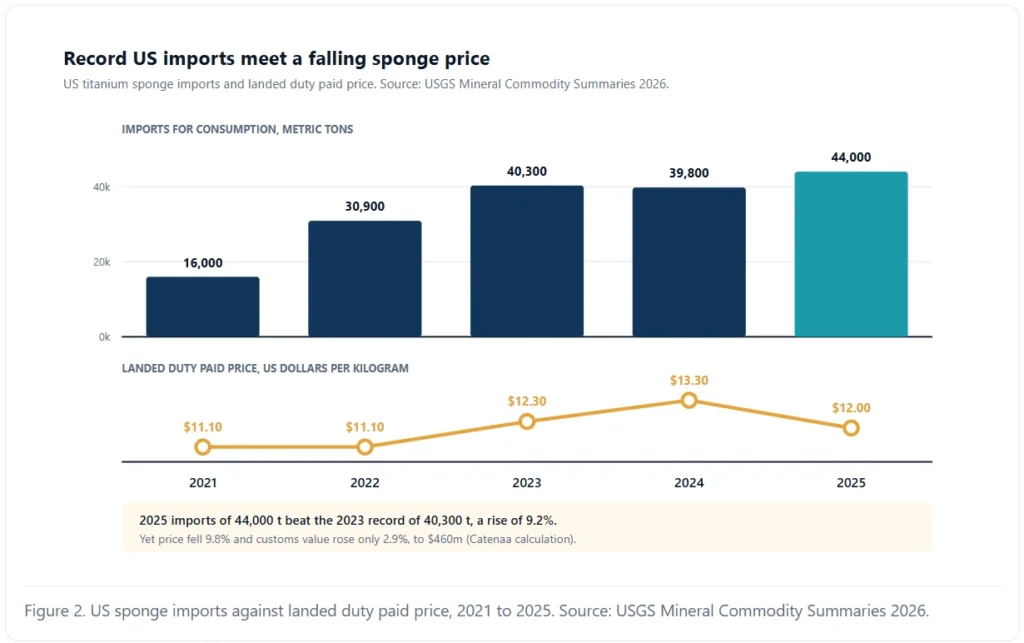
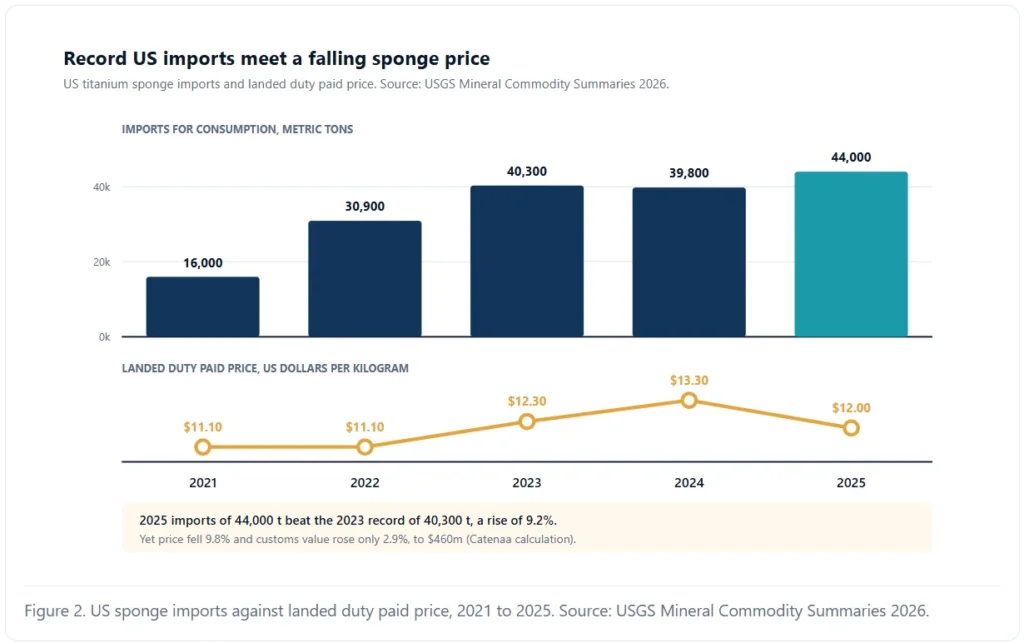
Imports filled the gap and then some. Buying reached about 44,000 tons in 2025. That beats the old record of 40,300 tons from 2023. Japan supplied 73% of shipments through July. Kazakhstan and Saudi Arabia each sent 13%.
Such reliance carries plain risk. Roughly three-quarters of American sponge now comes from one country. Also, unwrought titanium still faces a 15% tariff.
Why Titanium Stocks Ride Nickel, Not Titanium
Here lies the twist. Filings suggest the metal itself lags the rally in titanium stocks.
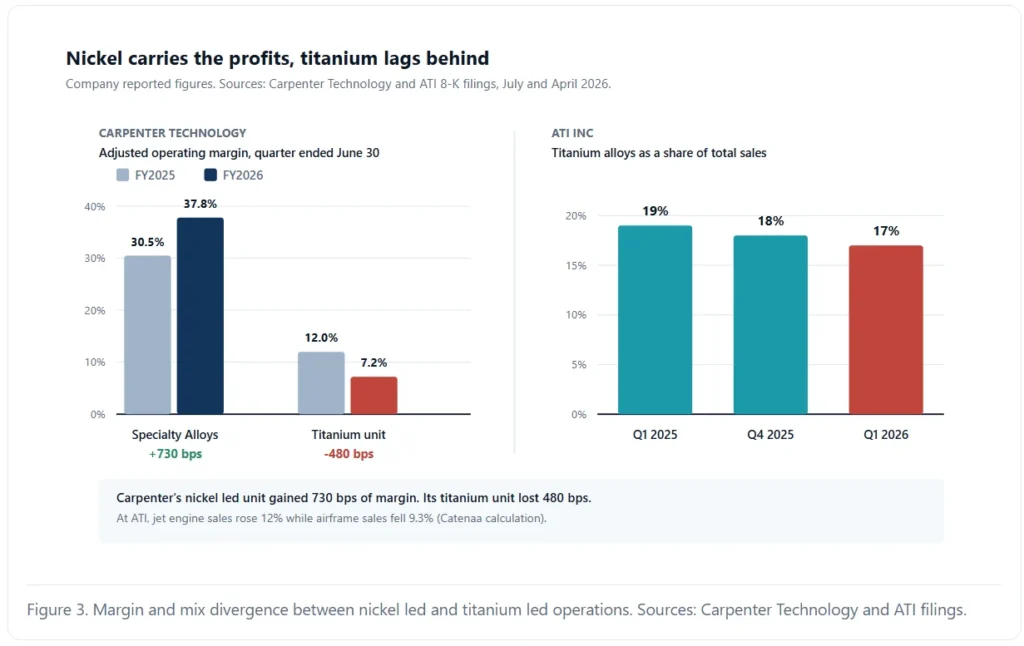
ATI posted first quarter sales of $1.15 billion on April 30. Aerospace and defence climbed to 69% of revenue. Yet titanium alloys slipped to 17% of sales. A year earlier they made up 19%. Nickel and speciality alloys, by contrast, rose to 49%.
That split mirrors engine versus airframe demand. Jet engine sales jumped 12% to $472.0 million. Airframe sales, though, fell 9.3% to $186.6 million. Engines burn through nickel superalloys. Airframes eat titanium.
Carpenter Technology showed the same pattern on July 30. Its Speciality Alloys unit hit a record 37.8% adjusted margin. That reading rose from 30.5% a year earlier. Meanwhile, the unit holding its Dynamet titanium arm saw margins sink to 7.2% from 12.0%.
Carpenter still guided higher for fiscal 2027, even so. It sees operating income between $850 million and $880 million.

So two big names shared one signal. Profits came from nickel. Titanium played only a supporting role.
Howmet Aerospace tells a similar tale. Its first quarter revenue grew 19% to $2.31 billion. Gas turbine sales, however, led the way with 39% growth. Engines again did the heavy lifting.
China Holds Seven Of Every Ten Tons
Chinese plants made 260,000 tons of sponge last year. That equals about 70% of world supply, by our math. Chinese capacity, though, reaches 320,000 tons. Roughly 60,000 tons therefore sat idle.
Global figures look similar. Capacity totalled 470,000 tons against 370,000 tons of output. Plants thus ran near 79% of what they could make.
These numbers matter for one blunt reason. The world holds ample spare sponge capacity. Western plane makers, though, cannot easily use Chinese metal. Sign-off takes years, not months. Hence a paper glut sits beside real scarcity.
Russia shows the squeeze clearly. Its output dropped to 25,000 tons from 33,000 tons. That marks a fall of nearly 24%. Russian capacity stands at 46,500 tons. Plants there ran close to 54%.
Prices Fell While Volumes Climbed
Sponge prices moved the wrong way for makers. Landed value averaged about $12.00 per kilogram in 2025. During 2024 it reached $13.30. That marks a drop of nearly 10%.
Volumes told the other story. Import tonnage grew roughly 11%. Yet customs value rose just 3% to $460 million. Buyers thus paid less per ton for more metal.
This mix explains the earnings pattern neatly. Mills gained volume but lost pricing power in titanium. Nickel alloys, meanwhile, held firmer prices and a richer mix.
New Supply Arrives Slowly
Washington has noticed the gap. Titanium sits on the federal critical minerals list. A Section 232 order followed on January 14, 2026. It called for talks rather than instant tariffs. Officials owed a status report by July 13.
Private money moved faster. IperionX now runs its Virginia campus around the clock. The firm put out its June quarter update on July 30. It still targets roughly 200 tons of yearly powder capacity by December.
Scale remains the hurdle. That 200-ton goal equals under 0.5% of American sponge imports. Even the planned 1,400-ton build-out covers barely 3%. State money helps, including a $47.1 million award. Still, real change will take many years.
Ore feed may come sooner. IperionX finished a study on its Titan project in June. The work showed an after-tax value of $813 million. It also flagged a 39.4% rate of return.
What Comes Next
Two events land almost at once. Both ATI and Howmet report second quarter results on August 6. Their airframe comments will matter more than headline profit.
Watch three things closely. First, check whether airframe destocking has finally ended. Second, track titanium’s share of the revenue mix. Third, follow sponge prices into the second half. Medical demand also bears watching. Carpenter saw that market shrink almost 30% last quarter.
Buyers should also weigh price against hope. ATI shares have climbed sharply from their 52-week low. Carpenter slipped almost 5% on July 30 despite record profit. Clearly, hopes now sit high.
The long-term case still looks solid. Boeing and Airbus hold a backlog near 16,000 planes. The 737 line, moreover, moves from 42 jets monthly toward 47. Defence budgets keep rising across allied nations. Also, no cheap swap matches titanium on strength and rust resistance.
Yet anyone buying titanium stocks should grasp what they own. Today these firms earn most profit from nickel. Titanium remains the option, not the engine.




