

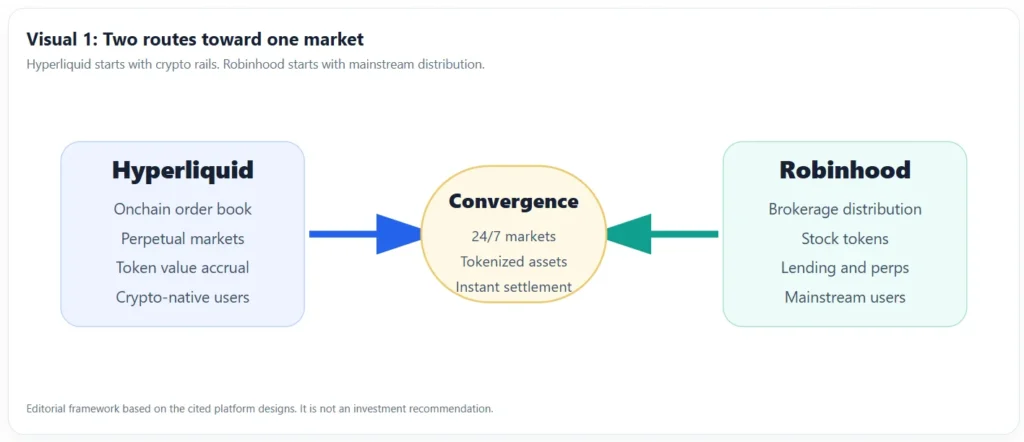
July 23, 2026 – DeFi TradFi convergence could shape crypto’s next market cycle. Hyperliquid and Robinhood now approach that opportunity from opposite directions.
Hyperliquid is pulling conventional markets onto crypto infrastructure. Robinhood is pushing familiar financial products onto public blockchain rails. Together, they offer a test of whether utility can replace hype as crypto’s main growth engine.
In Summary
Hyperliquid links onchain derivatives, instant settlement, and token value accrual through trading activity.
Robinhood combines mass distribution with stock tokens, lending, perpetual futures, and its own Ethereum Layer 2 network.
Early usage looks strong. However, transaction growth alone does not prove durable demand or sustainable revenue.
Leverage, regulatory fragmentation, smart contract risk, and speculative activity could weaken the bull case.
Why DeFi TradFi convergence matters
Previous crypto cycles often depended on rising token prices and retail speculation. The next cycle may require measurable financial utility.
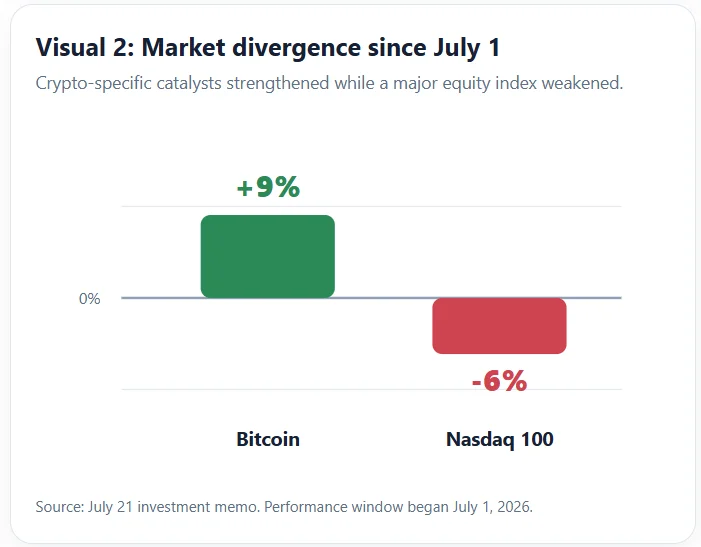
A July 21 investment memo framed tokenization, stablecoins, instant settlement, and institutional DeFi as the strongest future drivers. It noted Bitcoin gained 9% since July began. Meanwhile, the Nasdaq 100 fell 6%.
The bigger thesis concerns market structure. Blockchain networks operate continuously, settle quickly, and support programmable ownership. Traditional platforms offer trusted brands, regulated access, and large customer bases.
DeFi TradFi convergence combines those advantages. Yet success depends on liquidity, legal clarity, security, and genuine user demand.
Hyperliquid starts from crypto
Hyperliquid represents the crypto-native route. Its core product uses an onchain order book for perpetual futures and other markets.
The protocol’s HIP-3 framework allows builders to deploy perpetual markets. Deployers define contracts, oracle rules, leverage limits, and settlement processes.
That model can bring commodities, indexes, and other exposures onto always-open markets.
The July memo said conventional assets now generate nearly half of Hyperliquid’s trading volume. It also reported strong platform economics.
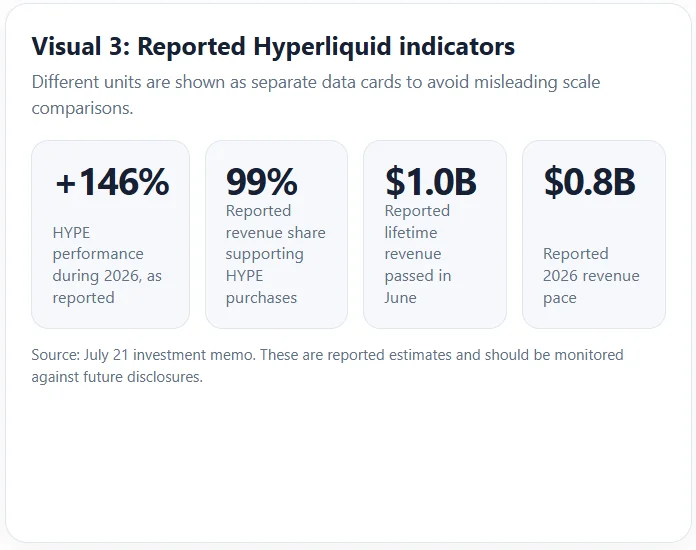
According to the memo, lifetime revenue passed $1 billion in June. The platform could generate about $800 million during 2026.
It also said 99% of revenue supports HYPE purchases. That structure links platform activity more directly to token demand.
However, those figures need context. Perpetual markets can generate large volumes during volatile periods. Revenue may decline sharply when activity normalizes.
Robinhood brings distribution
Robinhood follows the opposite route. It begins with a large brokerage audience, then adds onchain products and infrastructure.
The company launched Robinhood Chain’s public mainnet on July 1. The Ethereum Layer 2 supports tokenized assets, lending, swaps, and applications.
Stock tokens became available through its wallet in more than 120 countries. Eligible users can trade those products continuously.
European users gained selected commodity, ETF, and foreign exchange perpetuals.
Those products offer leverage up to 10 times. Therefore, they expand access while increasing liquidation and conduct risks.
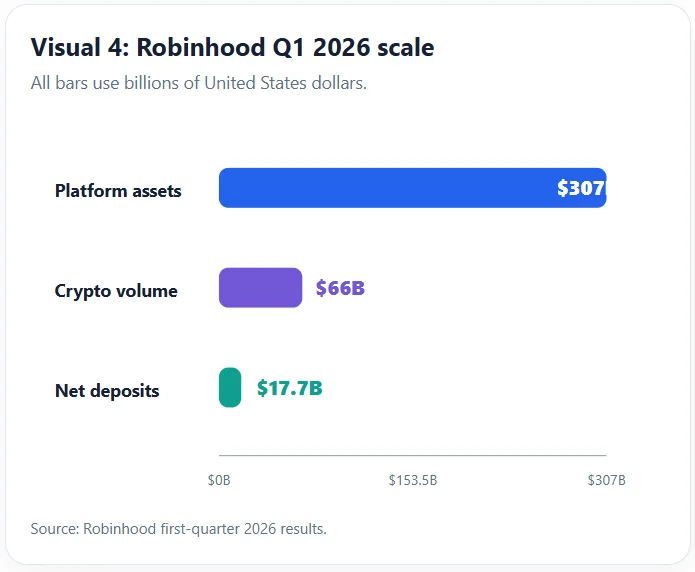
Robinhood entered 2026 with considerable scale. First-quarter platform assets reached $307 billion, while funded customers totalled 27.4 million.
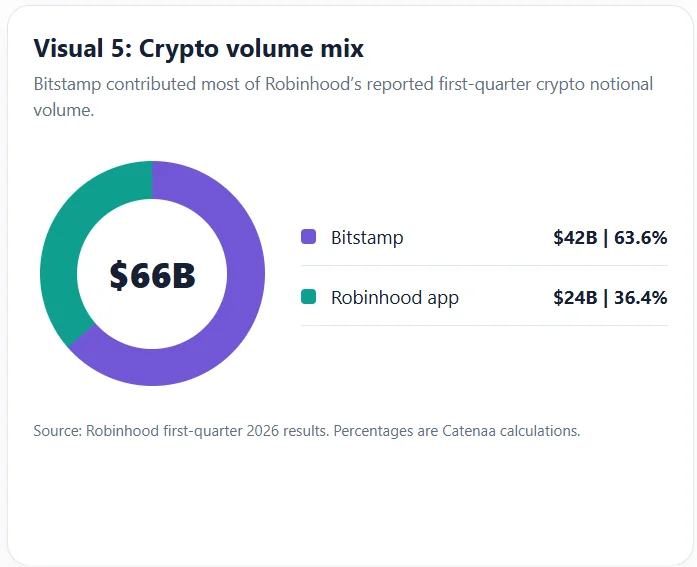
Crypto notional volume reached $66 billion. However, crypto transaction revenue fell 47% annually to $134 million.
That contrast matters. Robinhood is investing in blockchain infrastructure while its existing crypto revenue remains cyclical. This comparison deserves closer investor attention.
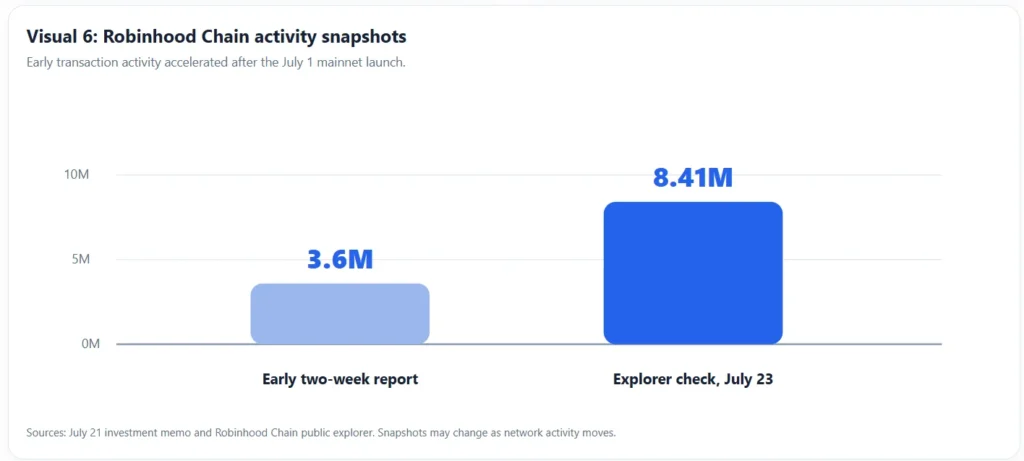
The new chain is already recording heavy activity. Its public explorer showed about 8.41 million daily transactions on July 23.
Yet raw transactions can overstate adoption. Incentives, bots, speculative tokens, and subsidized fees can inflate early network activity.
What could break the bull case
The highest risk is regulation. Tokenized shares may provide economic exposure without granting direct ownership rights in underlying companies.
Jurisdictional restrictions also limit distribution. Robinhood excludes several major markets and applies eligibility rules across products.
Leverage creates another vulnerability. Perpetual futures can trigger rapid liquidations, especially during thin liquidity or oracle disruptions.
Technology risk remains material. Smart contract flaws, bridges, sequencers, and oracle failures can interrupt trading or threaten user funds.
Finally, activity quality matters more than headline volume. Sustainable adoption requires repeat users, durable liquidity, and fee generation after incentives end.
Outlook
Hyperliquid and Robinhood show that finance is moving toward a shared architecture. One brings markets onchain. The other brings users onchain.
This shift could support crypto’s next expansion. However, the winners must prove that usage survives weaker prices and stricter oversight.
Investors should track revenue quality, active users, tokenized asset volumes, liquidity depth, and regulatory approvals. Those indicators will separate infrastructure growth from speculation.