

July 29, 2026 – The iPhone maker briefly joined Nvidia in the $5 trillion club on Tuesday. Its capital-light AI strategy, once mocked, now looks like the winning trade of 2026.

In Summary
Apple briefly crossed a $5 trillion market cap on July 28, 2026, the second company ever after Nvidia.
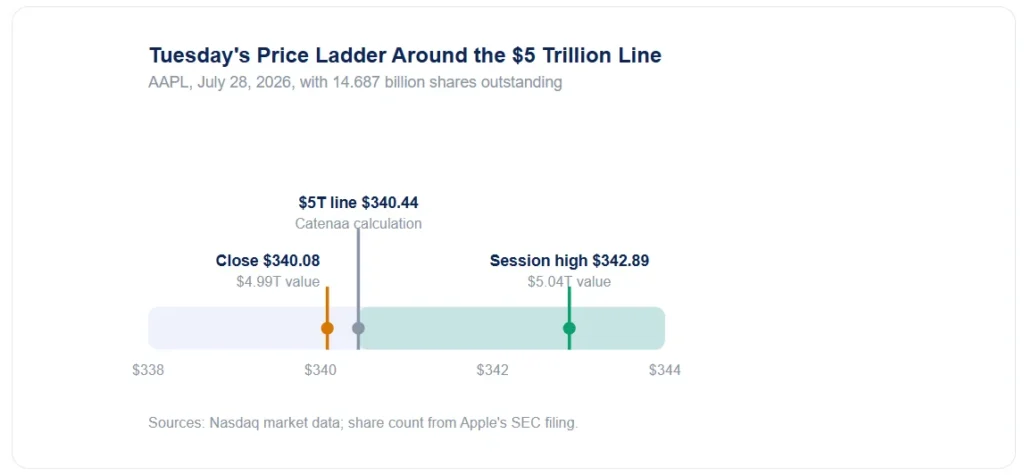
The stock closed at $340.08, a whisker below the $340.44 needed to hold the milestone at the bell.
Apple got there with minimal AI capital spending, while Nvidia got there by selling AI hardware.
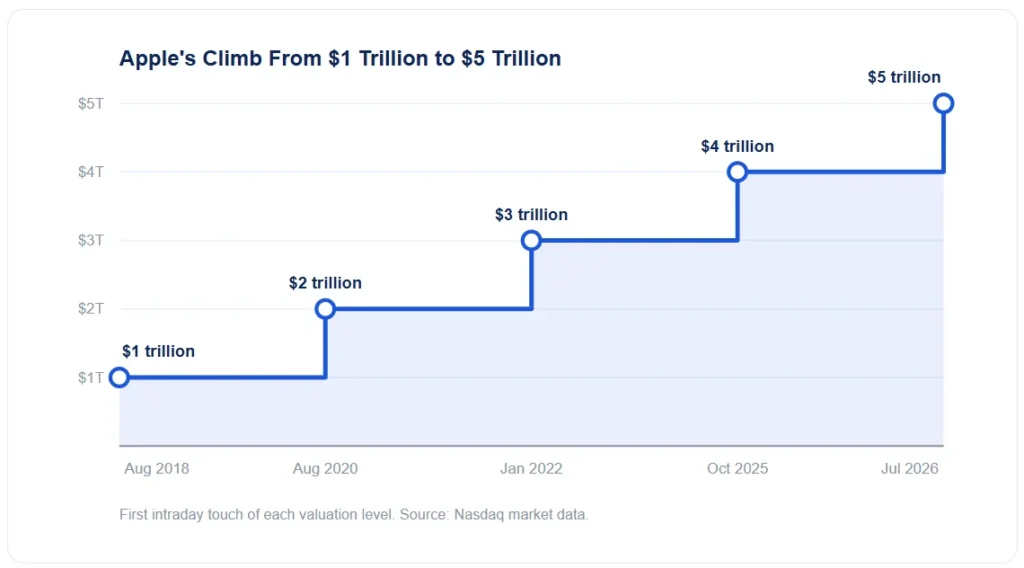
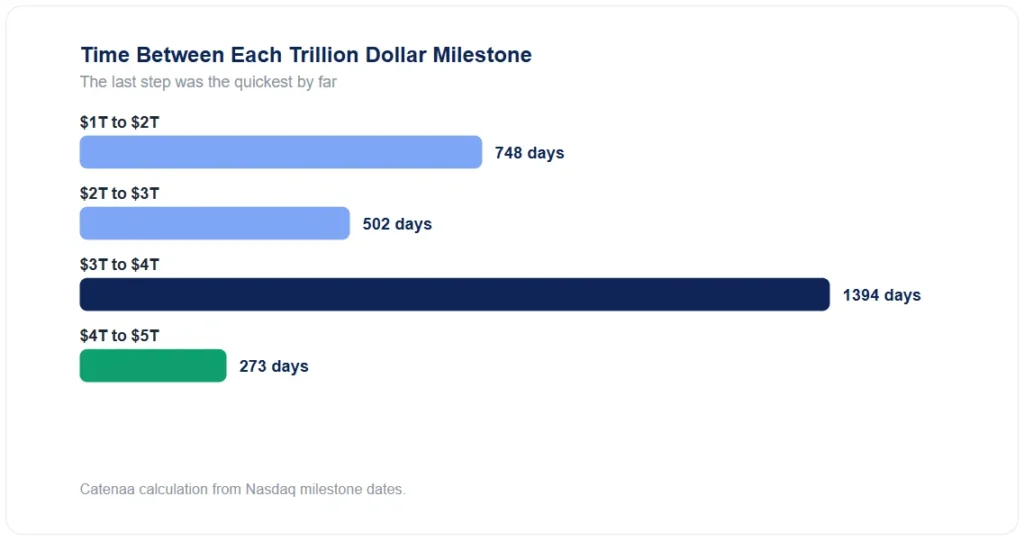
The jump from $4 trillion to $5 trillion took just 273 days, the fastest trillion in Apple’s history.
A new Klarna-backed leasing program and Thursday’s earnings report frame the next test.
Apple touched a $5 trillion market cap for the first time on Tuesday, July 28, 2026. The iPhone maker became only the second company ever to reach that level, after Nvidia. Shares rose as much as 1.8% to an intraday high of $342.89. As a result, Apple’s market value briefly hit about $5.04 trillion before easing back. That brief pop capped a stunning reversal for a stock that lagged badly last year.
What the Numbers Show
The stock closed at $340.08, just under the line. Based on 14.687 billion shares outstanding, Catenaa calculates a closing value near $4.99 trillion. Therefore, Apple needed a close above roughly $340.44 to finish the day as a $5 trillion company. That share count comes straight from Apple’s latest quarterly filing. Moreover, heavy buybacks keep moving the goalposts. Apple repurchased 135 million shares for $36 billion in the six months through March. Fewer shares mean the stock must climb higher to hold the same market value.
Meanwhile, the business behind the ticker keeps expanding. Revenue reached $111.2 billion in the March quarter, up 17% from a year earlier. Apple also poured $11.4 billion into research and development over those three months. In short, the caution applies to AI data centers, not to product spending.
How Apple Reached $5 Trillion Without an AI Splurge
Apple’s route to the milestone looks nothing like Nvidia’s. Nvidia crossed $5 trillion first, on October 29, 2025, by selling the chips behind the AI boom. Apple, in contrast, has largely stayed out of the AI spending race. Alphabet, Amazon, Meta, and Microsoft are pouring hundreds of billions into data centers this year. Apple has instead kept capital spending low and leans on Google’s cloud and Gemini models. That partnership will power the revamped Siri expected this fall.

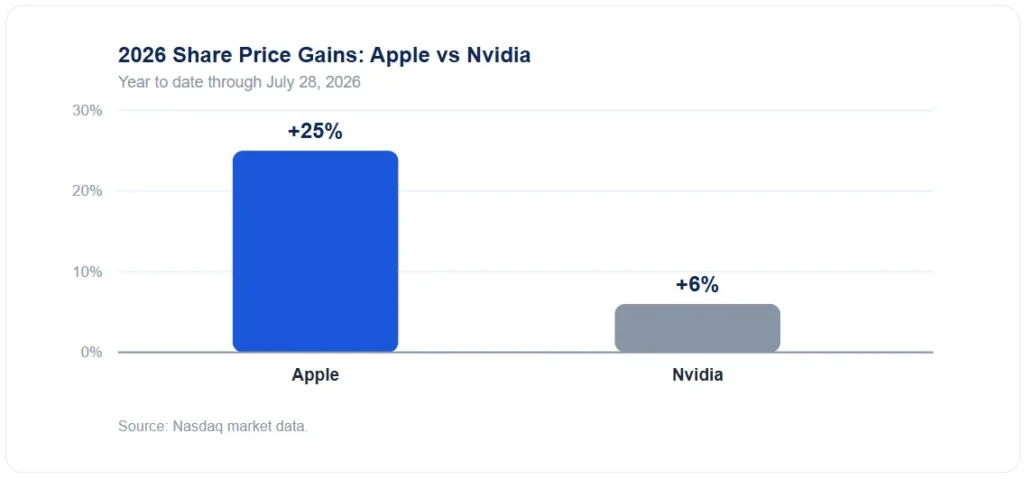
Investors once punished such caution, and the discount looked permanent. Last year, the stock trailed its mega cap peers on fears of an AI miss. Sentiment has flipped, however, as debt-funded AI budgets face harder questions. Apple stock has gained about 25% this year. Nvidia, by comparison, is up only around 6%. Consequently, the rally carried Apple past Nvidia on Monday to reclaim the title of most valuable company.
A Shrinking Climb Between Trillions
Apple has set most of the market’s headline valuation records. It became the first $1 trillion company on August 2, 2018. The second trillion arrived on August 19, 2020, roughly two years later. Furthermore, the third followed on January 3, 2022, after about 17 months. The fourth step took far longer. Apple only reached $4 trillion on October 28, 2025. Nvidia and Microsoft had beaten it there months earlier, in July of that year. Yet the final leg proved the fastest of all. Just 273 days separate that date from Tuesday’s peak. Strong results, along with relentless buybacks, explain much of the sprint. Revenue rose 16% to a record $143.8 billion in the December quarter, while earnings per share jumped 19%.
Leasing Push and Thursday’s Earnings Test
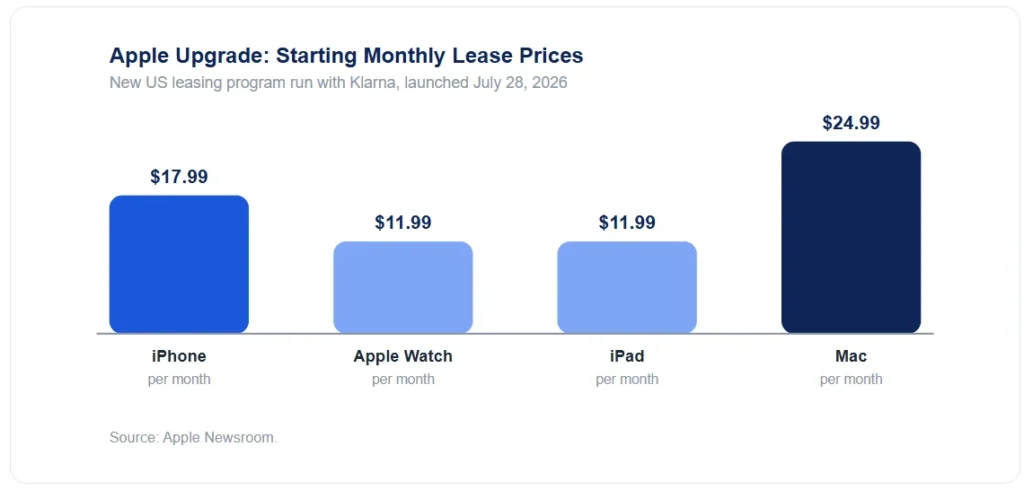
The milestone also landed on a busy product day. Apple launched Apple Upgrade, a new US leasing program run with Klarna. Customers can lease an iPhone from $17.99 a month. An Apple Watch or iPad starts at $11.99, while a Mac begins at $24.99. Terms run one or two years for the iPhone and Watch. Macs and iPads stretch to two or three years. The scheme replaces the older iPhone Upgrade Program. It should also soften the sting of higher prices. Last month, Apple raised Mac and iPad prices after the global memory shortage lifted component costs. iPhone prices, for now, have held steady.
Attention next turns to Thursday. Apple reports fiscal third quarter results on July 30, with guidance calling for 14% to 17% revenue growth. Notably, the call doubles as Tim Cook’s final earnings report as chief executive. John Ternus takes over on September 1. As a result, a durable $5 trillion close may hinge on how those numbers land. The threshold itself carries no operational weight, of course. Even so, round numbers shape sentiment, headlines, and index flows. Two companies now sit in the club. The gap between them, and the strategies behind them, will define the next leg of this race.




